







Question: solve this question please! all questions have been added and if theres anything else you need please let me know and i will add it
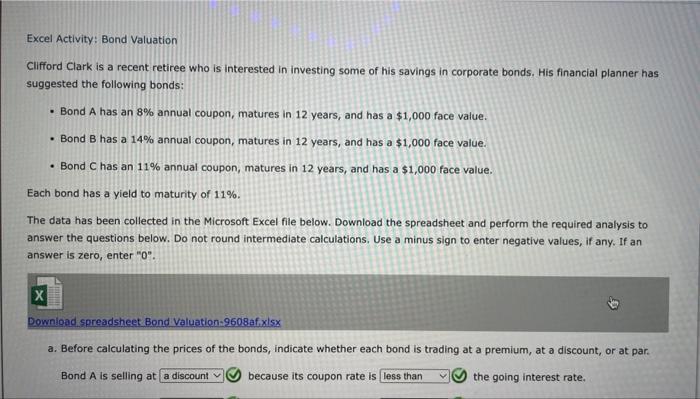
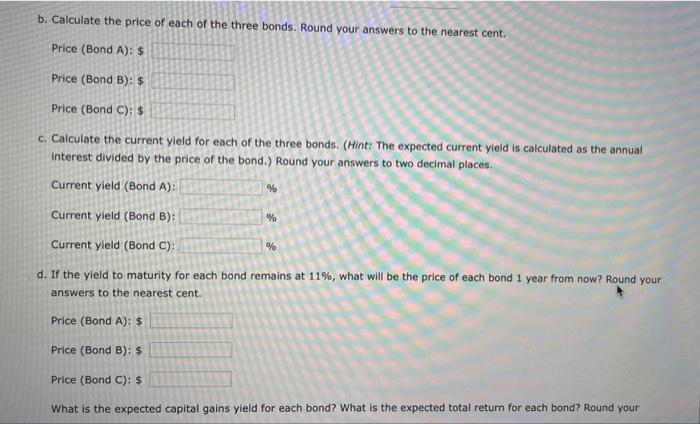
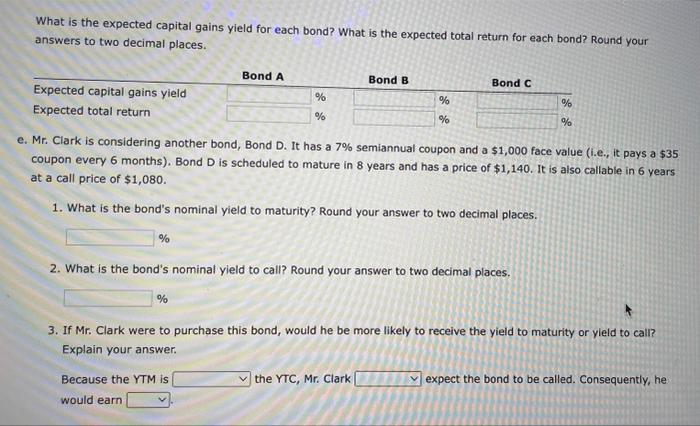
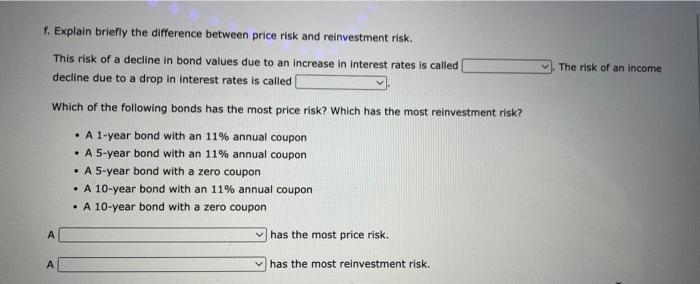
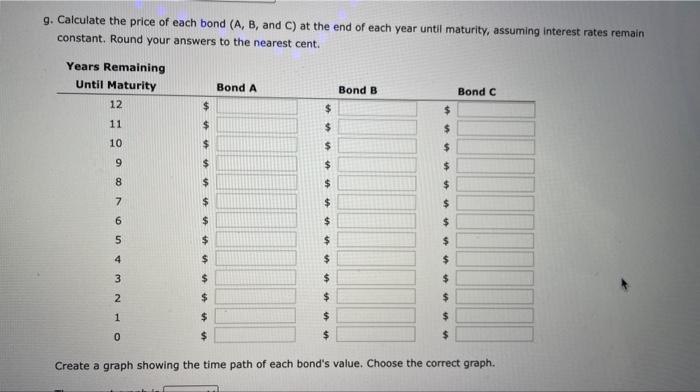
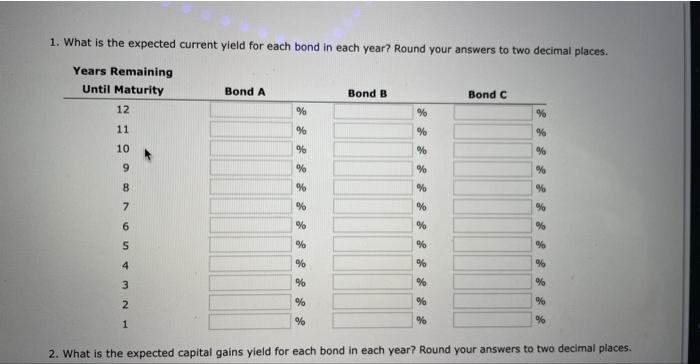
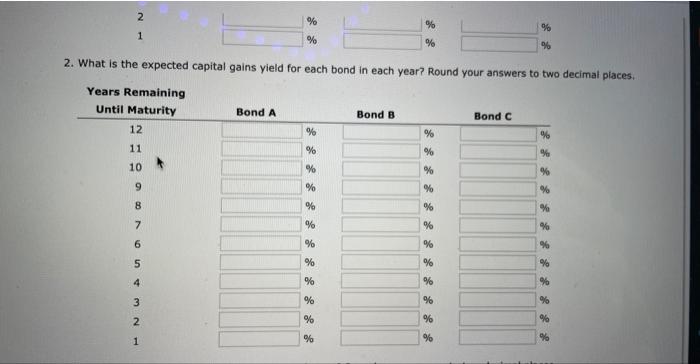
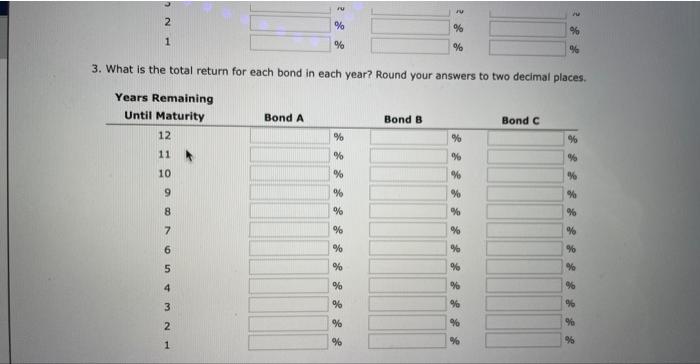
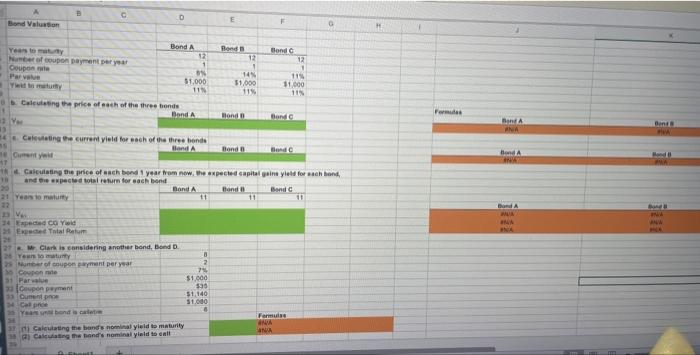
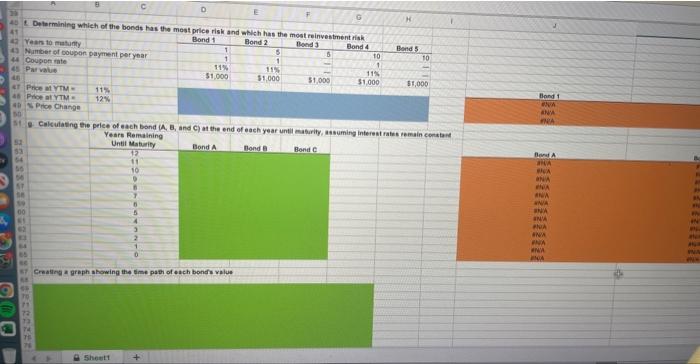
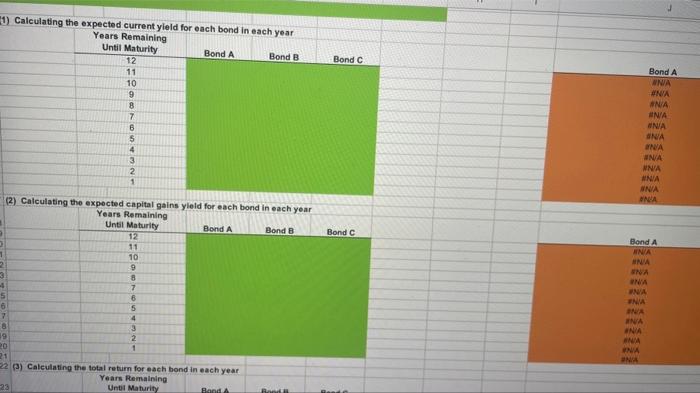
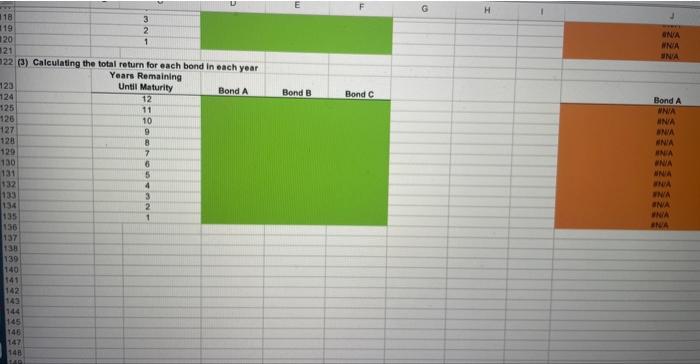
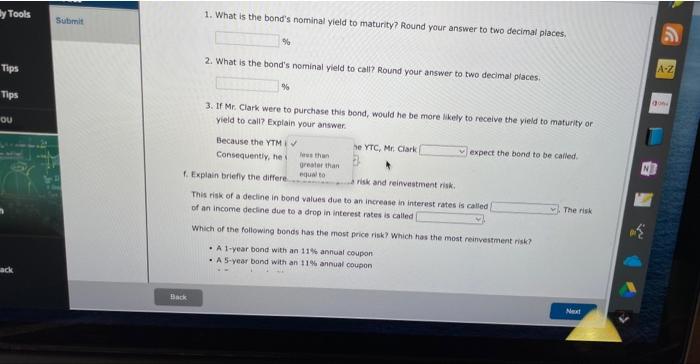
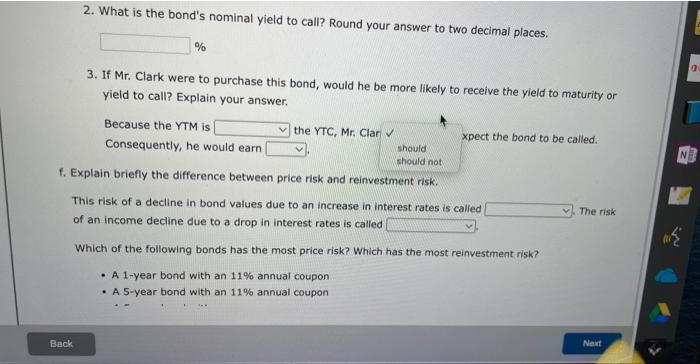
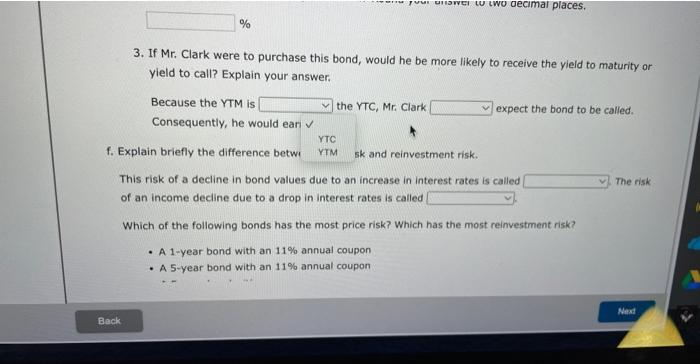
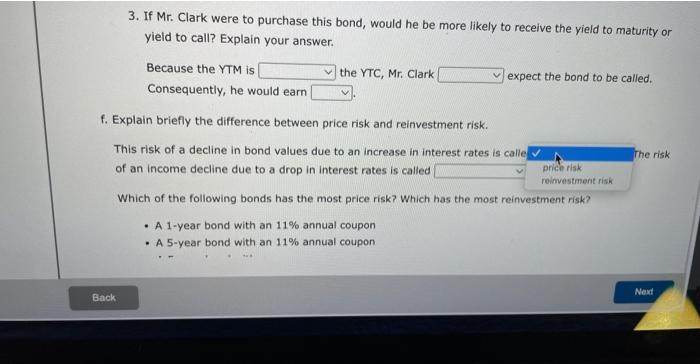
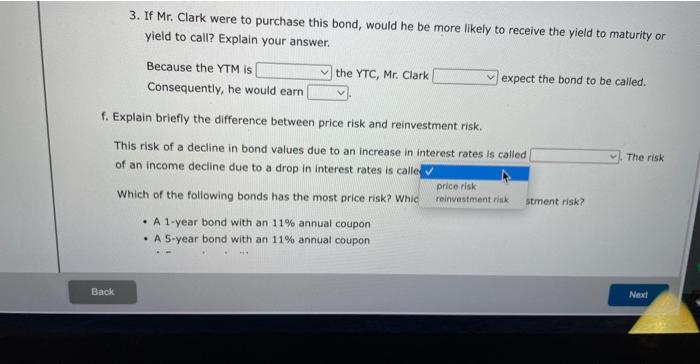
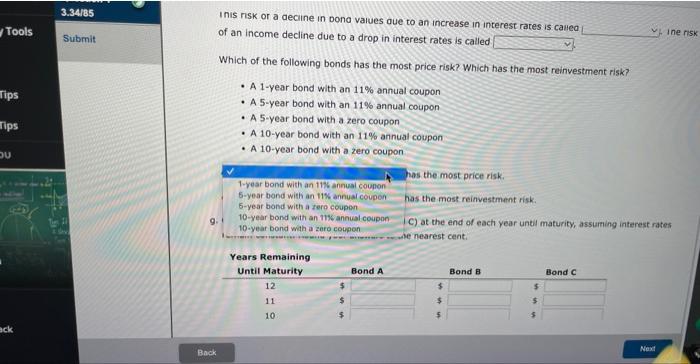
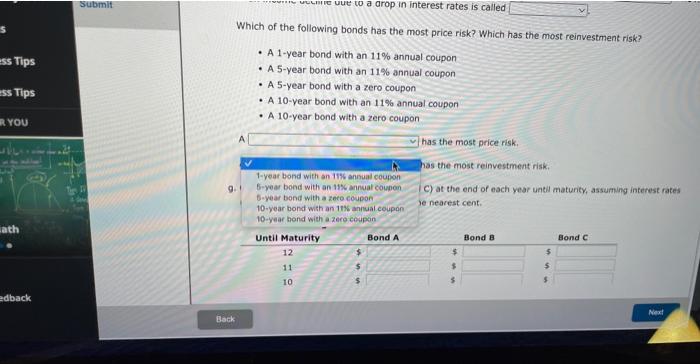
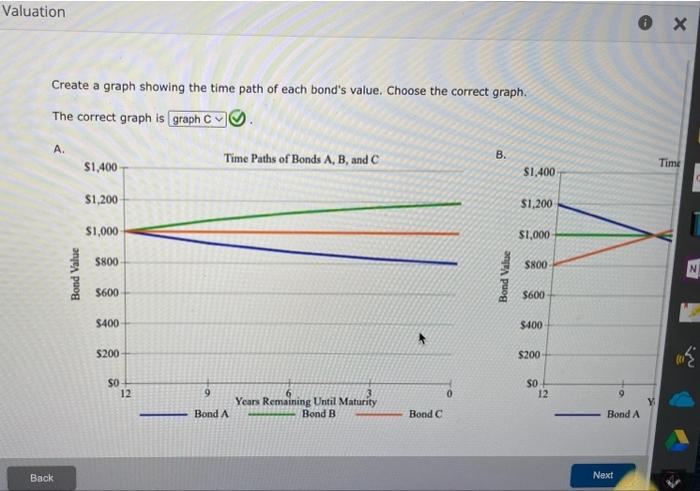
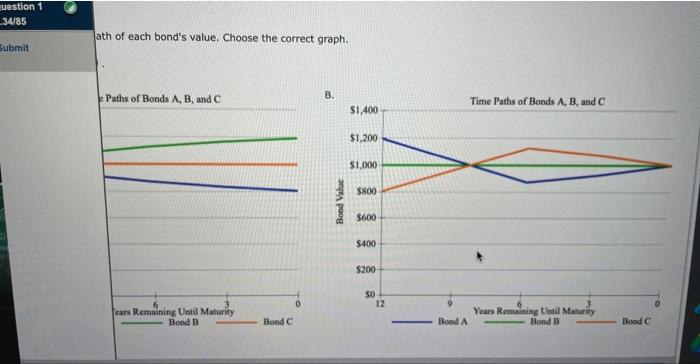
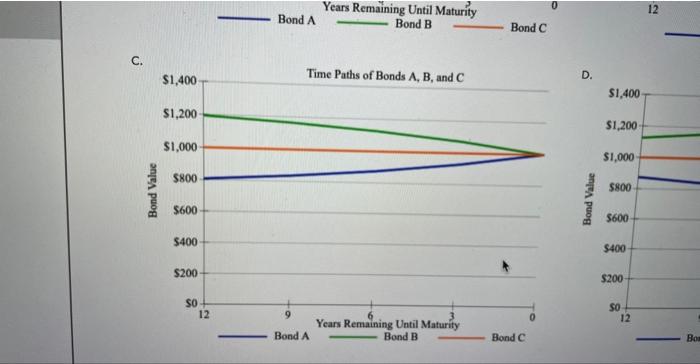
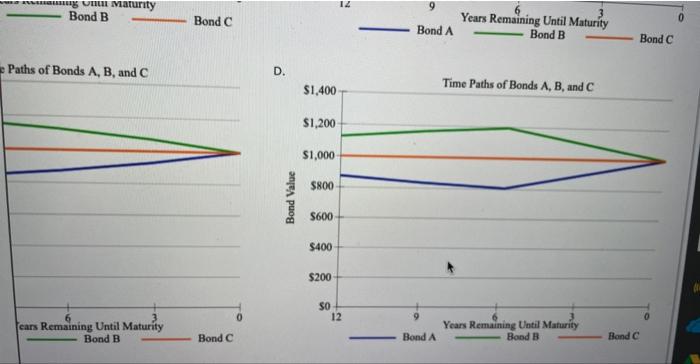
Excel Activity: Bond Valuation Clifford Clark is a recent retiree who is interested in investing some of his savings in corporate bonds. His financial planner has suggested the following bonds: - Bond A has an 8% annual coupon, matures in 12 years, and has a $1,000 face value. - Bond B has a 14% annual coupon, matures in 12 years, and has a $1,000 face value. - Bond C has an 11% annual coupon, matures in 12 years, and has a $1,000 face value. Each bond has a yield to maturity of 11%. The data has been collected in the Microsoft Excel file below. Download the spreadsheet and perform the required analysis to answer the questions below. Do not round intermediate calculations, Use a minus sign to enter negative values, if any. If an answer is zero, enter " 0 ". Downioad spreadsheet Bond Valuation-9608afixisx a. Before calculating the prices of the bonds, indicate whether each bond is trading at a premium, at a discount, or at par. Bond A is selling at because its coupon rate is the going interest rate. b. Calculate the price of each of the three bonds. Round your answers to the nearest cent. Price (Bond A ) : $ Price (Bond B): $ Price (Bond C): $ c. Calculate the current yield for each of the three bonds. (Hint: The expected current yield is calculated as the annual interest divided by the price of the bond.) Round your answers to two decimal places. Current yield (Bond A): Current yield (Bond B): % Current yieid (Bond C): % d. If the yield to maturity for each bond remains at 11%, what will be the price of each bond 1 year from now? Round your answers to the nearest cent. Price (Bond A): $ Price (Bond B) $ Price (Bond C ) $ What is the expected capital gains yield for each bond? What is the expected total return for each bond? Round your answers to two decimal places. Mr. Clark is considering another bond, Bond D. It has a 7% semiannual coupon and a $1,000 face value (i.e., it pays a $35 coupon every 6 months). Bond D is scheduled to mature in 8 years and has a price of $1,140. It is also callable in 6 years at a call price of $1,080. 1. What is the bond's nominal yield to maturity? Round your answer to two decimal places. % 2. What is the bond's nominal yield to call? Round your answer to two decimal places. % 3. If Mr. Clark were to purchase this bond, would he be more likely to receive the yield to maturity or yield to call? Explain your answer. Because the YTM is the YTC, Mr. Clark expect the bond to be called. Consequently, he would earn f. Explain briefly the difference between price risk and reinvestment risk. This risk of a decline in bond values due to an increase in interest rates is called The risk of an income decline due to a drop in interest rates is called Which of the following bonds has the most price risk? Which has the most reinvestment risk? - A 1-year bond with an 11% annual coupon - A 5-year bond with an 11% annual coupon - A 5-year bond with a zero coupon - A 10-year bond with an 11\% annual coupon - A 10-year bond with a zero coupon A has the most price risk. A has the most reinvestment risk. 9. Calculate the price of each bond (A,B, and C) at the end of each year until maturity, assuming interest rates remain constant. Round your answers to the nearest cent. Create a graph showing the time path of each bond's value. Choose the correct graph. 1. What is the expected current yield for each bond in each year? Round your answers to two decimal places. What is the expected capital gains yield for each bond in each year? Round your answers to two decimal places. 3. What is the total return for each bond in each year? Round your answers to two decimal places. 4. Falculating the price of each beed 1 year hom now, the axpeckeg capital gains yield for eaeh bons, and bie expected totsi rehurn for acheh bond 2. Deftermining which of the bonds has the mest price risk and which has the mest reinvestment risk - Calcutating the pelee of each bond (A,B, and c) at the end of each year until maburity, assuming interest rates iemain constant Yotrs Remaining Untit Mabarity Bond A Bond F Bond C. 17111098165432210 Crealles a greph ahowing the time pati of each bonds value 1) Calculating the expected current yield for each bond in each year Years Remaining Until Maturity Bond A Bond B Bond C 121110987654321 (2) Calculating the expected capital gains yleld for each bond in each year Years Remaining Until Maturity 121110987654321 Bond A Bond B Bond C (3) Caleculating the total retum for each bond in each year. Years Remaining. (3) Calculating the total return for each bond in each year Years Remaining \begin{tabular}{c|l} Until Maturity Bond A Bond B Bond C \\ \hline 12 & \end{tabular} 11 10 8 7 6 5 4 3 21 1. What is the bond's nominal yield to maturity? Round your answer to two decimal places, 2. What is the bond's nominal yield to call? Round your answer to two decimal piaces. 3. If Mr, Clark were to purchase this bond, would he be more Mely to receive the vieid to matiarity or yieid to call? Explain your answer. Gecause the YTM I Consequentir, hes expect the bond to be cailed. F. Eplain briefly the differe risk and reifvestment risk: This risk of a dectine in bond values due to an increase in interest rates is called of an income decline due to a drop in interest rates is called Which of the following bonds has then most price risk? Which has the most reinvestment risk? - A1-year bond with an 114 annual coupon - A 5-year bond with an 11% annual coupon 2. What is the bond's nominal yield to call? Round your answer to two decimal places. % 3. If Mr. Clark were to purchase this bond, would he be more likely to receive the yield to maturity or yield to call? Explain your answer. Because the YTM is Consequently, he would earn xpect the bond to be called. Explain briefly the difference between price risk and reinvestment risk. This risk of a decline in bond values due to an increase in interest rates is called of an income decline due to a drop in interest rates is called Which of the following bonds has the most price risk? Which has the most reinvestment risk? - A 1 -year bond with an 11% annual coupon - A 5-year bond with an 11% annual coupon 3. If Mr. Clark were to purchase this bond, would he be more likely to receive the yield to maturity or yield to call? Explain your answer. Because the YTM is the YTC, Mr. Clark expect the bond to be called. Consequently, he would ear f. Explain briefly the difference betw ik and reinvestment risk. This risk of a decline in bond values due to an increase in interest rates is called of an income decline due to a drop in interest rates is called Which of the following bonds has the most price risk? Which has the most reinvestment risk? - A 1-year bond with an 11% annual coupon - A 5 -year bond with an 11% annual coupon 3. If Mr. Clark were to purchase this bond, would he be more likely to receive the yield to maturity or yield to call? Explain your answer. Because the YTM is the YTC, Mr. Clark expect the bond to be called. Consequently, he would earn f. Explain briefly the difference between price risk and reinvestment risk. This risk of a decline in bond values due to an increase in interest rates is calle of an income decline due to a drop in interest rates is called Which of the following bonds has the most price risk? Which has the most reinvestment risk? - A 1-year bond with an 11% annual coupon - A 5 -year bond with an 11% annual coupon 3. If Mr. Clark were to purchase this bond, would he be more likely to receive the yield to maturity or yield to call? Explain your answer. Because the YTM is the YTC, Mr. Clark Consequently, he would earn expect the bond to be called. f. Explain briefly the difference between price risk and reinvestment risk. This risk of a decline in bond values due to an increase in interest rates is called of an income decline due to a drop in interest rates is calle Which of the following bonds has the most price risk? Whic tment risk? - A 1-year bond with an 11% annual coupon - A 5-year bond with an 11% annual coupon Inis risk or a decine in Dond vaiues due to an increase in interest rares is caule. of an income decline due to a drop in interest rates is called Which of the following bonds has the most price risk? Which has the most reinvestment risk? - A 1-year bond with an 11% annual coupon - A 5 -year bond with an 11% annual coupon - A 5 -year bond with a zero coupon - A 10 -year bond with an 11% annual coupon - A.10-year bond with a zero coupon Which of the following bonds has the most price risk? Which has the most reinvestment risk? - A 1-year bond with an 11% annual coupon - A 5-year bond with an 11% annual coupon - A 5-year bond with a zero coupon - A 10-year bond with an 11% annual coupon - A 10-year bond with a zero coupon Create a graph showing the time path of each bond's value. Choose the correct graph. The correct graph is ath of each bond's value. Choose the correct graph. Bond A Years Remaining Until Maturity Bond B Bond C 129 Years Remaining Until Maturity Bond A= Bond B= Bond C Excel Activity: Bond Valuation Clifford Clark is a recent retiree who is interested in investing some of his savings in corporate bonds. His financial planner has suggested the following bonds: - Bond A has an 8% annual coupon, matures in 12 years, and has a $1,000 face value. - Bond B has a 14% annual coupon, matures in 12 years, and has a $1,000 face value. - Bond C has an 11% annual coupon, matures in 12 years, and has a $1,000 face value. Each bond has a yield to maturity of 11%. The data has been collected in the Microsoft Excel file below. Download the spreadsheet and perform the required analysis to answer the questions below. Do not round intermediate calculations, Use a minus sign to enter negative values, if any. If an answer is zero, enter " 0 ". Downioad spreadsheet Bond Valuation-9608afixisx a. Before calculating the prices of the bonds, indicate whether each bond is trading at a premium, at a discount, or at par. Bond A is selling at because its coupon rate is the going interest rate. b. Calculate the price of each of the three bonds. Round your answers to the nearest cent. Price (Bond A ) : $ Price (Bond B): $ Price (Bond C): $ c. Calculate the current yield for each of the three bonds. (Hint: The expected current yield is calculated as the annual interest divided by the price of the bond.) Round your answers to two decimal places. Current yield (Bond A): Current yield (Bond B): % Current yieid (Bond C): % d. If the yield to maturity for each bond remains at 11%, what will be the price of each bond 1 year from now? Round your answers to the nearest cent. Price (Bond A): $ Price (Bond B) $ Price (Bond C ) $ What is the expected capital gains yield for each bond? What is the expected total return for each bond? Round your answers to two decimal places. Mr. Clark is considering another bond, Bond D. It has a 7% semiannual coupon and a $1,000 face value (i.e., it pays a $35 coupon every 6 months). Bond D is scheduled to mature in 8 years and has a price of $1,140. It is also callable in 6 years at a call price of $1,080. 1. What is the bond's nominal yield to maturity? Round your answer to two decimal places. % 2. What is the bond's nominal yield to call? Round your answer to two decimal places. % 3. If Mr. Clark were to purchase this bond, would he be more likely to receive the yield to maturity or yield to call? Explain your answer. Because the YTM is the YTC, Mr. Clark expect the bond to be called. Consequently, he would earn f. Explain briefly the difference between price risk and reinvestment risk. This risk of a decline in bond values due to an increase in interest rates is called The risk of an income decline due to a drop in interest rates is called Which of the following bonds has the most price risk? Which has the most reinvestment risk? - A 1-year bond with an 11% annual coupon - A 5-year bond with an 11% annual coupon - A 5-year bond with a zero coupon - A 10-year bond with an 11\% annual coupon - A 10-year bond with a zero coupon A has the most price risk. A has the most reinvestment risk. 9. Calculate the price of each bond (A,B, and C) at the end of each year until maturity, assuming interest rates remain constant. Round your answers to the nearest cent. Create a graph showing the time path of each bond's value. Choose the correct graph. 1. What is the expected current yield for each bond in each year? Round your answers to two decimal places. What is the expected capital gains yield for each bond in each year? Round your answers to two decimal places. 3. What is the total return for each bond in each year? Round your answers to two decimal places. 4. Falculating the price of each beed 1 year hom now, the axpeckeg capital gains yield for eaeh bons, and bie expected totsi rehurn for acheh bond 2. Deftermining which of the bonds has the mest price risk and which has the mest reinvestment risk - Calcutating the pelee of each bond (A,B, and c) at the end of each year until maburity, assuming interest rates iemain constant Yotrs Remaining Untit Mabarity Bond A Bond F Bond C. 17111098165432210 Crealles a greph ahowing the time pati of each bonds value 1) Calculating the expected current yield for each bond in each year Years Remaining Until Maturity Bond A Bond B Bond C 121110987654321 (2) Calculating the expected capital gains yleld for each bond in each year Years Remaining Until Maturity 121110987654321 Bond A Bond B Bond C (3) Caleculating the total retum for each bond in each year. Years Remaining. (3) Calculating the total return for each bond in each year Years Remaining \begin{tabular}{c|l} Until Maturity Bond A Bond B Bond C \\ \hline 12 & \end{tabular} 11 10 8 7 6 5 4 3 21 1. What is the bond's nominal yield to maturity? Round your answer to two decimal places, 2. What is the bond's nominal yield to call? Round your answer to two decimal piaces. 3. If Mr, Clark were to purchase this bond, would he be more Mely to receive the vieid to matiarity or yieid to call? Explain your answer. Gecause the YTM I Consequentir, hes expect the bond to be cailed. F. Eplain briefly the differe risk and reifvestment risk: This risk of a dectine in bond values due to an increase in interest rates is called of an income decline due to a drop in interest rates is called Which of the following bonds has then most price risk? Which has the most reinvestment risk? - A1-year bond with an 114 annual coupon - A 5-year bond with an 11% annual coupon 2. What is the bond's nominal yield to call? Round your answer to two decimal places. % 3. If Mr. Clark were to purchase this bond, would he be more likely to receive the yield to maturity or yield to call? Explain your answer. Because the YTM is Consequently, he would earn xpect the bond to be called. Explain briefly the difference between price risk and reinvestment risk. This risk of a decline in bond values due to an increase in interest rates is called of an income decline due to a drop in interest rates is called Which of the following bonds has the most price risk? Which has the most reinvestment risk? - A 1 -year bond with an 11% annual coupon - A 5-year bond with an 11% annual coupon 3. If Mr. Clark were to purchase this bond, would he be more likely to receive the yield to maturity or yield to call? Explain your answer. Because the YTM is the YTC, Mr. Clark expect the bond to be called. Consequently, he would ear f. Explain briefly the difference betw ik and reinvestment risk. This risk of a decline in bond values due to an increase in interest rates is called of an income decline due to a drop in interest rates is called Which of the following bonds has the most price risk? Which has the most reinvestment risk? - A 1-year bond with an 11% annual coupon - A 5 -year bond with an 11% annual coupon 3. If Mr. Clark were to purchase this bond, would he be more likely to receive the yield to maturity or yield to call? Explain your answer. Because the YTM is the YTC, Mr. Clark expect the bond to be called. Consequently, he would earn f. Explain briefly the difference between price risk and reinvestment risk. This risk of a decline in bond values due to an increase in interest rates is calle of an income decline due to a drop in interest rates is called Which of the following bonds has the most price risk? Which has the most reinvestment risk? - A 1-year bond with an 11% annual coupon - A 5 -year bond with an 11% annual coupon 3. If Mr. Clark were to purchase this bond, would he be more likely to receive the yield to maturity or yield to call? Explain your answer. Because the YTM is the YTC, Mr. Clark Consequently, he would earn expect the bond to be called. f. Explain briefly the difference between price risk and reinvestment risk. This risk of a decline in bond values due to an increase in interest rates is called of an income decline due to a drop in interest rates is calle Which of the following bonds has the most price risk? Whic tment risk? - A 1-year bond with an 11% annual coupon - A 5-year bond with an 11% annual coupon Inis risk or a decine in Dond vaiues due to an increase in interest rares is caule. of an income decline due to a drop in interest rates is called Which of the following bonds has the most price risk? Which has the most reinvestment risk? - A 1-year bond with an 11% annual coupon - A 5 -year bond with an 11% annual coupon - A 5 -year bond with a zero coupon - A 10 -year bond with an 11% annual coupon - A.10-year bond with a zero coupon Which of the following bonds has the most price risk? Which has the most reinvestment risk? - A 1-year bond with an 11% annual coupon - A 5-year bond with an 11% annual coupon - A 5-year bond with a zero coupon - A 10-year bond with an 11% annual coupon - A 10-year bond with a zero coupon Create a graph showing the time path of each bond's value. Choose the correct graph. The correct graph is ath of each bond's value. Choose the correct graph. Bond A Years Remaining Until Maturity Bond B Bond C 129 Years Remaining Until Maturity Bond A= Bond B= Bond C
Step by Step Solution
There are 3 Steps involved in it

Get step-by-step solutions from verified subject matter experts
 Study Help