







Question: discrete math problem!! Please solve these 1~3 Questions !!! Thanks for your effort. 2 Shift Cipher Let N >1 be any integer. Shift cipher mod

discrete math problem!! Please solve these 1~3 Questions !!! Thanks for your effort.
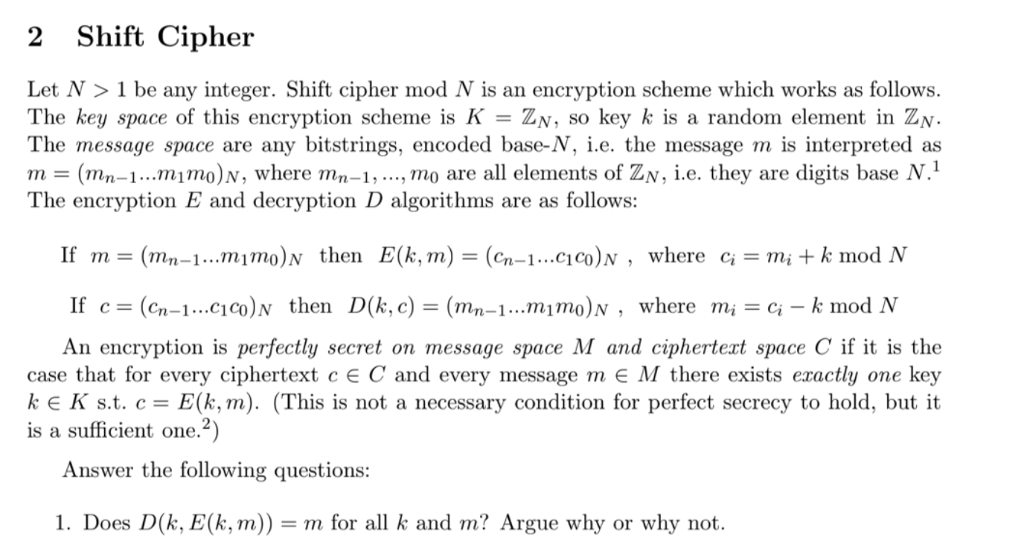
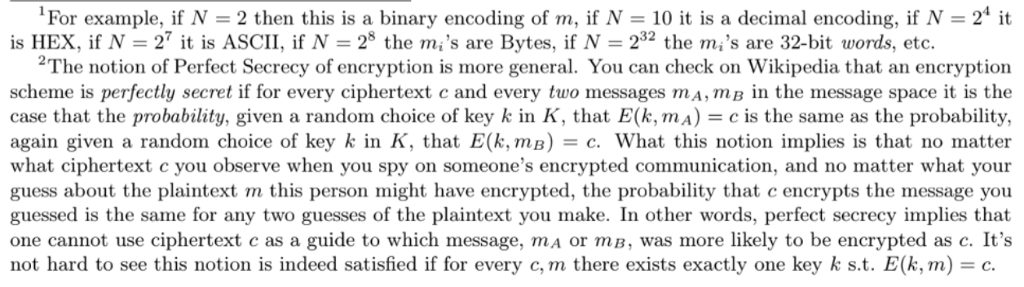
2 Shift Cipher Let N >1 be any integer. Shift cipher mod N is an encryption scheme which works as follows The key space of this encryption scheme is K ZN, so key k is a random element in Z The message space are any bitstrings, encoded base-N, i.e. the message m is interpreted as m = (mn-1 . . . mimo)N, where man-i, , mo are all elements of ZN, l.e. they are digits base N.1 The encryption E and decryption D algorithms are as follows: If m= (mn-1 mimo)N then E(k, m)=(cn-1 cia )N , where ci= mit k mod N If c = (Cn-1 C100)N then D(k, c) = (mn-1 mimo)N , where mi=ci-k mod N case that for every ciphertext cE C and every message m E M there exists eractly one key An encryption is perfectly secret on message space M and ciphertext space C if it is the k K s.t. c- E(k, m). (This is not a necessary condition for perfect secrecy to hold, but it is a sufficient one.2) Answer the following questions: I. Does D(k, E(k, m)) = m for all k and m? Argue why or why not. 2 Shift Cipher Let N >1 be any integer. Shift cipher mod N is an encryption scheme which works as follows The key space of this encryption scheme is K ZN, so key k is a random element in Z The message space are any bitstrings, encoded base-N, i.e. the message m is interpreted as m = (mn-1 . . . mimo)N, where man-i, , mo are all elements of ZN, l.e. they are digits base N.1 The encryption E and decryption D algorithms are as follows: If m= (mn-1 mimo)N then E(k, m)=(cn-1 cia )N , where ci= mit k mod N If c = (Cn-1 C100)N then D(k, c) = (mn-1 mimo)N , where mi=ci-k mod N case that for every ciphertext cE C and every message m E M there exists eractly one key An encryption is perfectly secret on message space M and ciphertext space C if it is the k K s.t. c- E(k, m). (This is not a necessary condition for perfect secrecy to hold, but it is a sufficient one.2) Answer the following questions: I. Does D(k, E(k, m)) = m for all k and m? Argue why or why not
Step by Step Solution
There are 3 Steps involved in it

Get step-by-step solutions from verified subject matter experts
 Study Help