







Question: Discrete Structures Identify the error or errors in this argument that supposedly shows that if xP(x)xQ(x) is true, then x(P(x)Q(x)) is true. 1. xP(x)xQ(x) Premise
Discrete Structures
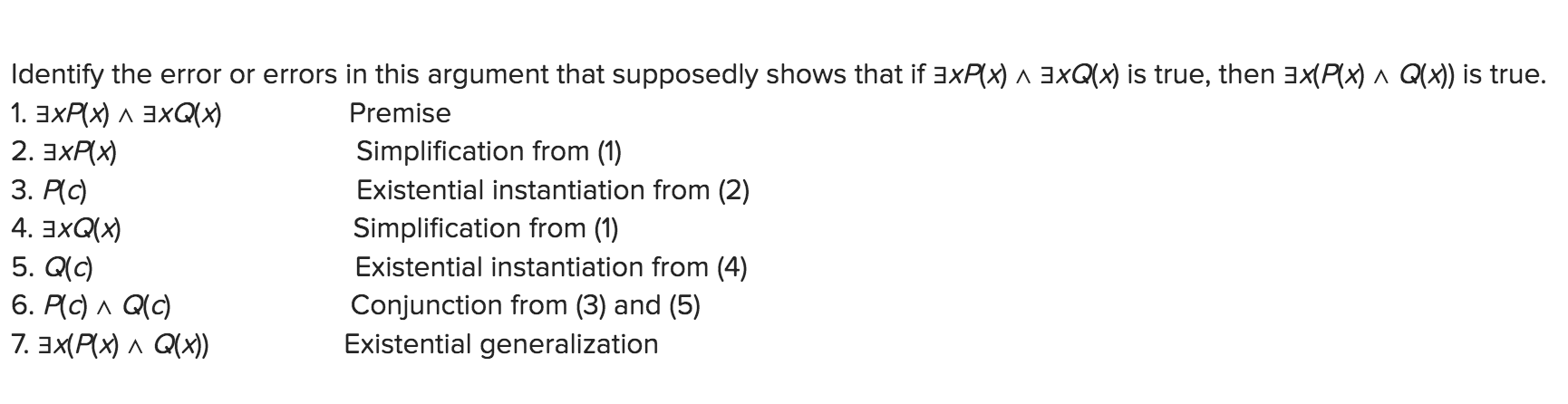
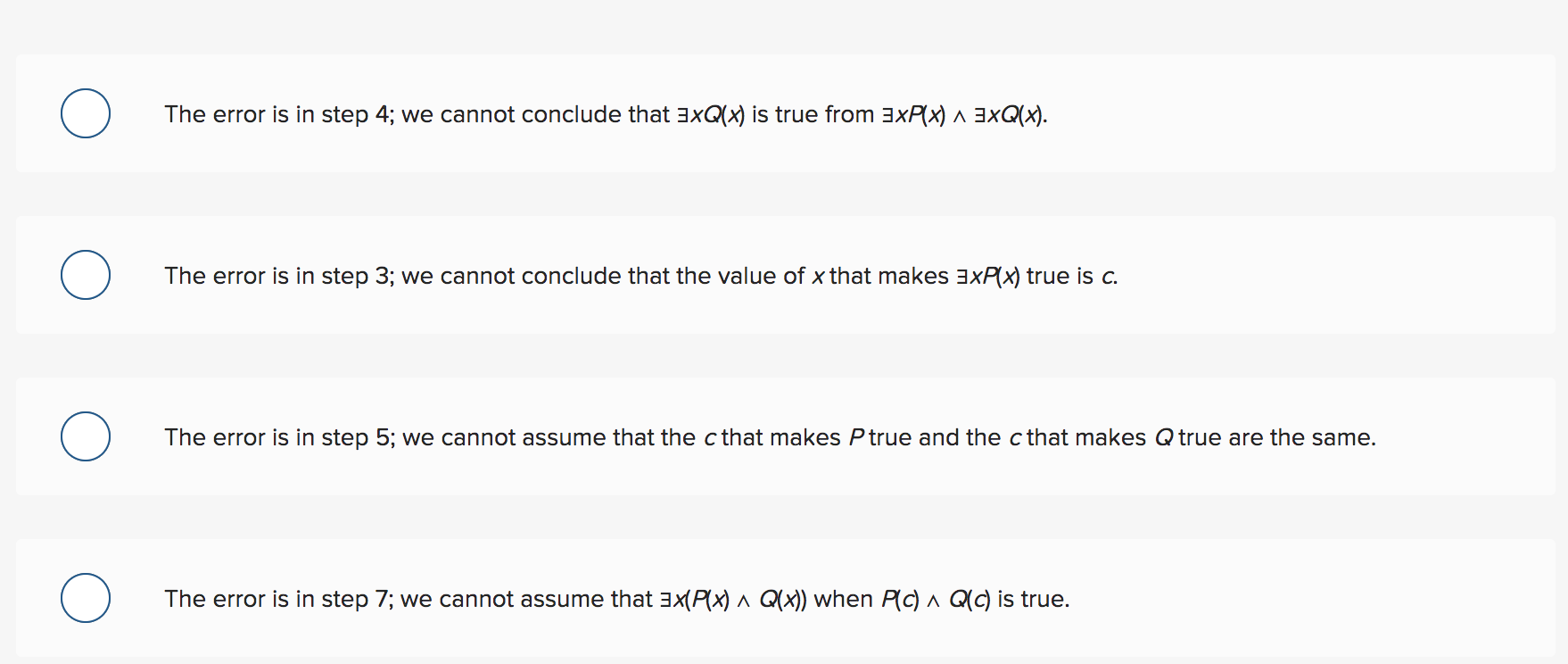
Identify the error or errors in this argument that supposedly shows that if xP(x)xQ(x) is true, then x(P(x)Q(x)) is true. 1. xP(x)xQ(x) Premise 2. xP(x) Simplification from (1) 3. P(c) Existential instantiation from (2) 4. xQ(x) Simplification from (1) 5. Q(c) Existential instantiation from (4) 6. P(c)Q(c) Conjunction from (3) and (5) 7. x(P(x)Q(x)) Existential generalization The error is in step 4; we cannot conclude that xQ(x) is true from xP(x)xQ(x). The error is in step 3; we cannot conclude that the value of x that makes xP(x) true is c. The error is in step 5; we cannot assume that the c that makes P true and the c that makes Q true are the same. The error is in step 7; we cannot assume that x(P(x)Q(x)) when P(c)Q(c) is true
Step by Step Solution
There are 3 Steps involved in it

Get step-by-step solutions from verified subject matter experts
 Study Help