Question: Discussion Board - 300 words *PLS do not give same answer as the other post with this question* 1. For which organization culture type do
Discussion Board - 300 words
*PLS do not give same answer as the other post with this question*
1. For which organization culture type do you think HR analytics will best integrate? Is there an ideal culture type to support HR analytics? Why?
2. Which organization culture type will be least likely to accept HR analytics as a viable part of the organization's strategy? Why?
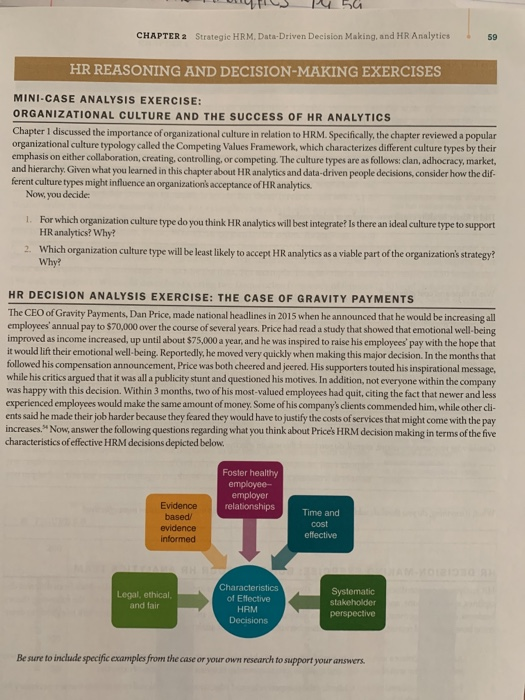
SG CHAPTER 2 Strategic HRM.Data-Driven Decision Making, and HR Analytics 59 HR REASONING AND DECISION-MAKING EXERCISES MINI-CASE ANALYSIS EXERCISE: ORGANIZATIONAL CULTURE AND THE SUCCESS OF HR ANALYTICS Chapter 1 discussed the importance of organizational culture in relation to HRM. Specifically, the chapter reviewed a popular organizational culture typology called the Competing Values Framework, which characterizes different culture types by their emphasis on either collaboration, creating, controlling, or competing. The culture types are as follows: clan, adhocracy, market, and hierarchy. Given what you learned in this chapter about HR analytics and data-driven people decisions, consider how the dif- ferent culture types might influence an organizations acceptance of HR analytics Now, you decide 1. For which organization culture type do you think HR analytics will best integrate? Is there an ideal culture type to support HR analytics? Why? 2. Which organization culture type will be least likely to accept HR analytics as a viable part of the organization's strategy? Why? HR DECISION ANALYSIS EXERCISE: THE CASE OF GRAVITY PAYMENTS The CEO of Gravity Payments, Dan Price, made national headlines in 2015 when he announced that he would be increasing all employees' annual pay to $70,000 over the course of several years. Price had read a study that showed that emotional well-being improved as income increased, up until about $75,000 a year, and he was inspired to raise his employees' pay with the hope that it would lift their emotional well-being, Reportedly, he moved very quickly when making this major decision. In the months that followed his compensation announcement, Price was both cheered and jeered. His supporters touted his inspirational message, while his critics argued that it was all a publicity stunt and questioned his motives. In addition, not everyone within the company was happy with this decision. Within 3 months, two of his most-valued employees had quit, citing the fact that newer and less experienced employees would make the same amount of money. Some of his company's clients commended him, while other cli- ents said he made their job harder because they feared they would have to justify the costs of services that might come with the pay increases." Now, answer the following questions regarding what you think about Price's HRM decision making in terms of the five characteristics of effective HRM decisions depicted below. Foster healthy employee- employer relationships Evidence based evidence informed Time and cost effective Legal, ethical and lair Characteristics of Effective HRM Decisions Systematic stakeholder perspective Be sure to include specific examples from the case or your own research to support your answers









 Study Help