







Question: disjunctive/conjunctive normal form. The Boolean function G(p, q, r) is defined in the table. You can think of the table as a truth table where
disjunctive/conjunctive normal form.
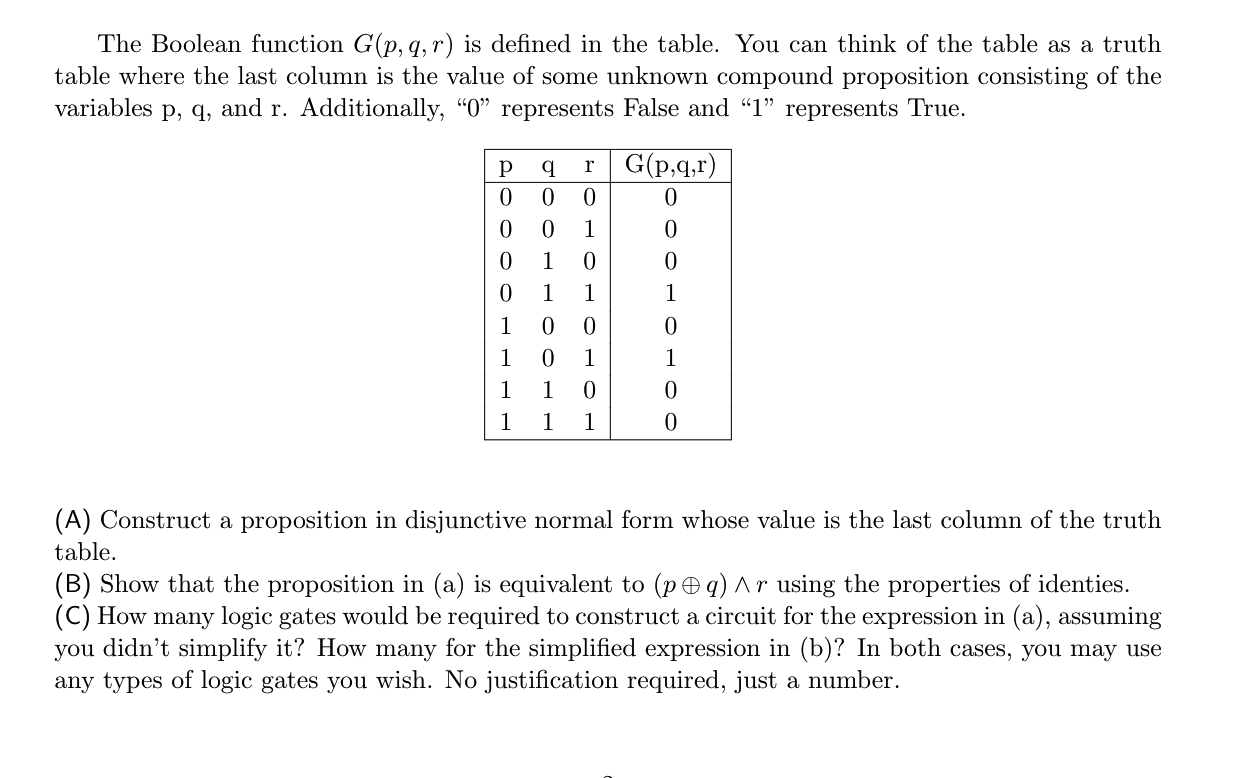
The Boolean function G(p, q, r) is defined in the table. You can think of the table as a truth table where the last column is the value of some unknown compound proposition consisting of the variables p, q, and r. Additionally, "0" represents False and "1" represents True. Construct a proposition in disjunctive normal form whose value is the last column of the truth table. Show that the proposition in (a) is equivalent to (p q) ^ r using the properties of identify. How many logic gates would be required to construct a circuit for the expression in (a), assuming you didn't simplify it? How many for the simplified expression in (b)? In both cases, you may use any types of logic gates you wish. No justification required, just a number
Step by Step Solution
There are 3 Steps involved in it

Get step-by-step solutions from verified subject matter experts
 Study Help