







Question: Do a SWOT analysis for the Analysis part. Case Study: Construction Craig Construction: A Home Improvement Project After Craig bought into TQM process, Nash explained
Do a SWOT analysis for the Analysis part.
Case Study: Construction
Craig Construction: A Home Improvement Project
After Craig bought into TQM process, Nash explained that TQM has to be implemented by using Quality Management Tools. There are many tools that may be used to implement quality in projects, Nash explained. Quality has been an issue in the construction industry. Quality tools are used in construction to prevent problems as well as to correct problems. For instance, QFD can be used during the project planning phase of a construction project. QFD is a simple procedure to capture customer requirements. The Kano model can be used to identify requirements that are really the choice of the customer and how the customer feels about the requirements. TMAP may be used to identify the idea behind a process.
Craig asked, What kind of process are we talking about? Construction process?
Nash answered, Let us do a small exercise to illustrate a processsay, a painting process. I told you that I wanted to paint the walls of the new home addition. So, let us see the thought process behind this idea so you can see what I am talking about.
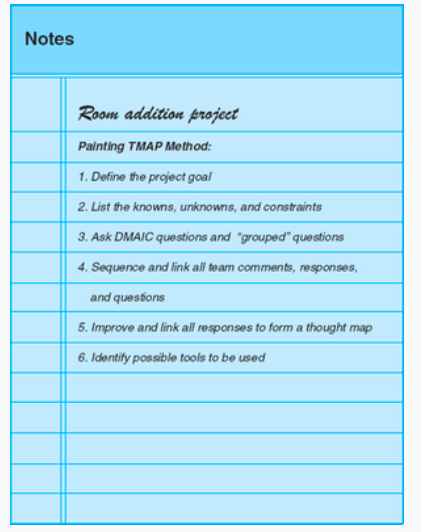
Nash took a sheet of paper and started to explain to Craig how to conduct a TMAP process of his painting adventure. He wrote down the process on the sheet as shown in Figure 3-11. He then explained to Craig, I am going to define the project goal first. The project goal should be very clear to me as well as anyone else who reads the goal. I am going to make the project goal:
I want to paint the home addition myself.
The project goal can be a goal or a statement of a problem. With this goal or problem on our minds, let us go through the thought process together. The next step is to list what is known about this idea or goal or problem. We also need to list the unknowns and the constraints that I have with painting the home addition. Let us write all the known, unknowns, and constraints on these stick-on notes and stick them on the wall here. With that, Nash started writing the known, unknowns, and constraints. Craig had something to say as well, and he also wrote a few of the notes. Having written all the notes, they stuck them one by one on the wall as shown in Figure 3-12.
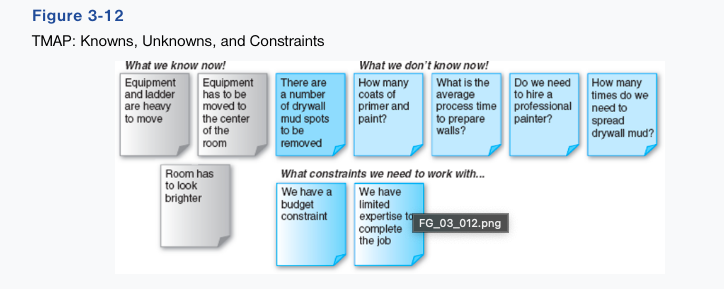
Craig looked at the notes on the wall and said, Nash! What about mud? Who is going to resurface the mud before the painting?
Nash replied, Honestly, I did not think about that. Let me add that note, and stuck the note on the wall under What we know!
Craig looked at the wall of notes and exclaimed, Nash! There is no way you are going to paint this yourself.
Nash said, Craig, this is the basic idea of the thought map. You will gain important insights once you start thinking about the problem. Now, let us continue to do DMAIC since it will help you in your future projects.
Craig asked Nash, Now what is DMAIC?
Nash started explaining, D is for Define. We have to define the problem a little more elaborately. We can also define the current status and how it is currently operating. The Kano model and SWOT analysis can be used to understand customer requirements and define the customers position on those requirements.
Craig kidded with Nash, Your position seems to be not doing the painting yourself now!
Nash smiled and continued, Craig, the next one is M for Measure. Usually data are gathered at this time using some measurements or metrics. We can ask questions on what metrics can be used to measure performance, for instance. Next is A for Analyze. What we measure in the previous step, we can analyze. We can ask questions pertaining to the unknowns in this part of the step. The next step is I for Improve, and we should be asking questions on what improvements can be made to the painting process. The last step is C for Control, and we should be asking questions regarding control for one of the overall performance measures, which is the beauty of the addition itself.
We are almost done, Craig, said Nash. All we need to do now is move these around and link them together to form a thought process map. From there we should be able to understand the problem or goal in this case. They moved the notes around, and the final product is shown in Figure 3-14.
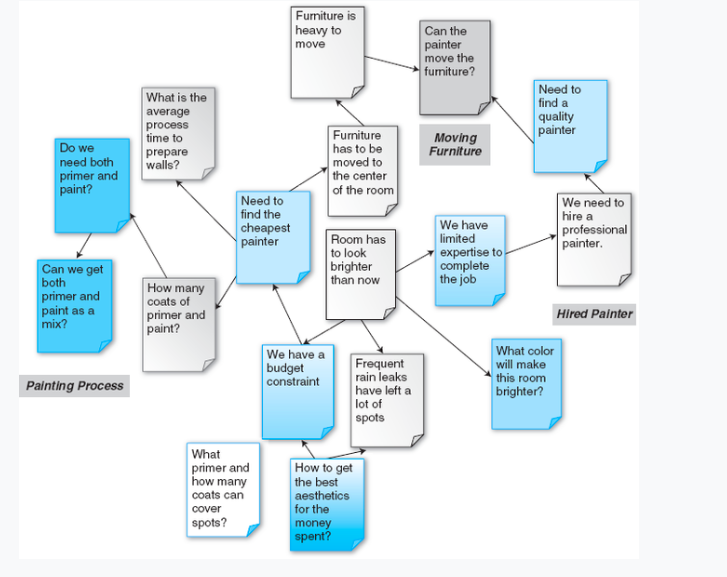
Craig looked at it and said, I could have told you that you cant paint without going through this whole exercise!
Nash replied, First of all, I did think that I could do this painting before I did this exercise. It was during the exercise that I realized that this is a job that I cant do. Secondly, this is a simple exercise. You will come across many complex problems in your construction life and this will certainly ease those days.
To that Craig exclaimed, Yes! I can see that!
Notes Roone addition fraject Painting TMAP Mothod: 1. Define the project goal 2. List the knowns, unknowns, and constraints 3. Ask DMAIC questions and "grouped" questions 4. Sequence and link all team comments, responses, and questions 5. Improve and link all responses to form a thought map 6. Identity possible tools to be used Figure 312 TMAP: Knowns IInknnwns and Connstraints
Step by Step Solution
There are 3 Steps involved in it

Get step-by-step solutions from verified subject matter experts
 Study Help