







Question: Do Babies Understand Probability? Can babies reason probabilistically? A study investigates this by showing ten- to twelve-month-old infants two jars of lollipop shaped objects colored
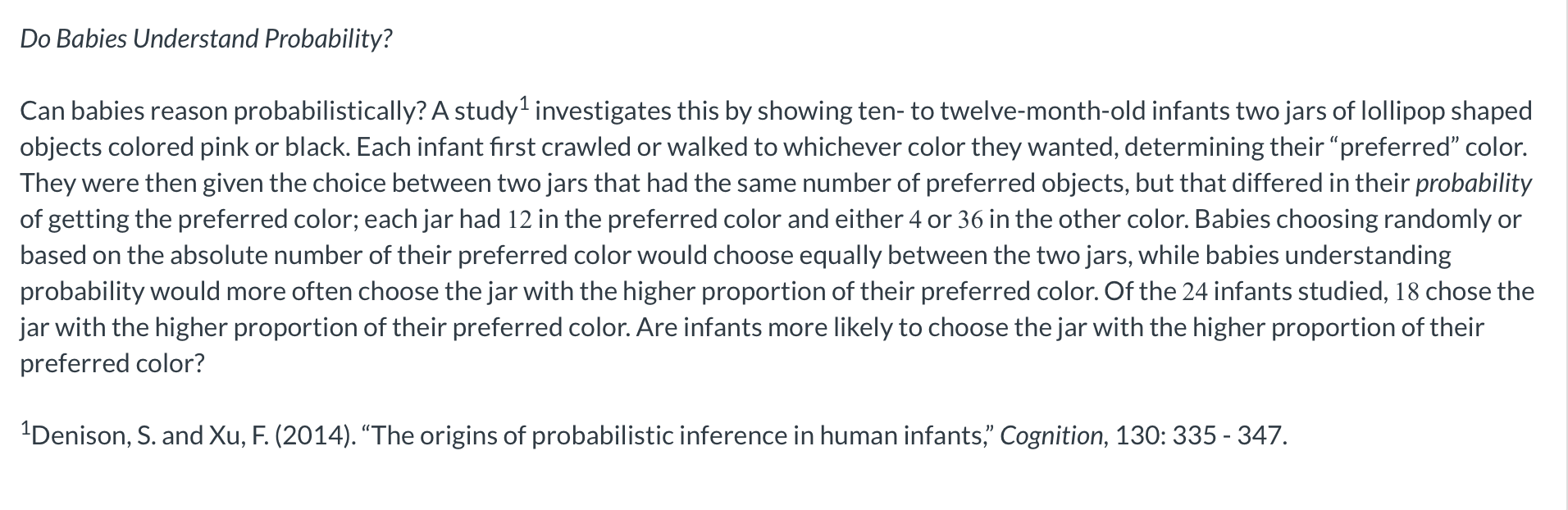
Do Babies Understand Probability? Can babies reason probabilistically? A study investigates this by showing ten- to twelve-month-old infants two jars of lollipop shaped objects colored pink or black. Each infant first crawled or walked to whichever color they wanted, determining their "preferred" color. They were then given the choice between two jars that had the same number of preferred objects, but that differed in their probability of getting the preferred color; each jar had 12 in the preferred color and either 4 or 36 in the other color. Babies choosing randomly or based on the absolute number of their preferred color would choose equally between the two jars, while babies understanding probability would more often choose the jar with the higher proportion of their preferred color. Of the 24 infants studied, 18 chose the jar with the higher proportion of their preferred color. Are infants more likely to choose the jar with the higher proportion of their preferred color? Denison, S. and Xu, F. (2014). "The origins of probabilistic inference in human infants," Cognition, 130: 335 - 347.(c) Find the exact value of the sample statistic. sample statistic = I eTextbook and Media (e) What is the p-value? Round your answer to three decimal places. p-value i eTextbook and Media
Step by Step Solution
There are 3 Steps involved in it

Get step-by-step solutions from verified subject matter experts
 Study Help