







Question: . DO CASE STUDY Specialty Packaging Corporation, Part B TABLE 8-9 Demand Forecast for Clear and Black Plastic Containers D . Julie Williams, facility production
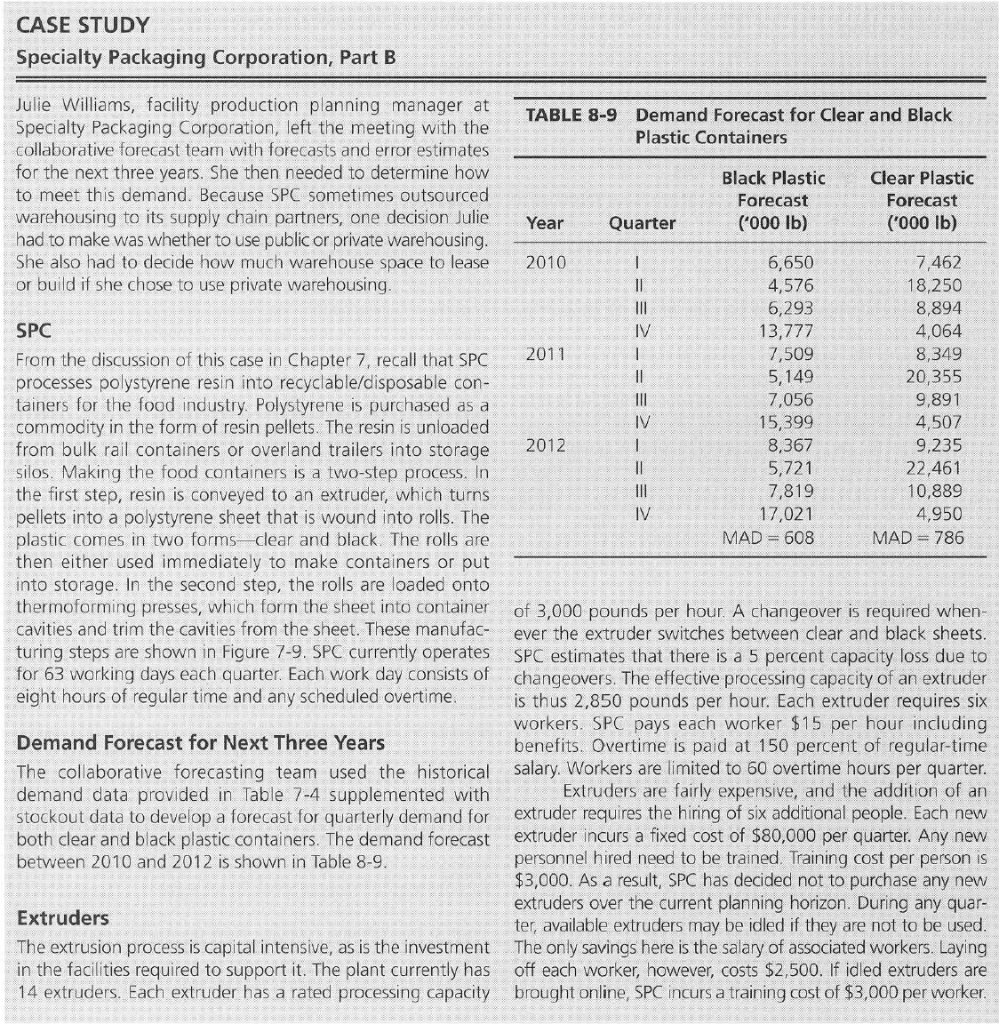
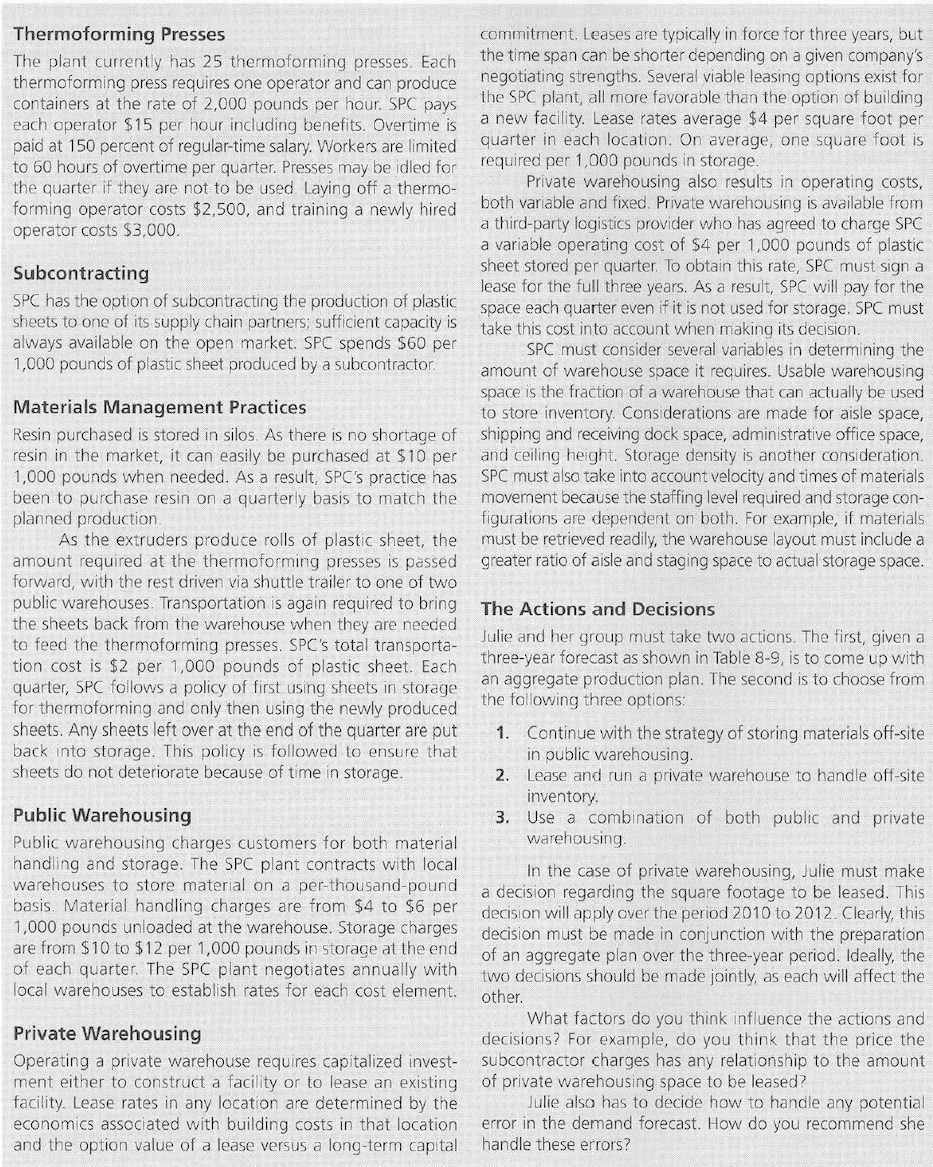
. DO CASE STUDY Specialty Packaging Corporation, Part B TABLE 8-9 Demand Forecast for Clear and Black Plastic Containers D . Julie Williams, facility production planning manager at Specialty Packaging Corporation, left the meeting with the collaborative forecast team with forecasts and error estimates for the next three years. She then needed to determine how to meet this demand. Because SPC sometimes outsourced warehousing to its supply chain partners, one decision Julie had to make was whether to use public or private warehousing. She also had to decide how much warehouse space to lease or build if she chose to use private warehousing. Black Plastic Forecast ('000 lb) Clear Plastic Forecast ('000 lb) Year Quarter 1 2010 - = = 2 2011 - = = 6,650 4,576 6,293 13,777 7,509 5,149 7,056 15,399 8,367 5,721 7,819 17,021 MAD = 608 7,462 18,250 8,894 4,064 8,349 20,355 9,891 4,507 9,235 22,461 10,889 4,950 MAD = 786 SPC From the discussion of this case in Chapter 7, recall that SPC processes polystyrene resin into recyclable/disposable con- tainers for the food industry. Polystyrene is purchased as a commodity in the form of resin pellets. The resin is unloaded from bulk rail containers or overland trailers into storage silos. Making the food containers is a two-step process. In the first step, resin is conveyed to an extruder, which turns pellets into a polystyrene sheet that is wound into rolls. The plastic comes in two forms-clear and black The rolls are then either used immediately to make containers or put into storage. In the second step, the rolls are loaded onto thermoforming presses, which form the sheet into container cavities and trim the cavities from the sheet. These manufac- turing steps are shown in Figure 7-9. SPC currently operates for 63 working days each quarter. Each work day consists of eight hours of regular time and any scheduled overtime 2012 - DAN 2 Demand Forecast for Next Three Years The collaborative forecasting team used the historical demand data provided in Table 7-4 supplemented with stockout data to develop a forecast for quarterly demand for both clear and black plastic containers. The demand forecast between 2010 and 2012 is shown in Table 8-9. of 3,000 pounds per hour. A changeover is required when- ever the extruder switches between clear and black sheets. SPC estimates that there is a 5 percent capacity loss due to changeovers. The effective processing capacity of an extruder is thus 2.850 pounds per hour. Each extruder requires six workers. SPC pays each worker $15 per hour including benefits. Overtime is paid at 150 percent of regular-time salary. Workers are limited to 60 overtime hours per quarter. Extruders are fairly expensive, and the addition of an extruder requires the hiring of six additional people. Each new extruder incurs a fixed cost of $80,000 per quarter. Any new personnel hired need to be trained. Training cost per person is $3,000. As a result, SPC has decided not to purchase any new extruders over the current planning horizon. During any quar- ter, available extruders may be idled if they are not to be used. The only savings here is the salary of associated workers. Laying off each worker, however, costs $2,500. If idled extruders are brought online, SPC incurs a training cost of $3,000 per worker. Extruders The extrusion process is capital intensive, as is the investment in the facilities required to support it. The plant currently has 14 extruders. Each extruder has a rated processing capacity Thermoforming Presses The plant currently has 25 thermoforming presses. Each thermoforming press requires one operator and can produce containers at the rate of 2,000 pounds per hour. SPC pays each operator $15 per hour including benefits. Overtime is paid at 150 percent of regular-time salary. Workers are limited to 60 hours of overtime per quarter. Presses may be idled for esses may be idled for the quarter if they are not to be used Laying off a thermo- forming operator costs $2,500, and training a newly hired operator costs $3,000. Subcontracting SPC has the option of subcontracting the production of plastic Sheets to one or TS supply chain partners, sutricient capacity is always available on the open market. SPC spends $60 per 1,000 pounds of plastic sheet produced by a subcontractor commitment. Leases are typically in force for three years, but the time span can be shorter depending on a given company's negotiating strengths. Several viable leasing options exist for the SPC plant, all more favorable than the option of building a new facility. Lease rates average $4 per square foot per quarter in each location. On average, one square foot is required per required per 1,000 pounds in storage. Private warehousing also results in operating costs, both variable and fixed. Private warehousing is available from a third-party logistics provider who has agreed to charge SPC a variable operating cost of $4 per 1,000 pounds of plastic sheet stored per quarter. To obtain this rate, SPC must sign a lease for the full three years. As a result, SPC will pay for the space each quarter even if it is not used for storage. SPC must take this cost into account when making its decision. SPC must consider several variables in determining the amount of warehouse space it requires. Usable warehousing space is the fraction of a warehouse that can actually be used to store inventory. Considerations are made for aisle space, shipping and receiving dock space, administrative office space, and ceiling height. Storage density is another consideration. SPC must also take into account velocity and times of materials movement because the staffing level required and storage con- figurations are dependent on both. For example, if materials must be retrieved readily, the warehouse layout must include a greater ratio of aisle and staging space to actual storage space. Materials Management Practices Resin purchased is stored in silos. As there is no shortage of resin in the market, it can easily be purchased at $10 per 1,000 pounds when needed. As a result, SPC's practice has been to purchase resin on a quarterly basis to match the planned production As the extruders produce rolls of plastic sheet, the amount required at the thermoforming presses is passed forward, with the rest driven via shuttle trailer to one of two public warehouses. Transportation is again required to bring the sheets back from the warehouse when they are needed to feed the thermoforming presses. SPC's total transporta- tion cost is $2 per 1,000 pounds of plastic sheet. Each quarter, SPC follows a policy of first using sheets in storage for thermoforming and only then using the newly produced sheets. Any sheets left over at the end of the quarter are put back into storage. This policy is followed to ensure that sheets do not deteriorate because of time in storage. The Actions and Decisions Julie and her group must take two actions. The first, given a three-year forecast as shown in Table 8-9, is to come up with an aggregate production plan. The second is to choose from the following three options: 1. Continue with the strategy of storing materials off-site in public warehousing. 2. Lease and run a private warehouse to handle off-site inventory. 3. Use a combination of both public and private warehousing. Public Warehousing Public warehousing charges customers for both material handling and storage. The SPC plant contracts with local warehouses to store material on a per-thousand-pound basis. Material handling charges are from $4 to $6 per 1,000 pounds unloaded at the warehouse. Storage charges are from $10 to $12 per 1,000 pounds in storage at the end of each quarter. The SPC plant negotiates annually with U hegouates annually with local warehouses to establish rates for each cost element. In the case of private warehousing, Julie must make a decision regarding the square footage to be leased. This decision will apply over the period 2010 to 2012. Clearly, this decision must be made in conjunction with the preparation of an aggregate plan over the three-year period. Ideally, the two decisions should be made jointly, as each will affect the other. What factors do you think influence the actions and decisions? For example, do you think that the price the subcontractor charges has any relationship to the amount of private warehousing space to be leased? Julie also has to decide how to handle any potential error in the demand forecast. How do you recommend she handle these errors? Private Warehousing Operating a private warehouse requires capitalized invest- ment either to construct a facility or to lease an existing facility. Lease rates in any location are determined by the economics associated with building costs in that location and the option value of a lease versus a long-term capital . DO CASE STUDY Specialty Packaging Corporation, Part B TABLE 8-9 Demand Forecast for Clear and Black Plastic Containers D . Julie Williams, facility production planning manager at Specialty Packaging Corporation, left the meeting with the collaborative forecast team with forecasts and error estimates for the next three years. She then needed to determine how to meet this demand. Because SPC sometimes outsourced warehousing to its supply chain partners, one decision Julie had to make was whether to use public or private warehousing. She also had to decide how much warehouse space to lease or build if she chose to use private warehousing. Black Plastic Forecast ('000 lb) Clear Plastic Forecast ('000 lb) Year Quarter 1 2010 - = = 2 2011 - = = 6,650 4,576 6,293 13,777 7,509 5,149 7,056 15,399 8,367 5,721 7,819 17,021 MAD = 608 7,462 18,250 8,894 4,064 8,349 20,355 9,891 4,507 9,235 22,461 10,889 4,950 MAD = 786 SPC From the discussion of this case in Chapter 7, recall that SPC processes polystyrene resin into recyclable/disposable con- tainers for the food industry. Polystyrene is purchased as a commodity in the form of resin pellets. The resin is unloaded from bulk rail containers or overland trailers into storage silos. Making the food containers is a two-step process. In the first step, resin is conveyed to an extruder, which turns pellets into a polystyrene sheet that is wound into rolls. The plastic comes in two forms-clear and black The rolls are then either used immediately to make containers or put into storage. In the second step, the rolls are loaded onto thermoforming presses, which form the sheet into container cavities and trim the cavities from the sheet. These manufac- turing steps are shown in Figure 7-9. SPC currently operates for 63 working days each quarter. Each work day consists of eight hours of regular time and any scheduled overtime 2012 - DAN 2 Demand Forecast for Next Three Years The collaborative forecasting team used the historical demand data provided in Table 7-4 supplemented with stockout data to develop a forecast for quarterly demand for both clear and black plastic containers. The demand forecast between 2010 and 2012 is shown in Table 8-9. of 3,000 pounds per hour. A changeover is required when- ever the extruder switches between clear and black sheets. SPC estimates that there is a 5 percent capacity loss due to changeovers. The effective processing capacity of an extruder is thus 2.850 pounds per hour. Each extruder requires six workers. SPC pays each worker $15 per hour including benefits. Overtime is paid at 150 percent of regular-time salary. Workers are limited to 60 overtime hours per quarter. Extruders are fairly expensive, and the addition of an extruder requires the hiring of six additional people. Each new extruder incurs a fixed cost of $80,000 per quarter. Any new personnel hired need to be trained. Training cost per person is $3,000. As a result, SPC has decided not to purchase any new extruders over the current planning horizon. During any quar- ter, available extruders may be idled if they are not to be used. The only savings here is the salary of associated workers. Laying off each worker, however, costs $2,500. If idled extruders are brought online, SPC incurs a training cost of $3,000 per worker. Extruders The extrusion process is capital intensive, as is the investment in the facilities required to support it. The plant currently has 14 extruders. Each extruder has a rated processing capacity Thermoforming Presses The plant currently has 25 thermoforming presses. Each thermoforming press requires one operator and can produce containers at the rate of 2,000 pounds per hour. SPC pays each operator $15 per hour including benefits. Overtime is paid at 150 percent of regular-time salary. Workers are limited to 60 hours of overtime per quarter. Presses may be idled for esses may be idled for the quarter if they are not to be used Laying off a thermo- forming operator costs $2,500, and training a newly hired operator costs $3,000. Subcontracting SPC has the option of subcontracting the production of plastic Sheets to one or TS supply chain partners, sutricient capacity is always available on the open market. SPC spends $60 per 1,000 pounds of plastic sheet produced by a subcontractor commitment. Leases are typically in force for three years, but the time span can be shorter depending on a given company's negotiating strengths. Several viable leasing options exist for the SPC plant, all more favorable than the option of building a new facility. Lease rates average $4 per square foot per quarter in each location. On average, one square foot is required per required per 1,000 pounds in storage. Private warehousing also results in operating costs, both variable and fixed. Private warehousing is available from a third-party logistics provider who has agreed to charge SPC a variable operating cost of $4 per 1,000 pounds of plastic sheet stored per quarter. To obtain this rate, SPC must sign a lease for the full three years. As a result, SPC will pay for the space each quarter even if it is not used for storage. SPC must take this cost into account when making its decision. SPC must consider several variables in determining the amount of warehouse space it requires. Usable warehousing space is the fraction of a warehouse that can actually be used to store inventory. Considerations are made for aisle space, shipping and receiving dock space, administrative office space, and ceiling height. Storage density is another consideration. SPC must also take into account velocity and times of materials movement because the staffing level required and storage con- figurations are dependent on both. For example, if materials must be retrieved readily, the warehouse layout must include a greater ratio of aisle and staging space to actual storage space. Materials Management Practices Resin purchased is stored in silos. As there is no shortage of resin in the market, it can easily be purchased at $10 per 1,000 pounds when needed. As a result, SPC's practice has been to purchase resin on a quarterly basis to match the planned production As the extruders produce rolls of plastic sheet, the amount required at the thermoforming presses is passed forward, with the rest driven via shuttle trailer to one of two public warehouses. Transportation is again required to bring the sheets back from the warehouse when they are needed to feed the thermoforming presses. SPC's total transporta- tion cost is $2 per 1,000 pounds of plastic sheet. Each quarter, SPC follows a policy of first using sheets in storage for thermoforming and only then using the newly produced sheets. Any sheets left over at the end of the quarter are put back into storage. This policy is followed to ensure that sheets do not deteriorate because of time in storage. The Actions and Decisions Julie and her group must take two actions. The first, given a three-year forecast as shown in Table 8-9, is to come up with an aggregate production plan. The second is to choose from the following three options: 1. Continue with the strategy of storing materials off-site in public warehousing. 2. Lease and run a private warehouse to handle off-site inventory. 3. Use a combination of both public and private warehousing. Public Warehousing Public warehousing charges customers for both material handling and storage. The SPC plant contracts with local warehouses to store material on a per-thousand-pound basis. Material handling charges are from $4 to $6 per 1,000 pounds unloaded at the warehouse. Storage charges are from $10 to $12 per 1,000 pounds in storage at the end of each quarter. The SPC plant negotiates annually with U hegouates annually with local warehouses to establish rates for each cost element. In the case of private warehousing, Julie must make a decision regarding the square footage to be leased. This decision will apply over the period 2010 to 2012. Clearly, this decision must be made in conjunction with the preparation of an aggregate plan over the three-year period. Ideally, the two decisions should be made jointly, as each will affect the other. What factors do you think influence the actions and decisions? For example, do you think that the price the subcontractor charges has any relationship to the amount of private warehousing space to be leased? Julie also has to decide how to handle any potential error in the demand forecast. How do you recommend she handle these errors? Private Warehousing Operating a private warehouse requires capitalized invest- ment either to construct a facility or to lease an existing facility. Lease rates in any location are determined by the economics associated with building costs in that location and the option value of a lease versus a long-term capital
Step by Step Solution
There are 3 Steps involved in it

Get step-by-step solutions from verified subject matter experts
 Study Help