







Question: Do exactly as same as the example provided. if done different or miss any step. i will give dislike. Example problem. answer. The answer that
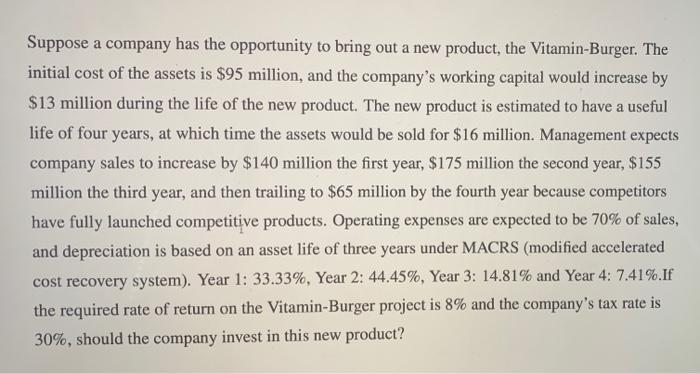
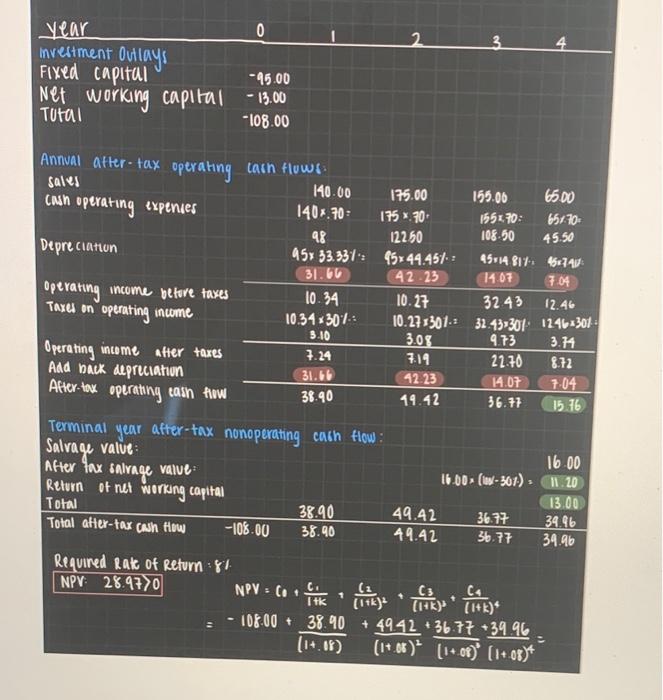
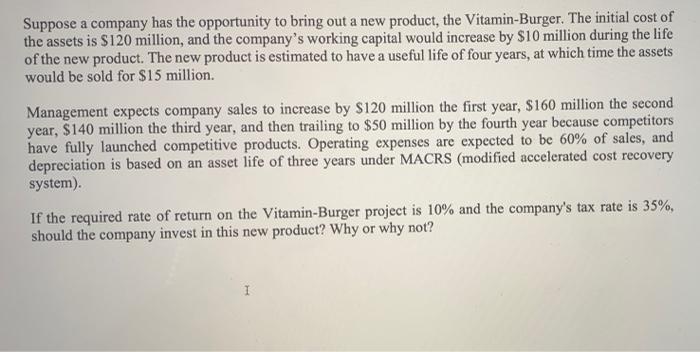
Suppose a company has the opportunity to bring out a new product, the Vitamin-Burger. The initial cost of the assets is $95 million, and the company's working capital would increase by $13 million during the life of the new product. The new product is estimated to have a useful life of four years, at which time the assets would be sold for $16 million. Management expects company sales to increase by $140 million the first year, $175 million the second year, $155 million the third year, and then trailing to $65 million by the fourth year because competitors have fully launched competitive products. Operating expenses are expected to be 70% of sales, and depreciation is based on an asset life of three years under MACRS (modified accelerated cost recovery system). Year 1: 33.33%, Year 2: 44.45%, Year 3: 14.81% and Year 4: 7.41%. If the required rate of return on the Vitamin-Burger project is 8% and the company's tax rate is 30%, should the company invest in this new product? Year 0 mvestment Outlays Fixed capital -45.00 Net working capital -13.00 Tural *108.00 Annval after-tax operating cash flows. sales 140.00 175.00 155.06 65.00 cash operating expenses 1403.70 175 70 155270 65170 98 122.50 108-50 45.50 Depreciation 453 33.331 95244.457 : 45514814: 155745 31.60 42.23 14.07 7.04 Operating income before taxes 10.34 10.27 3243 12.45 Taxel on operating inume 10.34*301 10.27-301. 32.43-301 12462301 3.10 3.08 4.73 3.71 Operating income after taxes 7.24 7.14 22.70 8.12 Add back depreciation 31.66 42.23 14.07 7.04 After-tax operating cash how 38.40 19.42 36.77 15.16 Terminal year after-tax nonoperating cash flow : Salvage value 16.00 After Tax salvage vaive 16.00 (ww-301) (11.20 Return of her working capital 13.00 Total 38.90 49.42 36.77 34.96 Total after-tax cash flow -108.00 38.90 49.42 36.77 39.96 Required Rate of Return 81- NPV 28.9770 NPV = ( (2 Ca (14k)* : - 10800 + 38.90 + 4942 +36-77 +39.96 (14.18) (1+06)" (1+08) (1+08)* 1 It + Suppose a company has the opportunity to bring out a new product, the Vitamin-Burger. The initial cost of the assets is $120 million, and the company's working capital would increase by $10 million during the life of the new product. The new product is estimated to have a useful life of four years, at which time the assets would be sold for $15 million. Management expects company sales to increase by S120 million the first year, $160 million the second year, $140 million the third year, and then trailing to $50 million by the fourth year because competitors have fully launched competitive products. Operating expenses are expected to be 60% of sales, and depreciation is based on an asset life of three years under MACRS (modified accelerated cost recovery system) If the required rate of return on the Vitamin-Burger project is 10% and the company's tax rate is 35%, should the company invest in this new product? Why or why not
Step by Step Solution
There are 3 Steps involved in it

Get step-by-step solutions from verified subject matter experts
 Study Help