







Question: do i 2, 100 do j-2, 100 S1: a(i, j) - b(i-1, j-1) 1 S2: b(i, j) = a(i, j-1) -1 enddo enddo 1. Give
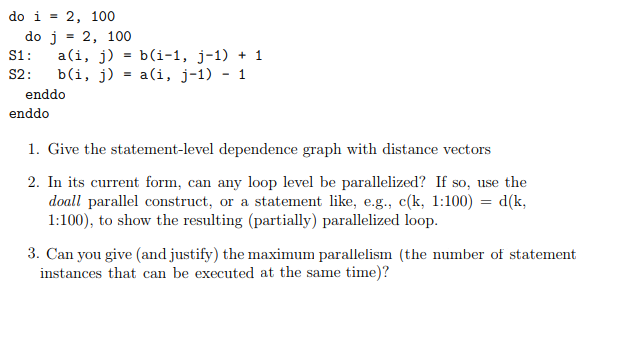
do i 2, 100 do j-2, 100 S1: a(i, j) - b(i-1, j-1) 1 S2: b(i, j) = a(i, j-1) -1 enddo enddo 1. Give the statement-level dependence graph with distance vectors 2. In its current form, can any loop level be parallelized? If so, use the doall parallel construct, or a statement like, eg, c(k 1:100) = d(k 1:100), to show the resulting (partially) parallelized loop 3. Can you give (and justify) the maximum parallelism (the number of statement instances that can be executed at the same time)? do i 2, 100 do j-2, 100 S1: a(i, j) - b(i-1, j-1) 1 S2: b(i, j) = a(i, j-1) -1 enddo enddo 1. Give the statement-level dependence graph with distance vectors 2. In its current form, can any loop level be parallelized? If so, use the doall parallel construct, or a statement like, eg, c(k 1:100) = d(k 1:100), to show the resulting (partially) parallelized loop 3. Can you give (and justify) the maximum parallelism (the number of statement instances that can be executed at the same time)
Step by Step Solution
There are 3 Steps involved in it

Get step-by-step solutions from verified subject matter experts
 Study Help