







Question: Do in MIPS and please show work The immediate bitwise logical instructions left-zero-fill the 16-bit immediate field to 32 bits. 1. For the following hexadecimal
 Do in MIPS and please show work
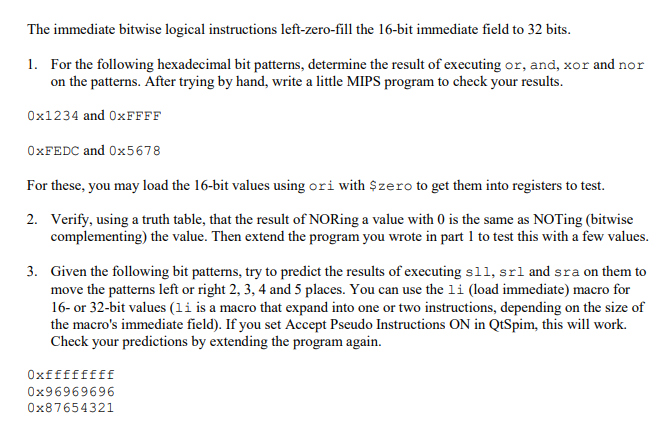
The immediate bitwise logical instructions left-zero-fill the 16-bit immediate field to 32 bits. 1. For the following hexadecimal bit patterns, determine the result of executing or, and, xor and nor on the patterns. After trying by hand, write a little MIPS program to check your results. Ox1234 and OxFFFF OxFEDC and Ox5678 For these, you may load the 16-bit values using ori with $zero to get them into registers to test. 2. Verify, using a truth table, that the result of NORing a value with 0 is the same as NOTing (bitwise complementing) the value. Then extend the program you wrote in part 1 to test this with a few values 3. Given the following bit patterns, try to predict the results of executing sll, srl and sra on them to move the patterns left or right 2, 3, 4 and 5 places. You can use the li (load immediate) macro for 16- or 32-bit values (li is a macro that expand into one or two instructions, depending on the size of the macro's immediate field). If you set Accept Pseudo Instructions ON in QtSpim, this will work. Check your predictions by extending the program again. Oxffffffff Ox96969696 Ox87654321 The immediate bitwise logical instructions left-zero-fill the 16-bit immediate field to 32 bits. 1. For the following hexadecimal bit patterns, determine the result of executing or, and, xor and nor on the patterns. After trying by hand, write a little MIPS program to check your results. Ox1234 and OxFFFF OxFEDC and Ox5678 For these, you may load the 16-bit values using ori with $zero to get them into registers to test. 2. Verify, using a truth table, that the result of NORing a value with 0 is the same as NOTing (bitwise complementing) the value. Then extend the program you wrote in part 1 to test this with a few values 3. Given the following bit patterns, try to predict the results of executing sll, srl and sra on them to move the patterns left or right 2, 3, 4 and 5 places. You can use the li (load immediate) macro for 16- or 32-bit values (li is a macro that expand into one or two instructions, depending on the size of the macro's immediate field). If you set Accept Pseudo Instructions ON in QtSpim, this will work. Check your predictions by extending the program again. Oxffffffff Ox96969696 Ox87654321
Step by Step Solution
There are 3 Steps involved in it

Get step-by-step solutions from verified subject matter experts
 Study Help