







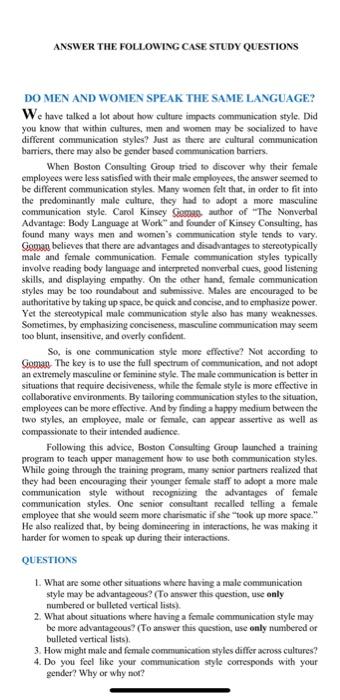
Question: DO MEN AND WOMEN SPEAK THE SAME LANGUAGE? W e have talked a lot about how culture impacts communication style. Did you know that within
DO MEN AND WOMEN SPEAK THE SAME LANGUAGE?
We have talked a lot about how culture impacts communication style. Did you know that within cultures, men and women may be socialized to have different communication styles? Just as there are cultural communication barriers, there may also be gender based communication barriers.
When Boston Consulting Group tried to discover why their female employees were less satisfied with their male employees, the answer seemed to be different communication styles. Many women felt that, in order to fit into the predominantly male culture, they had to adopt a more masculine communication style. Carol Kinsey Goman, author of The Nonverbal Advantage: Body Language at Work and founder of Kinsey Consulting, has found many ways men and womens communication style tends to vary. Goman believes that there are advantages and disadvantages to stereotypically male and female communication. Female communication styles typically involve reading body language and interpreted nonverbal cues, good listening skills, and displaying empathy. On the other hand, female communication styles may be too roundabout and submissive. Males are encouraged to be authoritative by taking up space, be quick and concise, and to emphasize power. Yet the stereotypical male communication style also has many weaknesses. Sometimes, by emphasizing conciseness, masculine communication may seem too blunt, insensitive, and overly confident.
So, is one communication style more effective? Not according to Goman. The key is to use the full spectrum of communication, and not adopt an extremely masculine or feminine style. The male communication is better in situations that require decisiveness, while the female style is more effective in collaborative environments. By tailoring communication styles to the situation, employees can be more effective. And by finding a happy medium between the two styles, an employee, male or female, can appear assertive as well as compassionate to their intended audience.
Following this advice, Boston Consulting Group launched a training program to teach upper management how to use both communication styles. While going through the training program, many senior partners realized that they had been encouraging their younger female staff to adopt a more male communication style without recognizing the advantages of female communication styles. One senior consultant recalled telling a female employee that she would seem more charismatic if she took up more space. He also realized that, by being domineering in interactions, he was making it harder for women to speak up during their interactions.
QUESTIONS
1. What are some other situations where having a male communication style may be advantageous? (To answer this question, use only numbered or bulleted vertical lists).
2. What about situations where having a female communication style may be more advantageous? (To answer this question, use only numbered or bulleted vertical lists).
3. How might male and female communication styles differ across cultures?
4. Do you feel like your communication style corresponds with your gender? Why or why not?
*Note: Need 200-220 word for every Question,please.
Step by Step Solution
There are 3 Steps involved in it

Get step-by-step solutions from verified subject matter experts
 Study Help