







Question: DO NO ANSWER THE QUESTIONS IN THE SCREENSHOT!! ANSWER THE QUESTIONS BELOW: A. Provide an example of communication and collaboration network applications that could be
 DO NO ANSWER THE QUESTIONS IN THE SCREENSHOT!!
ANSWER THE QUESTIONS BELOW:
A. Provide an example of communication and collaboration network applications that could be used by
Zaras employees.
(i) Network applications: communication
(ii) Network applications: collaboration
B. Provide an example of how Zara could (or did) implement two different E-Commerce Business Models
from Table 7.1. State the name of the e-commerce business model with the example.
(i) Name: __________, Example:
(ii) Name: __________, Example:
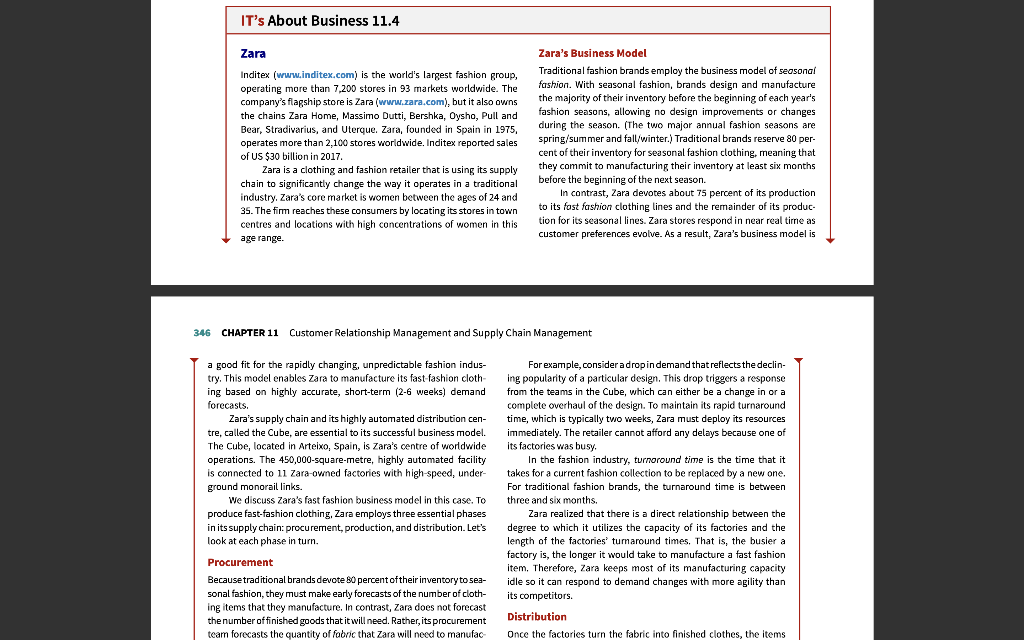
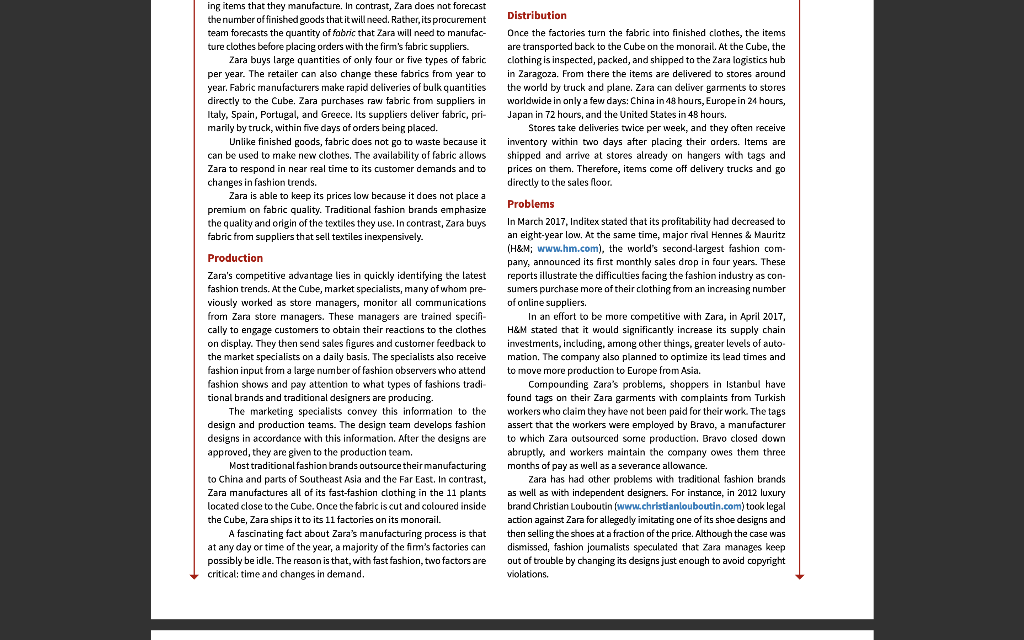
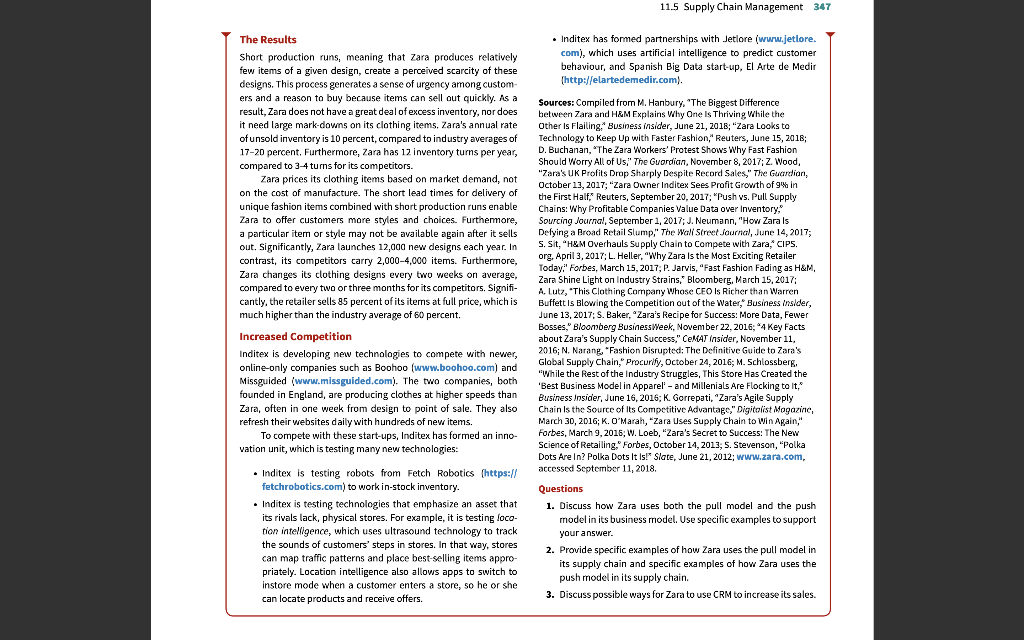
IT's About Business 11.4 Zara Inditex (www.inditex.com) is the world's largest fashion group, operating more than 7,200 stores in 93 markets worldwide. The company's flagship store is Zara (www.zara.com), but it also owns the chains Zara Home, Massimo Dutti, Bershka, Oysho, Pull and Bear, Stradivarius, and Uterque. Zara, founded in Spain in 1975, operates more than 2,100 stores worldwide. Inditex reported sales of US $30 billion in 2017. Zara is a clothing and fashion retailer that is using its supply chain to significantly change the way it operates in a traditional industry. Zara's core market is women between the ages of 24 and 35. The firm reaches these consumers by locating its stores in town centres and locations with high concentrations of women in this age range. a good fit for the rapidly changing, unpredictable fashion indus- try. This model enables Zara to manufacture its fast-fashion cloth- ing based on highly accurate, short-term (2-6 weeks) demand forecasts. 346 CHAPTER 11 Customer Relationship Management and Supply Chain Management Zara's supply chain and its highly automated distribution cen- tre, called the Cube, are essential to its successful business model. The Cube, located in Arteixo, Spain, is Zara's centre of worldwide operations. The 450,000-square-metre, highly automated facility is connected to 11 Zara-owned factories with high-speed, under- ground monorail links. Zara's Business Model Traditional fashion brands employ the business model of seasonal fashion. With seasonal fashion, brands design and manufacture the majority of their inventory before the beginning of each year's fashion seasons, allowing no design improvements or changes during the season. (The two major annual fashion seasons are spring/summer and fall/winter.) Traditional brands reserve 80 per- cent of their inventory for seasonal fashion clothing, meaning that they commit to manufacturing their inventory at least six months before the beginning of the next season. We discuss Zara's fast fashion business model in this case. To produce fast-fashion clothing, Zara employs three essential phases in its supply chain: procurement, production, and distribution. Let's look at each phase in turn. Procurement Because traditional brands devote 80 percent of their inventory to sea- sonal fashion, they must make early forecasts of the number of cloth- ing items that they manufacture. In contrast, Zara does not forecast the number of finished goods that it will need. Rather, its procurement team forecasts the quantity of fabric that Zara will need to manufac In contrast, Zara devotes about 75 percent of its production to its fast fashion clothing lines and the remainder of its produc- tion for its seasonal lines. Zara stores respond in near real time as customer preferences evolve. As a result, Zara's business model is For example, consider a drop in demand that reflects the declin- ing popularity of a particular design. This drop triggers a response from the teams in the Cube, which can either be a change in or complete overhaul of the design. To maintain its rapid turnaround time, which is typically two weeks, Zara must deploy its resources immediately. The retailer cannot afford any delays because one of its factories was busy. In the fashion industry, turnaround time is the time that it takes for a current fashion collection to be replaced by a new one. For traditional fashion brands, the turnaround time is between three and six months. Zara realized that there is a direct relationship between the degree to which it utilizes the capacity of its factories and the length of the factories' tumaround times. That is, the busier a factory is, the longer it would take to manufacture a fast fashion item. Therefore, Zara keeps most of its manufacturing capacity idle so it can respond to demand changes with more agility than its competitors. Distribution Once the factories turn the fabric into finished clothes, the items ing items that they manufacture. In contrast, Zara does not forecast the number of finished goods that it will need. Rather, its procurement team forecasts the quantity of fabric that Zara will need to manufac- ture clothes before placing orders with the firm's fabric suppliers. Zara buys large quantities of only four or five types of fabric per year. The retailer can also change these fabrics from year to year. Fabric manufacturers make rapid deliveries of bulk quantities directly to the Cube. Zara purchases raw fabric from suppliers in Italy, Spain, Portugal, and Greece. Its suppliers deliver fabric, pri- marily by truck, within five days of orders being placed. Unlike finished goods, fabric does not go to waste because it can be used to make new clothes. The availability of fabric allows Zara to respond in near real time to its customer demands and to changes in fashion trends. Zara is able to keep its prices low because it does not place a premium on fabric quality. Traditional fashion brands emphasize the quality and origin of the textiles they use. In contrast, Zara buys fabric from suppliers that sell textiles inexpensively. Production Zara's competitive advantage lies in quickly identifying the latest fashion trends. At the Cube, market specialists, many of whom pre- viously worked as store managers, monitor all communications from Zara store managers. These managers are trained specifi- cally to engage customers to obtain their reactions to the clothes on display. They then send sales figures and customer feedback to the market specialists on a daily basis. The specialists also receive fashion input from a large number of fashion observers who attend fashion shows and pay attention to what types of fashions tradi- tional brands and traditional designers are producing. The marketing specialists convey this information to the design and production teams. The design team develops fashion designs in accordance with this information. After the designs are approved, they are given to the production team. Most traditional fashion brands outsource their manufacturing to China and parts of Southeast Asia and the Far East. In contrast, Zara manufactures all of its fast-fashion clothing in the 11 plants located close to the Cube. Once the fabric is cut and coloured inside the Cube, Zara ships it to its 11 factories on its monorail. A fascinating fact about Zara's manufacturing process is that at any day or time of the year, a majority of the firm's factories can possibly be idle. The reason is that, with fast fashion, two factors are critical: time and changes in demand. Distribution Once the factories turn the fabric into finished clothes, the items are transported back to the Cube on the monorail. At the Cube, the clothing is inspected, packed, and shipped to the Zara logistics hub in Zaragoza. From there the items are delivered to stores around the world by truck and plane. Zara can deliver garments to stores worldwide in only a few days: China in 48 hours, Europe in 24 hours, Japan in 72 hours, and the United States in 48 hours. Stores take deliveries twice per week, and they often receive inventory within two days after placing their orders. Items are shipped and arrive at stores already on hangers with tags and prices on them. Therefore, items come off delivery trucks and go directly to the sales floor. Problems In March 2017, Inditex stated that its profitability had decreased to an eight-year low. At the same time, major rival Hennes & Mauritz (H&M; www.hm.com), the world's second-largest fashion com- pany, announced its first monthly sales drop in four years. These reports illustrate the difficulties facing the fashion industry as con- sumers purchase more of their clothing from an increasing number of online suppliers. In an effort to be more competitive with Zara, in April 2017, H&M stated that it would significantly increase its supply chain. investments, including, among other things, greater levels of auto- mation. The company also planned to optimize its lead times and to move more production to Europe from Asia. Compounding Zara's problems, shoppers in Istanbul have found tags on their Zara garments with complaints from Turkish workers who claim they have not been paid for their work. The tags assert that the workers were employed by Bravo, a manufacturer to which Zara outsourced some production. Bravo closed down. abruptly, and workers maintain the company owes them three months of pay as well as a severance allowance. Zara has had other problems with traditional fashion brands. as well as with independent designers. For instance, in 2012 luxury brand Christian Louboutin (www.christianlouboutin.com) took legal action against Zara for allegedly imitating one of its shoe designs and then selling the shoes at a fraction of the price. Although the case was dismissed, fashion joumalists speculated that Zara manages keep out of trouble by changing its designs just enough to avoid copyright violations. The Results Short production runs, meaning that Zara produces relatively few items of a given design, create a perceived scarcity of these designs. This process generates a sense of urgency among custom- ers and a reason to buy because items can sell out quickly. As a result, Zara does not have a great deal of excess inventory, nor does it need large mark-downs on its clothing items. Zara's annual rate of unsold inventory is 10 percent, compared to industry averages of 17-20 percent. Furthermore, Zara has 12 inventory turns per year, compared to 3-4 turns for its competitors. Zara prices its clothing items based on market demand, not on the cost of manufacture. The short lead times for delivery of unique fashion items combined with short production runs enable Zara to offer customers more styles and choices. Furthermore, a particular item or style may not be available again after it sells out. Significantly, Zara launches 12,000 new designs each year. In contrast, its competitors carry 2,000-4,000 items. Furthermore, Zara changes its clothing designs every two weeks on average, compared to every two or three months for its competitors. Signifi- cantly, the retailer sells 85 percent of its items at full price, which is much higher than the industry average of 60 percent. Increased Competition Inditex is developing new technologies to compete with newer, online-only companies such as Boohoo (www.boohoo.com) and Missguided (www.missguided.com). The two companies, both founded in England, are producing clothes at higher speeds than Zara, often in one week from design to point of sale. They also refresh their websites daily with hundreds of new items. To compete with these start-ups, Inditex has formed an inno- vation unit, which is testing many new technologies: Inditex is testing robots from Fetch Robotics (https:// fetchrobotics.com) to work in-stock inventory. Inditex is testing technologies that emphasize an asset that its rivals lack, physical stores. For example, it is testing loco- tion intelligence, which uses ultrasound technology to track the sounds of customers' steps in stores. In that way, stores can map traffic patterns and place best-selling items appro- priately. Location intelligence also allows apps to switch to instore mode when a customer enters a store, so he or she can locate products and receive offers. 11.5 Supply Chain Management 347 Inditex has formed partnerships with Jetlore (www.jetlore. com), which uses artificial intelligence to predict customer behaviour, and Spanish Big Data start-up, El Arte de Medir (http://elartedemedir.com). Sources: Compiled from M. Hanbury, "The Biggest Difference between Zara and H&M Explains Why One Is Thriving While the Other Is Flailing, Business Insider, June 21, 2018; "Zara Looks to Technology to Keep Up with Faster Fashion," Reuters, June 15, 2018; D. Buchanan, "The Zara Workers' Protest Shows Why Fast Fashion Should Worry All of Us," The Guardian, November 8, 2017; Z. Wood, "Zara's UK Profits Drop Sharply Despite Record Sales," The Guardian, October 13, 2017; "Zara Owner Inditex Sees Profit Growth of 9% in the First Half, Reuters, September 20, 2017; "Push vs. Pull Supply Chains: Why Profitable Companies Value Data over Inventory, Sourcing Journal, September 1, 2017; J. Neumann, "How Zara Is Defying a Broad Retail Slump," The Wall Street Journal, June 14, 2017; S. Sit, "H&M Overhauls Supply Chain to Compete with Zara, CIPS. org, April 3, 2017; L. Heller, "Why Zara Is the Most Exciting Retailer Today, Forbes, March 15, 2017; P. Jarvis, "Fast Fashion Fading as H&M, Zara Shine Light on Industry Strains, Bloomberg, March 15, 2017; A. Lutz, "This Clothing Company Whose CEO Is Richer than Warren Buffett Is Blowing the Competition out of the Water, Business Insider, June 13, 2017; S. Baker, "Zara's Recipe for Success: More Data, Fewer Bosses, Bloomberg BusinessWeek, November 22, 2016; "4 Key Facts about Zara's Supply Chain Success," CeMAT Insider, November 11, 2016; N. Narang, "Fashion Disrupted: The Definitive Guide to Zara's Global Supply Chain," Procurify, October 24, 2016; M. Schlossberg, "While the Rest of the Industry Struggles, This Store Has Created the 'Best Business Model in Apparel - and Millenials Are Flocking to it," Business Insider, June 16, 2016; K. Gorrepati, "Zara's Agile Supply Chain Is the Source of Its Competitive Advantage," Digitalist Magazine, March 30, 2016; K. O'Marah, "Zara Uses Supply Chain to Win Again," Forbes, March 9, 2016; W. Loeb, "Zara's Secret to Success: The New Science of Retailing, Forbes, October 14, 2013; S. Stevenson, "Polka Dots Are In? Polka Dots It Is!" Slate, June 21, 2012; www.zara.com, accessed September 11, 2018. Questions 1. Discuss how Zara uses both the pull model and the push model in its business model. Use specific examples to support your answer. 2. Provide specific examples of how Zara uses the pull model in its supply chain and specific examples of how Zara uses the push model in its supply chain. 3. Discuss possible ways for Zara to use CRM to increase its salesStep by Step Solution
There are 3 Steps involved in it
1 Expert Approved Answer
Step: 1 Unlock

Question Has Been Solved by an Expert!
Get step-by-step solutions from verified subject matter experts
Step: 2 Unlock
Step: 3 Unlock
 Study Help