







Question: DO NOT GIVE SAME RESPONSE AS OTHER POSTS! THE FUNCTION NEEDS TO BE CALLED AS Prims(G) NOT g.Prims(). T implementation: Implement Prims' algorithm Name your
DO NOT GIVE SAME RESPONSE AS OTHER POSTS! THE FUNCTION NEEDS TO BE CALLED AS "Prims(G)" NOT "g.Prims()".
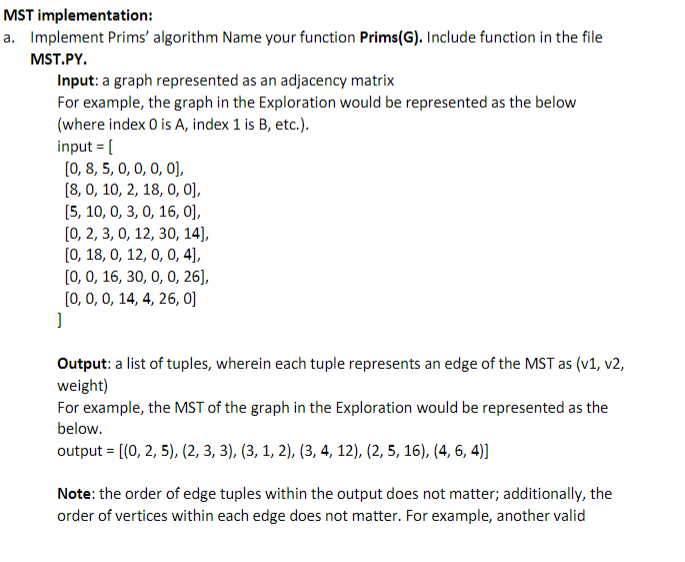

T implementation: Implement Prims' algorithm Name your function Prims(G). Include function in the file MST.PY. Input: a graph represented as an adjacency matrix For example, the graph in the Exploration would be represented as the below (where index 0 is A, index 1 is B, etc.). input=[[0,8,5,0,0,0,0],[8,0,10,2,18,0,0][5,10,0,3,0,16,0],[0,2,3,0,12,30,14],[0,18,0,12,0,0,4][0,0,16,30,0,0,26],[0,0,0,14,4,26,0]] Output: a list of tuples, wherein each tuple represents an edge of the MST as (v1, v2, weight) For example, the MST of the graph in the Exploration would be represented as the below. output=[(0,2,5),(2,3,3),(3,1,2),(3,4,12),(2,5,16),(4,6,4)] Note: the order of edge tuples within the output does not matter; additionally, the order of vertices within each edge does not matter. For example, another valid output would be below (v1 and v2 in the first edge are flip-flopped; the last two edges in the list are flip-flopped). output =[(2,0,5),(2,3,3),(3,1,2),(3,4,12),(4,6,4),(2,5,16)]
Step by Step Solution
There are 3 Steps involved in it

Get step-by-step solutions from verified subject matter experts
 Study Help