







Question: 1. In your own words, state the writers thesis. 2. What method of development does Sykes use in paragraph 2? How do the questions in

1. In your own words, state the writer’s thesis.
2. What method of development does Sykes use in paragraph 2? How do the questions in paragraph one relate to this method? Explain fully Sykes’ purpose in using this method.
3. Identify the figure of speech in each of the following and explain its effect: a) “We all have our own ladders of privacy” (par. 3); b) “Our lives were hedged about by neighbours” (par. 6); c) “Neighbours acted as a ‘chorus of censure’ ” (par. 6); d) “as much a fishbowl as an information highway” (par. 8).
4. The writer’s tone in this passage may be described as thoughtful and analytical. Quote three examples of this tone and explain why each example may be described as thoughtful and analytical.
5. Sykes, in paragraph 10, refers to the “paradox of privacy.” What does he mean by this? What, according to Sykes, are the two paradoxes of privacy? Be sure to use your own words.
6. In what ways, according to Sykes, did privacy in the past differ from privacy today?
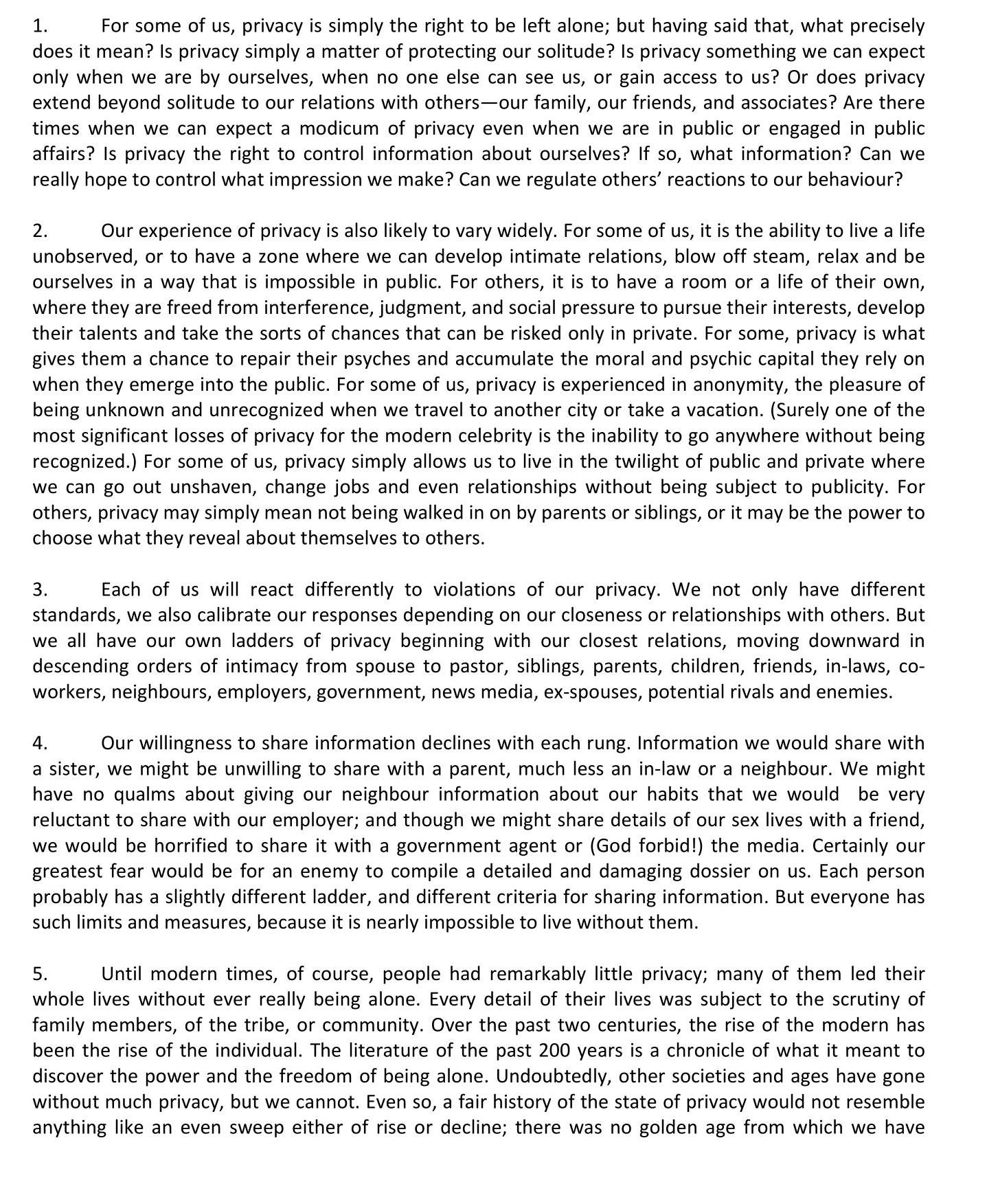
1. For some of us, privacy is simply the right to be left alone; but having said that, what precisely does it mean? Is privacy simply a matter of protecting our solitude? Is privacy something we can expect only when we are by ourselves, when no one else can see us, or gain access to us? Or does privacy extend beyond solitude to our relations with others-our family, our friends, and associates? Are there times when we can expect a modicum of privacy even when we are in public or engaged in public affairs? Is privacy the right to control information about ourselves? If so, what information? Can we really hope to control what impression we make? Can we regulate others reactions to our behaviour? Our experience of privacy is also likely to vary widely. For some of us, it is the ability to live a life unobserved, or to have a zone where we can develop intimate relations, blow off steam, relax and be ourselves in a way that is impossible in public. For others, it is to have a room or a life of their own, where they are freed from interference, judgment, and social pressure to pursue their interests, develop their talents and take the sorts of chances that can be risked only in private. For some, privacy is what gives them a chance to repair their psyches and accumulate the moral and psychic capital they rely on when they emerge into the public. For some of us, privacy is experienced in anonymity, the pleasure of being unknown and unrecognized when we travel to another city or take a vacation. (Surely one of the most significant losses of privacy for the modern celebrity is the inability to go anywhere without being recognized.) For some of us, privacy simply allows us to live in the twilight of public and private where we can go out unshaven, change jobs and even relationships without being subject to publicity. For others, privacy may simply mean not being walked in on by parents or siblings, or it may be the power to choose what they reveal about themselves to others. 2. 3. Each of us will react differently to violations of our privacy. We not only have different standards, we also calibrate our responses depending on our closeness or relationships with others. But we all have our own ladders of privacy beginning with our closest relations, moving downward in descending orders of intimacy from spouse to pastor, siblings, parents, children, friends, in-laws, co- workers, neighbours, employers, government, news media, ex-spouses, potential rivals and enemies. 4. Our willingness to share information declines with each rung. Information we would share with a sister, we might be unwilling to share with a parent, much less an in-law or a neighbour. We might I have no qualms about giving our neighbour information about our habits that we would be very reluctant to share with our employer; and though we might share details of our sex lives with a friend, we would be horrified to share it with a government agent or (God forbid!) the media. Certainly our greatest fear would be for an enemy to compile a detailed and damaging dossier on us. Each person probably has a slightly different ladder, and different criteria for sharing information. But everyone has such limits and measures, because it is nearly impossible to live without them. 5. Until modern times, of course, people had remarkably little privacy; many of them led their whole lives without ever really being alone. Every detail of their lives was subject to the scrutiny of family members, of the tribe, or community. Over the past two centuries, the rise of the modern has been the rise of the individual. The literature of the past 200 years is a chronicle of what it meant to discover the power and the freedom of being alone. Undoubtedly, other societies and ages have gone without much privacy, but we cannot. Even so, a fair history of the state of privacy would not resemble anything like an even sweep either of rise or decline; there was no golden age from which we have fallen. Although we can chronicle the technologies that have enhanced the possibilities of privacy in our lives, every development and milestone has been shadowed by another taking us in quite a different direction. 6. The spread of prosperity, the single-family home, the automobile, the invention of television and computers have all made it possible for us to live private lives unimaginable to previous generations. We no longer live cheek by jowl with our neighbours, we can move about without crowding into buses or trains; our entertainment comes to us virtually one on one; we do not have to go to theatres or share our tastes with our neighbours. Once, our lives were hedged about by neighbours who would watch us nearly as closely as members of our own family; they would be silent-or not so silent-audience to our lives, acting sometimes as a support network, other times as a chorus of censure or unsolicited advice. They knew how we dressed, how we shopped, whom we dated, and the meaning of the various noises and odors coming from our homes. Today, we may not even know their names. Many of us can go through life with only a nodding acquaintance with the people who live around us and even work with us. As Janna Malamud Smith notes, an adult living in a modern suburb is unlikely to have more than a few people who know her across time in different settings. 7. 8. But the account runs parallel to another story: the same technologies that separate us from the crowds also make it possible to monitor and record our behaviours. Although fewer people have intimate knowledge of our lives, many people-mostly unknown to us-know something about us. Here is the rub. The very technology that was supposed to free us from mass society and the conformity of mass media has turned out to be as much a fishbowl as an information highway. In modern society, we have discovered that being free often means also being naked. The same society that allows us to live anonymously relies on surveillance to keep track of us because we are a society of strangers. We can close the blinds on our neighbours, but we have also opened doors to strangers who now know what we eat, what we wear, how we shop, who our doctor is, how much we earn, where we work, what drugs we take, and what we read. 9. Historical comparisons are useful, but also limited because the conditions of privacy in the modern technological world are, in fact, radically different from the challenges it faced in the past. Some critics dismiss concerns about massive commercial databases that track individual purchases and buying habits, by saying that such information was really no different from small-town gossip. But this misses the fundamental difference between being known by neighbours and friends, and being monitored by a faceless database. As intrusive as small-town gossip might have been, it was always shaded by some personal knowledge and connection. Being watched by a neighbour is not at all of the same magnitude as being watched by a bureaucracy, or tracked by a dataweb that misses little and forgets nothing. 10. The second paradox of privacy is that though most of us have far more physical privacy, many of us seem extraordinarily anxious to get rid of that privacy. A man can reasonably expect to be left alone in his home, safe from prying eyes. But that same man can turn on the television set on any given afternoon and find a window into the most graphic, embarrassing details of the lives of others. From The End of Privacy by Charles J. Sykes, St Martin s Press, 1999.
Step by Step Solution
3.48 Rating (164 Votes )
There are 3 Steps involved in it
1 Every one has a different approach to the violaton of their privacy and it is completely depending on the way they are considering their interests on the concept of privacy The invention of technolo... View full answer

Get step-by-step solutions from verified subject matter experts
 Study Help