







Question: do only question 4 What are the pros and cons for a company such as Nike to take on these materials handling services as opposed
do only question 4
What are the pros and cons for a company such as Nike to take on these materials handling services as opposed to leaving them to retail?
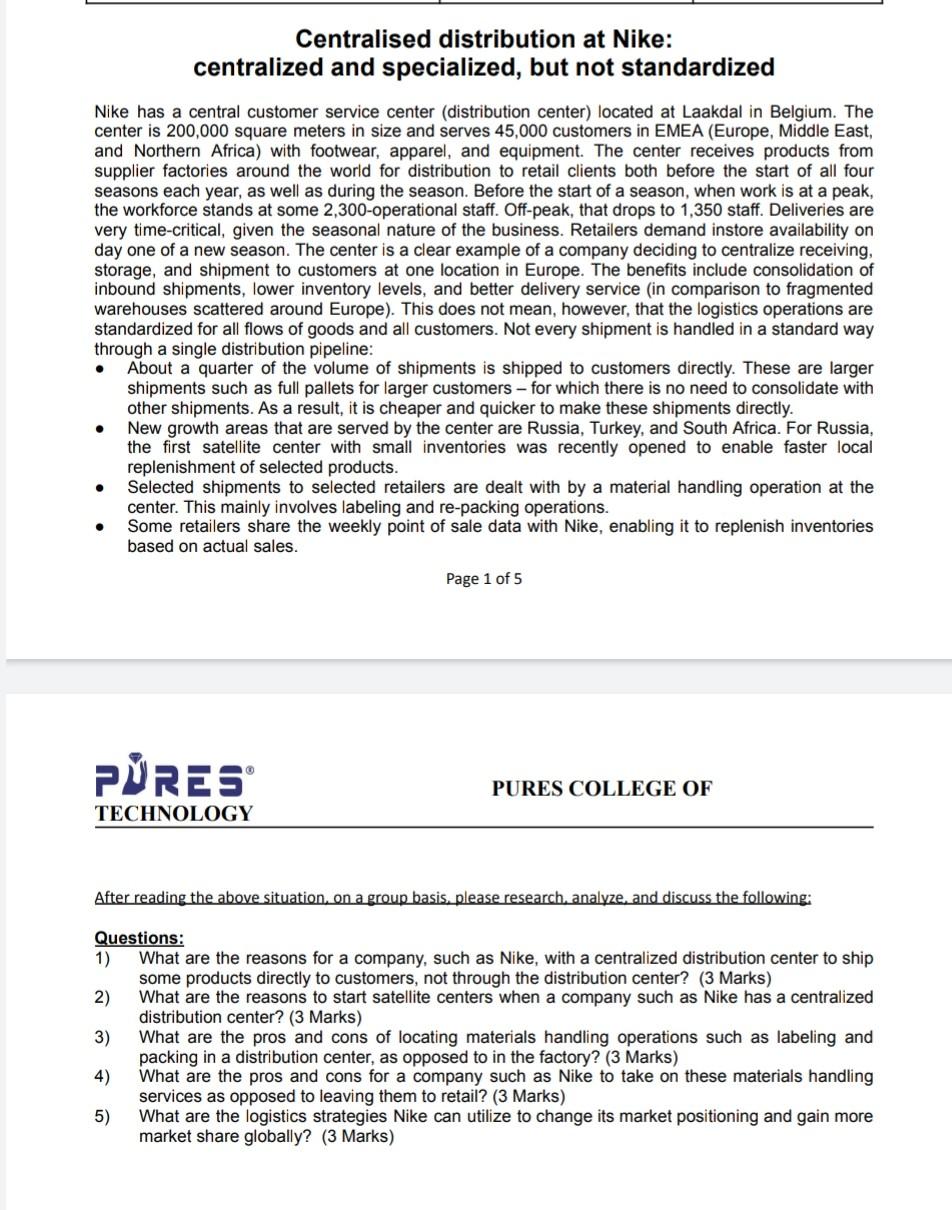
Nike has a central customer service center (distribution center) located at Laakdal in Belgium. The center is 200,000 square meters in size and serves 45,000 customers in EMEA (Europe, Middle East, and Northern Africa) with footwear, apparel, and equipment. The center receives products from supplier factories around the world for distribution to retail clients both before the start of all four seasons each year, as well as during the season. Before the start of a season, when work is at a peak, the workforce stands at some 2,300-operational staff. Off-peak, that drops to 1,350 staff. Deliveries are very time-critical, given the seasonal nature of the business. Retailers demand instore availability on day one of a new season. The center is a clear example of a company deciding to centralize receiving, storage, and shipment to customers at one location in Europe. The benefits include consolidation of inbound shipments, lower inventory levels, and better delivery service (in comparison to fragmented warehouses scattered around Europe). This does not mean, however, that the logistics operations are standardized for all flows of goods and all customers. Not every shipment is handled in a standard way through a single distribution pipeline: About a quarter of the volume of shipments is shipped to customers directly. These are larger shipments such as full pallets for larger customers - for which there is no need to consolidate with other shipments. As a result, it is cheaper and quicker to make these shipments directly. New growth areas that are served by the center are Russia, Turkey, and South Africa. For Russia, the first satellite center with small inventories was recently opened to enable faster local replenishment of selected products. Selected shipments to selected retailers are dealt with by a material handling operation at the center. This mainly involves labeling and re-packing operations. Some retailers share the weekly point of sale data with Nike, enabling it to replenish inventories based on actual sales. Centralised distribution at Nike: centralized and specialized, but not standardized PURES TECHNOLOGY Page 1 of 5 1) 2) 3) 4) 5) PURES COLLEGE OF After reading the above situation, on a group basis, please research, analyze, and discuss the following: Questions: What are the reasons for a company, such as Nike, with a centralized distribution center to ship some products directly to customers, not through the distribution center? (3 Marks) What are the reasons to start satellite centers when a company such as Nike has a centralized distribution center? (3 Marks) What are the pros and cons of locating materials handling operations such as labeling and packing in a distribution center, as opposed to in the factory? (3 Marks) What are the pros and cons for a company such as Nike to take on these materials handling services as opposed to leaving them to retail? (3 Marks) What are the logistics strategies Nike can utilize to change its market positioning and gain more market share globallyStep by Step Solution
There are 3 Steps involved in it
1 Expert Approved Answer
Step: 1 Unlock

Question Has Been Solved by an Expert!
Get step-by-step solutions from verified subject matter experts
Step: 2 Unlock
Step: 3 Unlock
 Study Help