Question: Do this Java Task Urgent in Netbeans 8.2 Part 1: import java.util.*; import java.util.stream.Collectors; public class Filter { public static List apply( List lst, Double
Do this Java Task Urgent in Netbeans 8.2
Part 1:
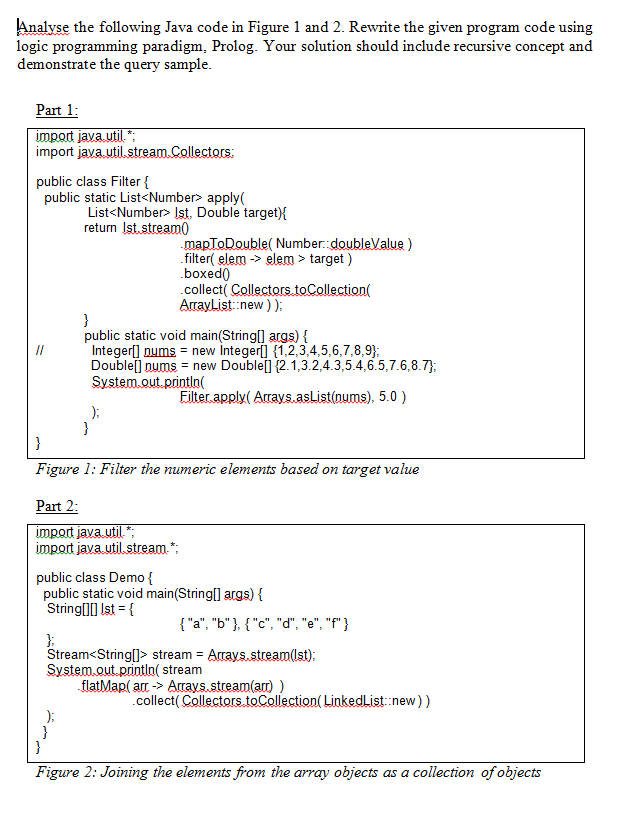
| import java.util.*; import java.util.stream.Collectors; public class Filter { public static List apply( List lst, Double target){ return lst.stream() .mapToDouble( Number::doubleValue ) .filter( elem -> elem > target ) .boxed() .collect( Collectors.toCollection( ArrayList::new ) ); } public static void main(String[] args) { // Integer[] nums = new Integer[] {1,2,3,4,5,6,7,8,9}; Double[] nums = new Double[] {2.1,3.2,4.3,5.4,6.5,7.6,8.7}; System.out.println( Filter.apply( Arrays.asList(nums), 5.0 ) ); } } |
Figure 1: Filter the numeric elements based on target value
Part 2:
| import java.util.*; import java.util.stream.*; public class Demo { public static void main(String[] args) { String[][] lst = { { "a", "b" }, { "c", "d", "e", "f" } }; Stream stream = Arrays.stream(lst); System.out.println( stream .flatMap( arr -> Arrays.stream(arr) ) .collect( Collectors.toCollection( LinkedList::new ) ) ); } } |
Figure 2: Joining the elements from the array objects as a collection of objects
Analyse the following Java code in Figure 1 and 2. Rewrite the given program code using logic programming paradigm. Prolog. Your solution should include recursive concept and demonstrate the query sample. Part 1: import java.util. *; import java.util.stream Collectors: public class Filter { public static List apply List Ist, Double target){ return Ist.stream mapToDouble( Number doubleValue) filter( elem -> elem > target) .boxedo collect( Collectors to Collection ArrayList:new)); } public static void main(String[] args) { // Integer[] nums = new Integer[] {1,2,3,4,5,6,7,8,9}; Double[] nums = new Double[] {2.1, 3.2.4.3,5.4.6.5 7.6,8.7}; System.out.println( Filter.apply( Arrays.asList(nums), 5.0 ) ); } } Figure 1: Filter the numeric elements based on target value Part 2: import java.util.*; import java.util.stream.*; public class Demo public static void main(String[] args) { String[][] Ist = { {"a", "b"}, {"c", "d", "e", "f"} }; Stream stream = Arrays.stream(Ist); System.out.println( stream flatMap(arr-> Arrays.stream(ar)) collect( Collectors to Collection LinkedList-new)) ); } } Figure 2: Joining the elements from the array objects as a collection of objects Analyse the following Java code in Figure 1 and 2. Rewrite the given program code using logic programming paradigm. Prolog. Your solution should include recursive concept and demonstrate the query sample. Part 1: import java.util. *; import java.util.stream Collectors: public class Filter { public static List apply List Ist, Double target){ return Ist.stream mapToDouble( Number doubleValue) filter( elem -> elem > target) .boxedo collect( Collectors to Collection ArrayList:new)); } public static void main(String[] args) { // Integer[] nums = new Integer[] {1,2,3,4,5,6,7,8,9}; Double[] nums = new Double[] {2.1, 3.2.4.3,5.4.6.5 7.6,8.7}; System.out.println( Filter.apply( Arrays.asList(nums), 5.0 ) ); } } Figure 1: Filter the numeric elements based on target value Part 2: import java.util.*; import java.util.stream.*; public class Demo public static void main(String[] args) { String[][] Ist = { {"a", "b"}, {"c", "d", "e", "f"} }; Stream stream = Arrays.stream(Ist); System.out.println( stream flatMap(arr-> Arrays.stream(ar)) collect( Collectors to Collection LinkedList-new)) ); } } Figure 2: Joining the elements from the array objects as a collection of objects









 Study Help