







Question: Do this problem in Racket. Can someone also please explain how to solve this problem? Suppose you are located at the seashore looking out over
Do this problem in Racket.
Can someone also please explain how to solve this problem?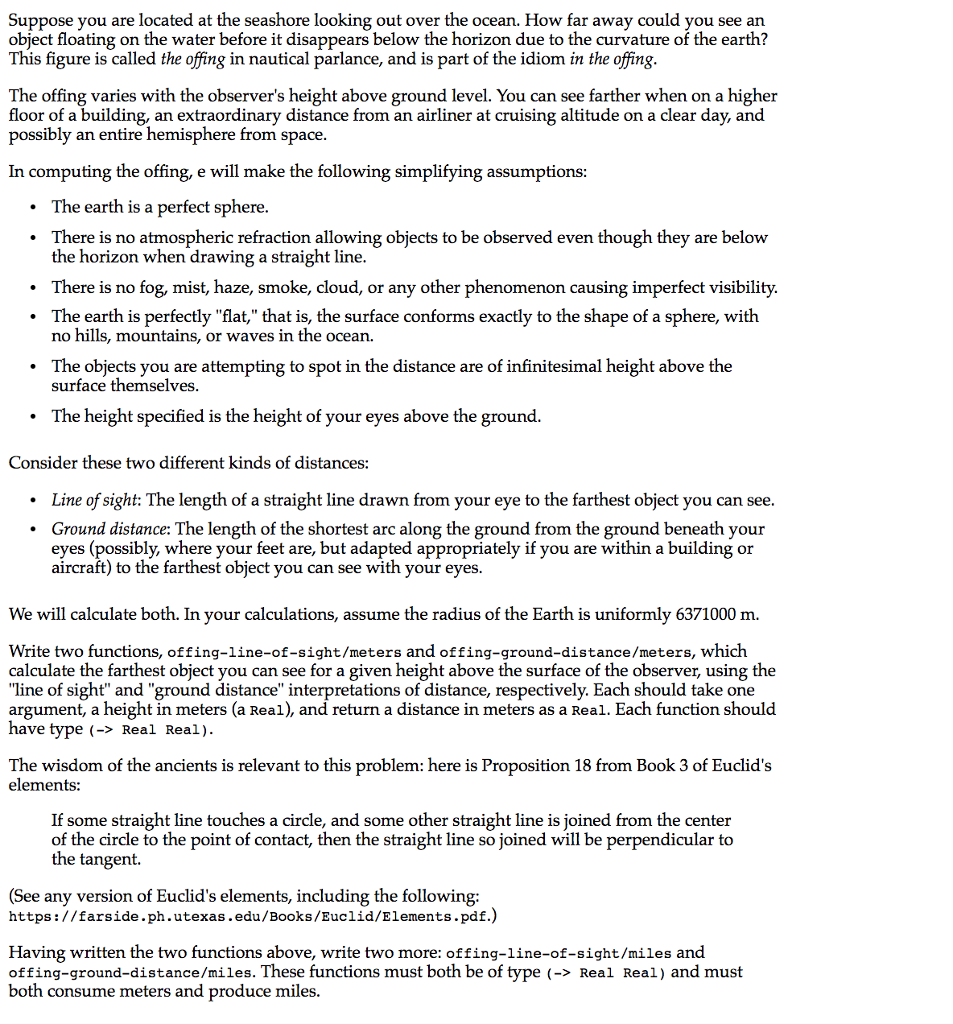
Suppose you are located at the seashore looking out over the ocean. How far away could you see an object floating on the water before it disappears below the horizon due to the curvature of the earth? This figure is called the offing in nautical parlance, and is part of the idiom in the offing possibly an entire henextraordinary distance frore You can In computing the offing, e will make the following simplifying assumptions The offing varies with the observer's height above ground level. You can see farther when on a higher floor of a building, an extraordinary distance from an airliner at cruising altitude on a clear day, and possibly an entire hemisphere from space The earth is a perfect sphere There is no atmospheric refraction allowing objects to be observed even though they are below the horizon when drawing a straight line There is no fog, mist, haze, smoke, cloud, or any other phenomenon causing imperfect visibility no hills, mountains, or waves in the ocean. The objects you are attempting to spot in the distance are of infinitesimal height above the .The earth is perfectly "flat," that is, the surface conforms exactly to the shape of a sphere, with surface themselves The height specified is the height of your eyes above the ground Consider these two different kinds of distances: Line of sight: The length of a straight line drawn from your eye to the farthest object you can see Ground distance: The length of the shortest arc along the ground from the ground beneath your eyes (possibly, where your feet are, but adapted appropriately if you are within a building or aircraft) to the farthest object you can see with your eyes We will calculate both. In your calculations, assume the radius of the Earth is uniformly 6371000 m. Write two functions, offing-line-of-sight/meters and offing-ground-distance/meters, which calculate the farthest object you can see for a given height above the surface of the observer, using the "line of sight" and "ground distance" interpretations of distance, respectively. Each should take one argument, a height in meters (a Real), and return a distance in meters as a Real. Each function should have type (-> Real Real). The wisdom of the ancients is relevant to this problem: here is Proposition 18 from Book 3 of Euclid's elements: If some straight line touches a circle, and some other straight line is joined from the center of the circle to the point of contact, then the straight line so joined will be perpendicular to the tangent. (See any version of Euclid's elements, including the following: https://farside.ph.utexas.edu/Books/Euclid/Elements.pdf.) Having written the two functions above, write two more: offing-line-of-sight/miles and offing-ground-distance/miles. These functions must both be of type (-> Real Real) and must both consume meters and produce miles
Step by Step Solution
There are 3 Steps involved in it

Get step-by-step solutions from verified subject matter experts
 Study Help