







Question: do you agree with the point or the counterpoint? and why? Employer-Employee Loyalty Is an Outdated Concept COUNTERPOINT POINT geed. the word loyaty is outdated
do you agree with the point or the counterpoint? and why? 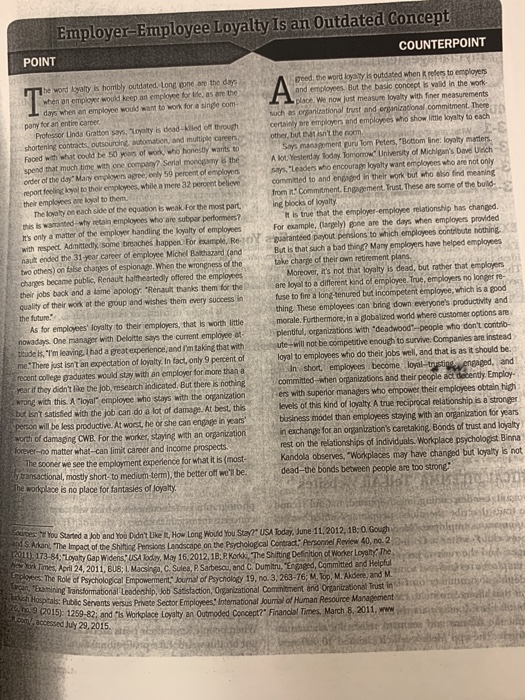
Employer-Employee Loyalty Is an Outdated Concept COUNTERPOINT POINT geed. the word loyaty is outdated when k refers to employers and employees. But the basic concept is valid in the work- place We now just measure lovalty with finer measunrements such as organizational trust and erganizational.commitment. There certainly bre employers and employees who show little loyalty to each The word Ayalty is hombly outdated. Long gone are the days when an emplover would keep an employee for lide, as am the days when an emplovee would want to work for a singe com- pany for an entire career Professor Linda Gratton says, "Loyalty is dead kled off throush shortening contracts, outsourcing, automation, and multiple careers Faoed with what could be 50 mas of work who honestly warits to spend that much time with one company? Serial monogamy is the order of the day Many emplovers agree only 59 percent of emolows report feeling koyal to their employees, while a mere 32 peroent believe their emploes are loyal to them The lovalty on each side of the equation is weak For the most part. his is wamanted-why retain employees who are subpar perfomers? It's only a matter of the employer handling the loyalty of employees with respect. Admittedhy some breaches happen. For example, Re-0 nault ended the 31-year career of employee Michel Balthazard (and two others) on false changes of espionage. When the wrongness of the changes became public, Renault haltheartedly offered the emplovees their jobs back and a lame apology: "Renault thanks them for the quality of their work at the goup and wishes them every sUccess in other, but that isn't the norm. Says management guru Tom Peters, "Bottom line: loyalty matters. A lotYesterday foday. TomorOw University of Michigan's Dave Urich says, "Leaders who encourage loyalty want employees who are not only commited to and engaged in their work but who also find meaning from it Commitment. Engagement. Trust. These are some of the build- ing blocks of loyalty t is true that the employer-employee relationship has changed. For example, (largely) gone are the days when employers provided puaranted payout pensions to which employees contribute nothing But is that such a bad thing? Many employers have helped employees take charge of their own retirement plans. Moreover, it's not that loyalty is dead, but rather that employers are loyal to a different kind of employee. True, employers no longer re- fuse to fire a long-tenured but incompetent employee, which is a good thing These employees can bring down everyone's productivity and morale, Furthermore, in a globalized world where customer options are the future" As for emplovees' loyalty to their employers, that is worth little nowadays. One manager with Deloitte says the current employee at ttude is, "I'm leaving, Ihad a great experience, and l'm taking that with me There just isn't an expectation of loyalty In fact, only 9 percent of plentiful, organizations with "deadwood-people who don't contrib- ute-will not be competitive enough to surviive. Companies are instead loyal to employees who do their jobs well, and that is as it should be. san short, employees become loyal-trusting engaged, and committed when organizations and their people act decently. Employ- ers with superlor managers who empower their employees obtain high levels of this kind of loyalty A true reciprocal relationship is a stronger Erecent college gaduates would stay with an employer for more than a year if they didn't like the job research indicated. But there is nothing NTong with this. A "loyal" employee who stays with the onganization but isnt satisfied with the job can do a lot of damage. At best, this person will be less productive. At wost, he or she can engnge in years orth of damaging CWB. For the worker, staying with an organitation Lorever-no matter what-can limit career and income prospects. business model than emplovees staving with an organiration for years in exchange for an organization's caretaking. Bonds of trust and loyalty rest on the relationships of individuals. Workplace psychologist Binna Kandola observes, "Workplaces may have changed but loyalty is not dead-the bonds between people are too strong The sooner we see the employment experience for what it is (most- y.transactional, mostly short-to medium-term), the better off we'll be. he workplace is no place for fantasies of loyalty. beYou Started a Job'and You Didn't Like t, How Long Would You Stay? USA Today, June 11,2012, 18: 0. Gough S Akani, The Impact of the Shitiog Pensions Landscape on the Psychological Contract Aersonnel Review 40, no. 2 AU173-84: "Loyaty Gap Widens ISA Taday. May 16.2012.18: P Kord The Shifting Definltion of Worker Loyalty The mes, April 24, 2011. BUS: L Macsingn. C. Sulea. P Sarbesau, and C. Dumitru. "Engaged, Committed and Helpful The Role of Psychological Empowerment, Journal of Psychology 19, no. 3, 263-76; M. Top, M. Akdere, and M. "bamining lanstormational Leadeship, Job Satistaction, Organizational Commitment and Organizational Trust in Hospitals: Public Servents versus Prvete Sector Employees International Jourmal of Human Resource Management 2015): 1259-82; and fis Workolace Lovalty an Outmoded Concept?" Financlal Times, March 8, 2011, www 2 coessed uy 29, 2015
Step by Step Solution
There are 3 Steps involved in it
1 Expert Approved Answer
Step: 1 Unlock

Question Has Been Solved by an Expert!
Get step-by-step solutions from verified subject matter experts
Step: 2 Unlock
Step: 3 Unlock
 Study Help