







Question: Do you agree with the result in this case? Why or why not? Make sure to make a LEGAL argument to back your opinion (you

Do you agree with the result in this case? Why or why not? Make sure to make a LEGAL argument to back your opinion (you might want to contrast what the Court of Appeal says as quoted in paragraphs above 12 -14 and 28 and look at paragraph 29 where Wilson, J. disagrees rather strongly with their conclusion) PLEASE ANSWER ASAP, THANK YOU SO MUCH
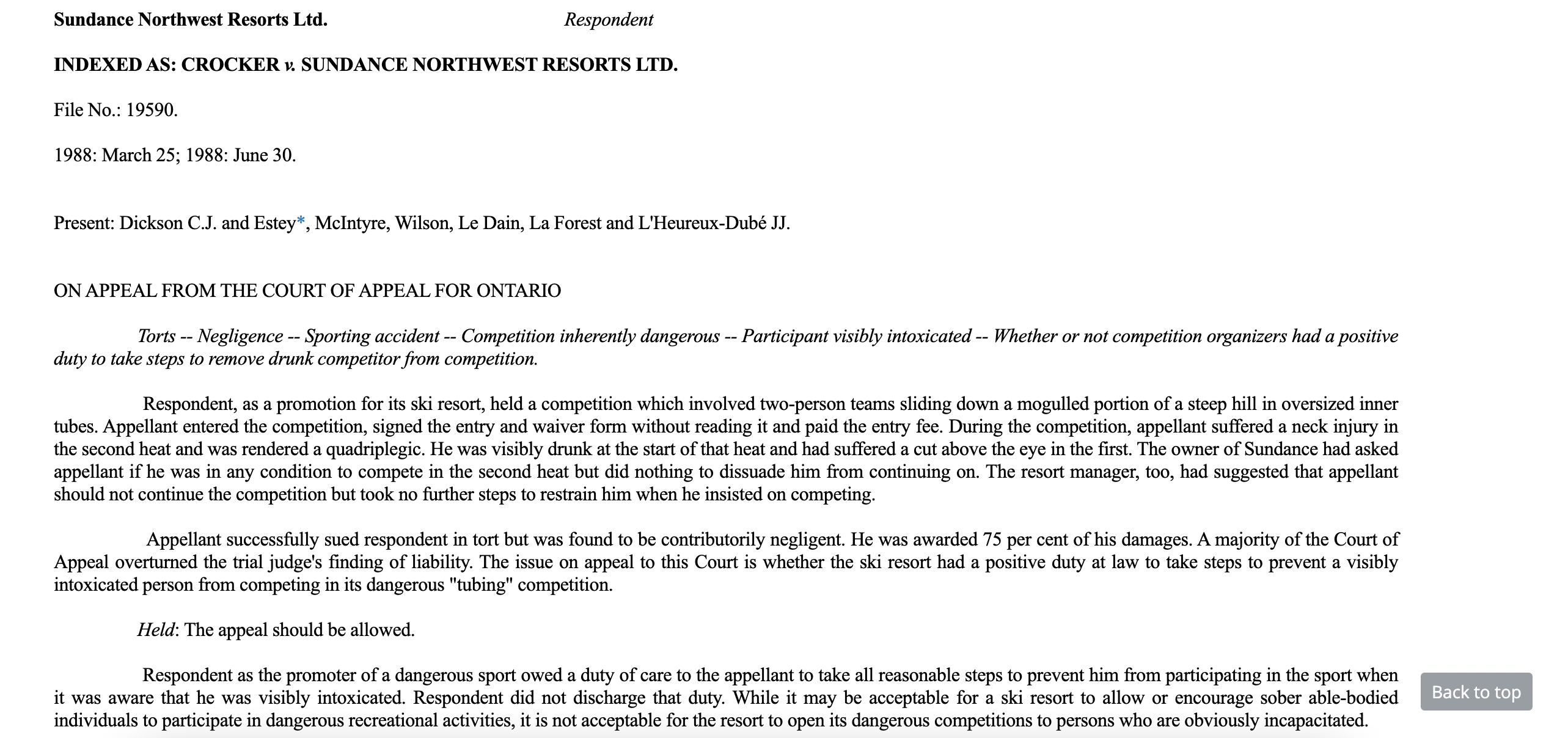
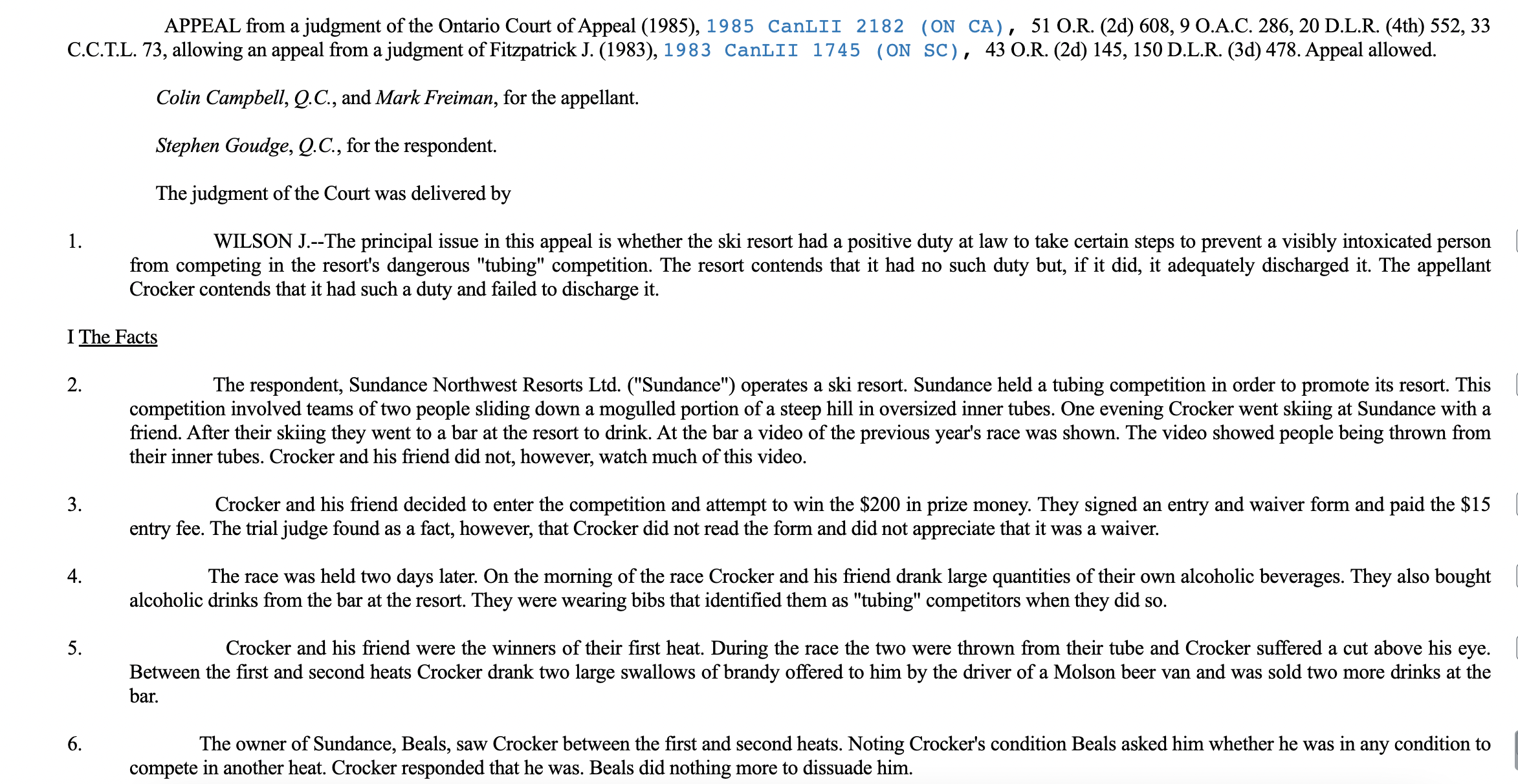
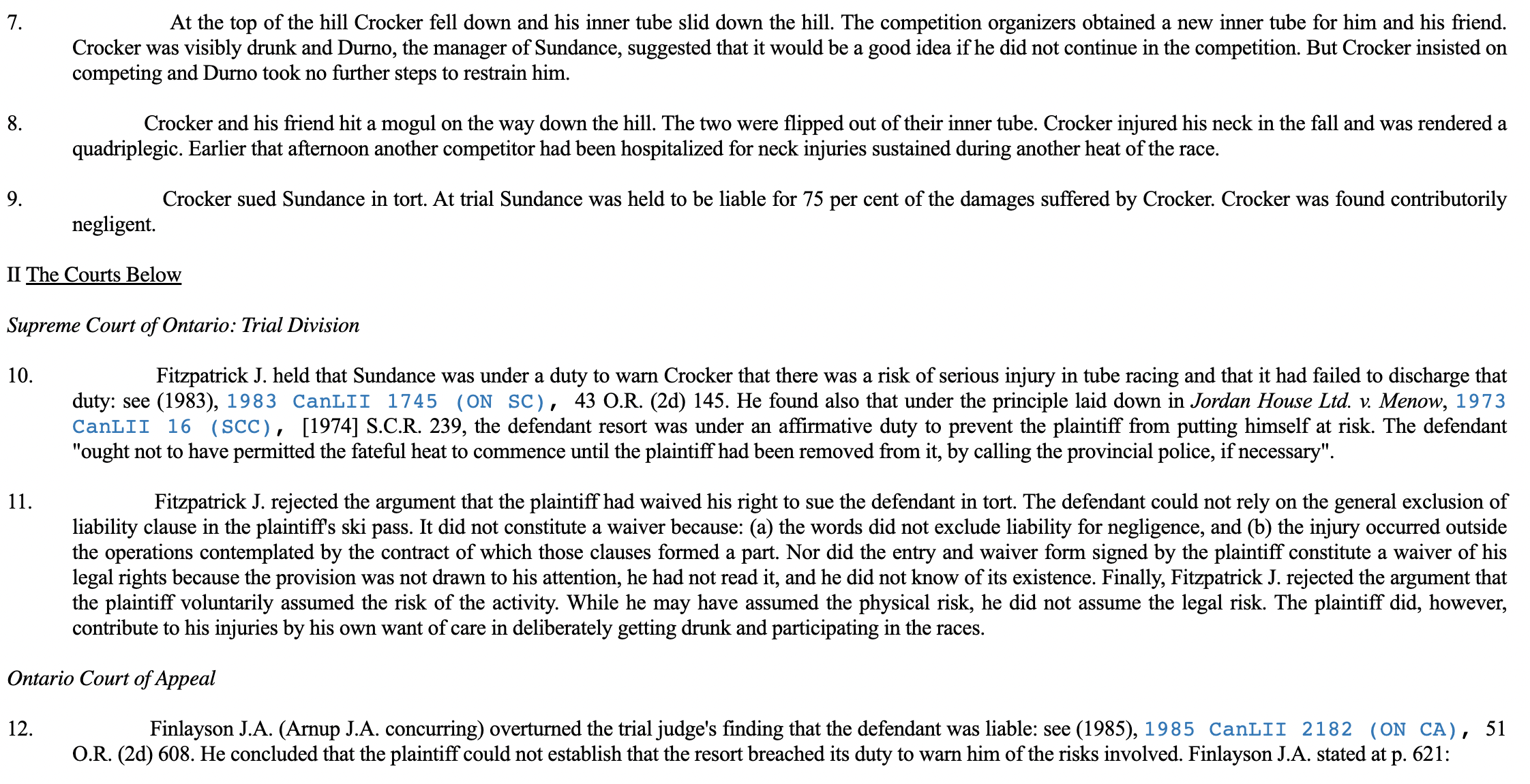
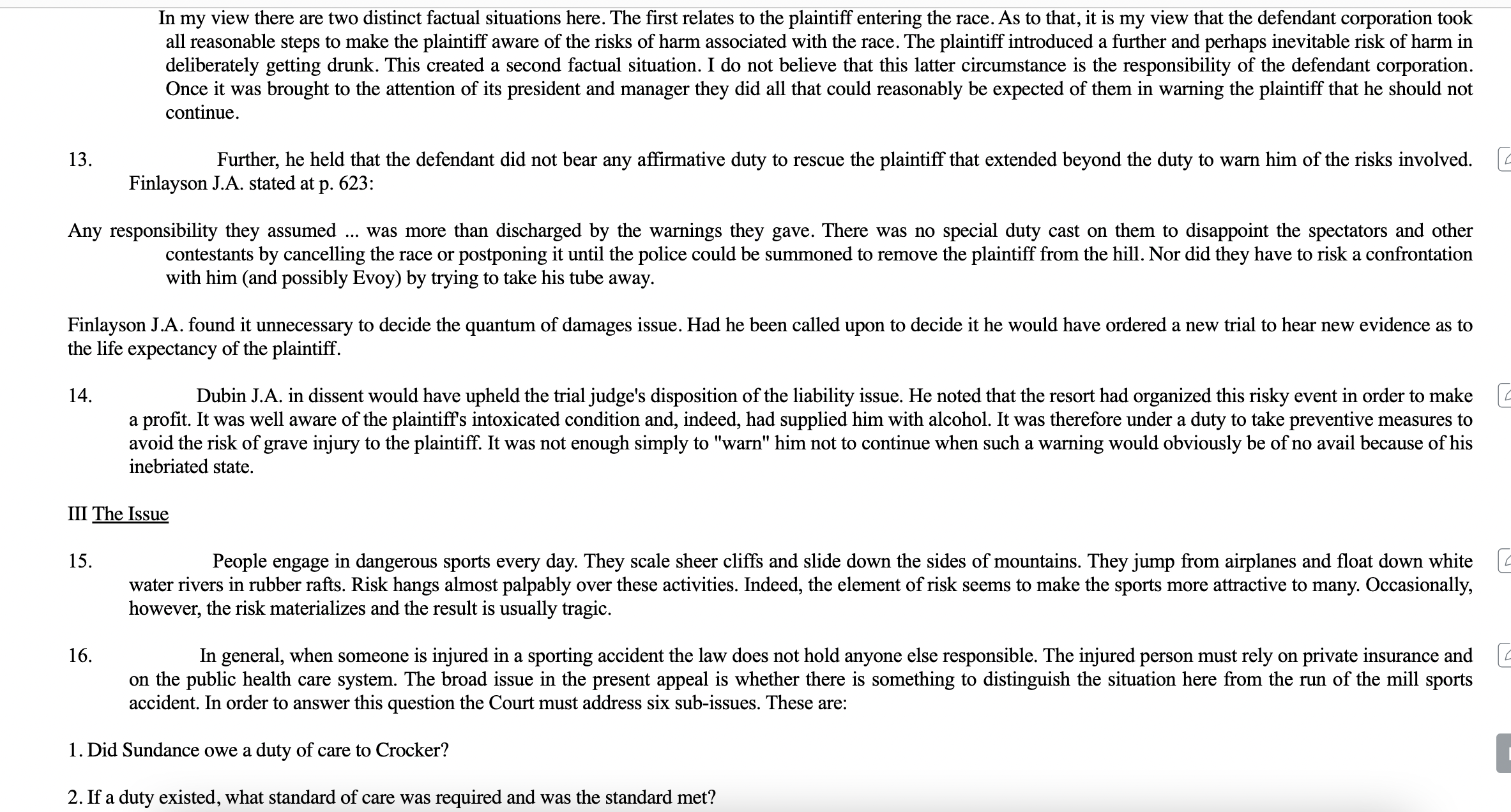
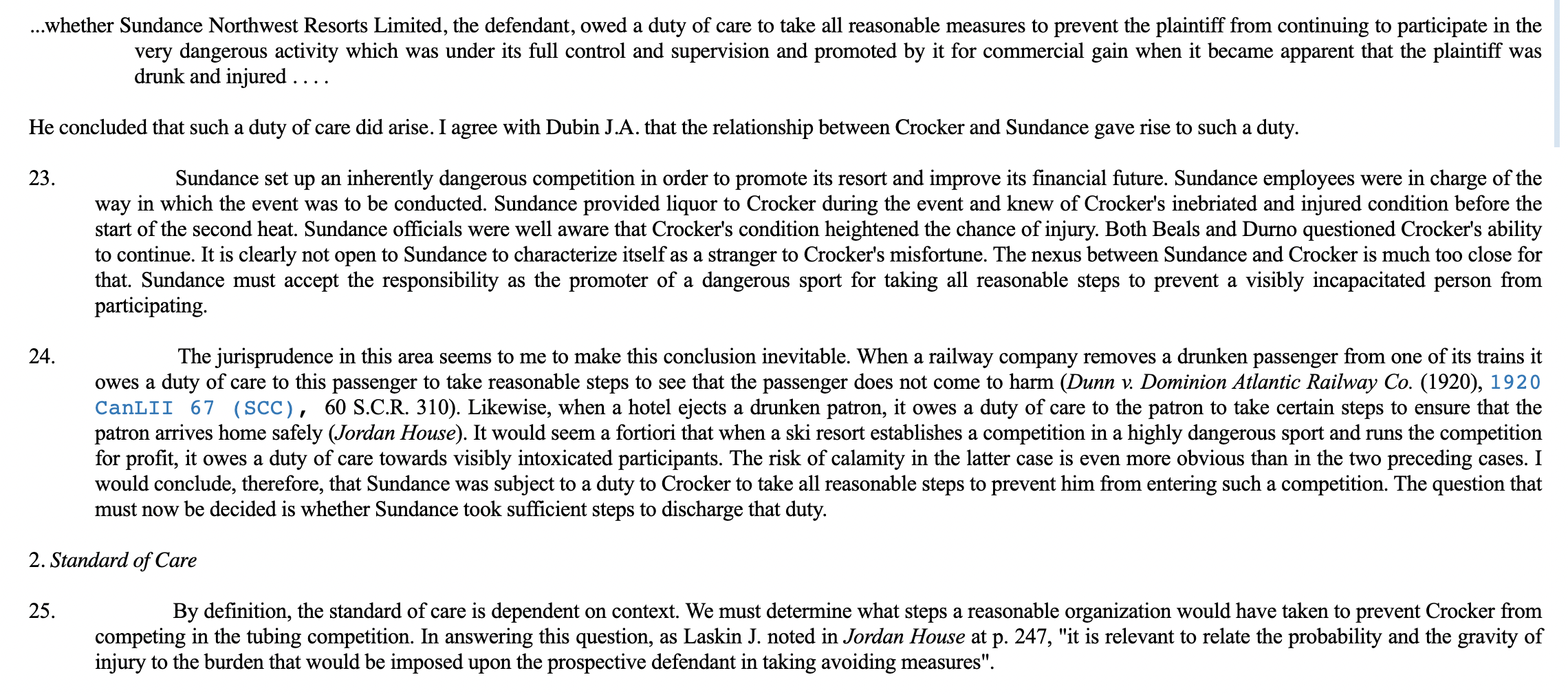
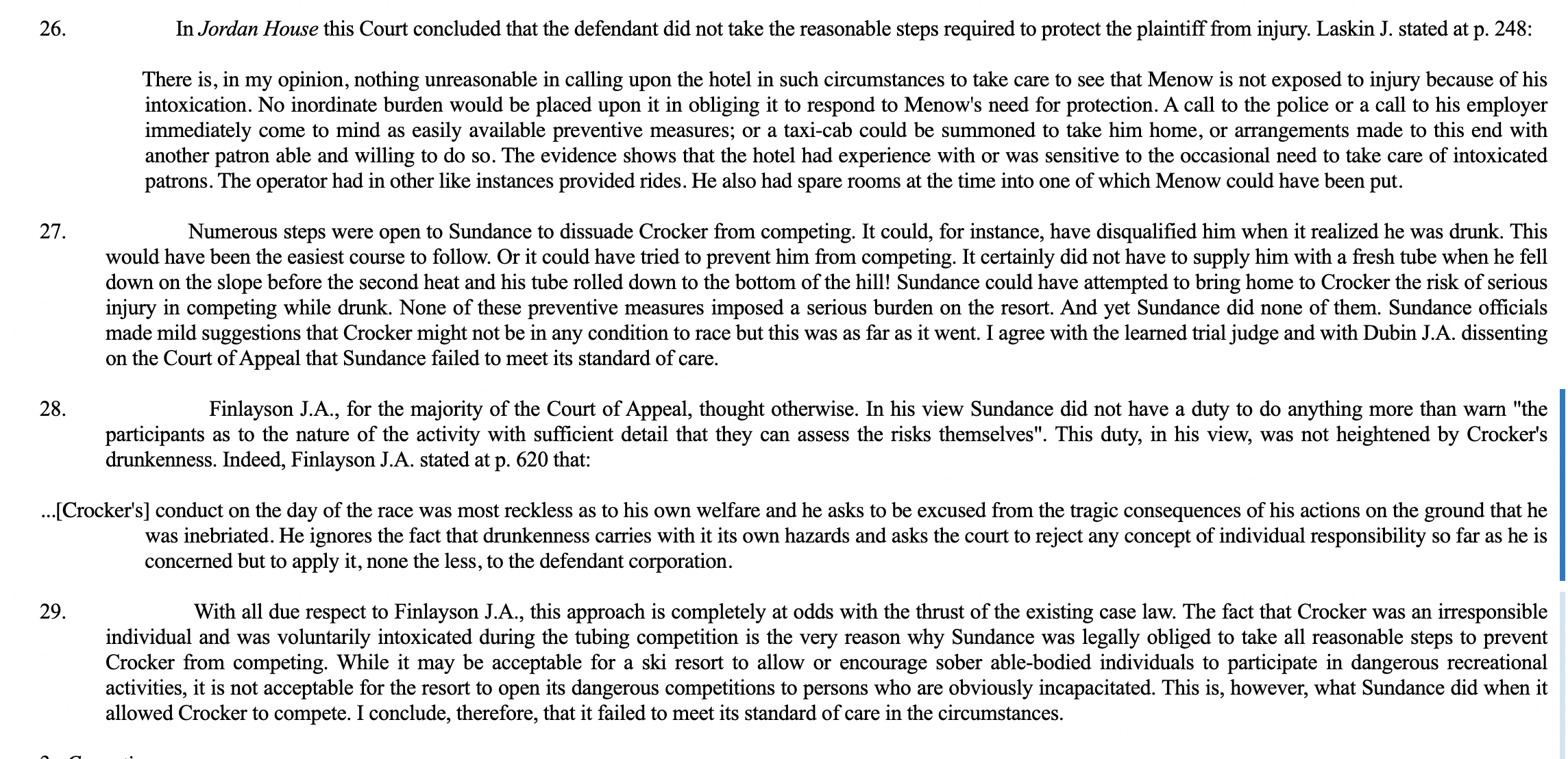
Sundance Northwest Resorts Ltd. Respondent INDEXED AS: CROCKER v. SUNDANCE NORTHWEST RESORTS LTD. File No.: 19590 . 1988: March 25; 1988: June 30. Present: Dickson C.J. and Estey*, McIntyre, Wilson, Le Dain, La Forest and L'Heureux-Dub JJ. ON APPEAL FROM THE COURT OF APPEAL FOR ONTARIO Torts -- Negligence -- Sporting accident -- Competition inherently dangerous -- Participant visibly intoxicated -- Whether or not competition organizers had a positive duty to take steps to remove drunk competitor from competition. Respondent, as a promotion for its ski resort, held a competition which involved two-person teams sliding down a mogulled portion of a steep hill in oversized inner tubes. Appellant entered the competition, signed the entry and waiver form without reading it and paid the entry fee. During the competition, appellant suffered a neck injury in the second heat and was rendered a quadriplegic. He was visibly drunk at the start of that heat and had suffered a cut above the eye in the first. The owner of Sundance had asked appellant if he was in any condition to compete in the second heat but did nothing to dissuade him from continuing on. The resort manager, too, had suggested that appellant should not continue the competition but took no further steps to restrain him when he insisted on competing. Appellant successfully sued respondent in tort but was found to be contributorily negligent. He was awarded 75 per cent of his damages. A majority of the Court of Appeal overturned the trial judge's finding of liability. The issue on appeal to this Court is whether the ski resort had a positive duty at law to take steps to prevent a visibly intoxicated person from competing in its dangerous "tubing" competition. Held: The appeal should be allowed. Respondent as the promoter of a dangerous sport owed a duty of care to the appellant to take all reasonable steps to prevent him from participating in the sport when it was aware that he was visibly intoxicated. Respondent did not discharge that duty. While it may be acceptable for a ski resort to allow or encourage sober able-bodied individuals to participate in dangerous recreational activities, it is not acceptable for the resort to open its dangerous competitions to persons who are obviously incapacitated. Injury to the appellant was clearly foreseeable in this case and respondent's failure to take reasonable steps to prevent appellant from competing because he was drunk caused appellant's injury. Appellant did not, either by word or conduct, voluntarily assume the legal risk involved in competing. The volenti defence, therefore, was inapplicable. Appellant's participation in the tubing competition did not amount to an assumption of the physical risks involved, let alone the legal risks, given that appellant's mind was clouded by alcohol at the time. Although a contractual waiver clause can serve as a full defence to a claim in tort, the waiver signed by appellant did not relieve respondent of liability for its negligent conduct because it had not been drawn to appellant's attention and had not been read by him. The trial judge's conclusion with respect to contributory negligence was not challenged and should not be interfered with by this Court. APPEAL from a judgment of the Ontario Court of Appeal (1985), 1985 CanLII 2182 (ON CA), 51 O.R. (2d) 608, 9 O.A.C. 286, 20 D.L.R. (4th) 552, 33 C.C.T.L. 73, allowing an appeal from a judgment of Fitzpatrick J. (1983), 1983 CanLII 1745 (ON SC), 43 O.R. (2d) 145, 150 D.L.R. (3d) 478. Appeal allowed. Colin Campbell, Q.C., and Mark Freiman, for the appellant. Stephen Goudge, Q.C., for the respondent. The judgment of the Court was delivered by 1. WILSON J.--The principal issue in this appeal is whether the ski resort had a positive duty at law to take certain steps to prevent a visibly intoxicated person from competing in the resort's dangerous "tubing" competition. The resort contends that it had no such duty but, if it did, it adequately discharged it. The appellant Crocker contends that it had such a duty and failed to discharge it. I The Facts 2. The respondent, Sundance Northwest Resorts Ltd. ("Sundance") operates a ski resort. Sundance held a tubing competition in order to promote its resort. This a two people sliding down a mogulled portion of a steep hill in oversized inner tubes. One evening Crocker went skiing at Sundance with a friend. After their skiing they went to a bar at the resort to drink. At the bar a video of the previous year's race was shown. The video showed people being thrown from their inner tubes. Crocker and his friend did not, however, watch much of this video. 3. 4. 5. Crocker and his friend were the winners of their first heat. During the race the two were thrown from their tube and Crocker suffered a cut above his eye. Between the first and second heats Crocker drank two large swallows of brandy offered to him by the driver of a Molson beer van and was sold two more drinks at the bar. 6. The owner of Sundance, Beals, saw Crocker between the first and second heats. Noting Crocker's condition Beals asked him whether he was in any condition to compete in another heat. Crocker responded that he was. Beals did nothing more to dissuade him. At the top of the hill Crocker fell down and his inner tube slid down the hill. The competition organizers obtained a new inner tube for him and his friend. Crocker was visibly drunk and Durno, the manager of Sundance, suggested that it would be a good idea if he did not continue in the competition. But Crocker insisted on competing and Durno took no further steps to restrain him. Crocker and his friend hit a mogul on the way down the hill. The two were flipped out of their inner tube. Crocker injured his neck in the fall and was rendered a quadriplegic. Earlier that afternoon another competitor had been hospitalized for neck injuries sustained during another heat of the race. Crocker sued Sundance in tort. At trial Sundance was held to be liable for 75 per cent of the damages suffered by Crocker. Crocker was found contributorily negligent. II The Courts Below Supreme Court of Ontario: Trial Division 10. Fitzpatrick J. held that Sundance was under a duty to warn Crocker that there was a risk of serious injury in tube racing and that it had failed to discharge that duty: see (1983), 1983 CanLII 1745 (ON SC), 43 O.R. (2d) 145. He found also that under the principle laid down in Jordan House Ltd. v. Menow, 1973 CanLII 16 (SCC), [1974] S.C.R. 239, the defendant resort was under an affirmative duty to prevent the plaintiff from putting himself at risk. The defendant "ought not to have permitted the fateful heat to commence until the plaintiff had been removed from it, by calling the provincial police, if necessary". Fitzpatrick J. rejected the argument that the plaintiff had waived his right to sue the defendant in tort. The defendant could not rely on the general exclusion of liability clause in the plaintiff's ski pass. It did not constitute a waiver because: (a) the words did not exclude liability for negligence, and (b) the injury occurred outside the operations contemplated by the contract of which those clauses formed a part. Nor did the entry and waiver form signed by the plaintiff constitute a waiver of his legal rights because the provision was not drawn to his attention, he had not read it, and he did not know of its existence. Finally, Fitzpatrick J. rejected the argument that the plaintiff voluntarily assumed the risk of the activity. While he may have assumed the physical risk, he did not assume the legal risk. The plaintiff did, however, contribute to his injuries by his own want of care in deliberately getting drunk and participating in the races. Ontario Court of Appeal 12. Finlayson J.A. (Arnup J.A. concurring) overturned the trial judge's finding that the defendant was liable: see (1985), 1985 CanLII 2182 (ON CA) , 51 O.R. (2d) 608 . He concluded that the plaintiff could not establish that the resort breached its duty to warn him of the risks involved. Finlayson J.A. stated at p. 621 : In my view there are two distinct factual situations here. The first relates to the plaintiff entering the race. As to that, it is my view that the defendant corporation took all reasonable steps to make the plaintiff aware of the risks of harm associated with the race. The plaintiff introduced a further and perhaps inevitable risk of harm in deliberately getting drunk. This created a second factual situation. I do not believe that this latter circumstance is the responsibility of the defendant corporation. Once it was brought to the attention of its president and manager they did all that could reasonably be expected of them in warning the plaintiff that he should not continue. 13. Further, he held that the defendant did not bear any affirmative duty to rescue the plaintiff that extended beyond the duty to warn him of the risks involved. Finlayson J.A. stated at p. 623: Any responsibility they assumed ... was more than discharged by the warnings they gave. There was no special duty cast on them to disappoint the spectators and other contestants by cancelling the race or postponing it until the police could be summoned to remove the plaintiff from the hill. Nor did they have to risk a confrontation with him (and possibly Evoy) by trying to take his tube away. Finlayson J.A. found it unnecessary to decide the quantum of damages issue. Had he been called upon to decide it he would have ordered a new trial to hear new evidence as to the life expectancy of the plaintiff. 14. Dubin J.A. in dissent would have upheld the trial judge's disposition of the liability issue. He noted that the resort had organized this risky event in order to make a profit. It was well aware of the plaintiff's intoxicated condition and, indeed, had supplied him with alcohol. It was therefore under a duty to take preventive measures to avoid the risk of grave injury to the plaintiff. It was not enough simply to "warn" him not to continue when such a warning would obviously be of no avail because of his inebriated state. III The Issue 15. People engage in dangerous sports every day. They scale sheer cliffs and slide down the sides of mountains. They jump from airplanes and float down white water rivers in rubber rafts. Risk hangs almost palpably over these activities. Indeed, the element of risk seems to make the sports more attractive to many. Occasionally, however, the risk materializes and the result is usually tragic. 16. In general, when someone is injured in a sporting accident the law does not hold anyone else responsible. The injured person must rely on private insurance and on the public health care system. The broad issue in the present appeal is whether there is something to distinguish the situation here from the run of the mill sports accident. In order to answer this question the Court must address six sub-issues. These are: 1. Did Sundance owe a duty of care to Crocker? 2. If a duty existed, what standard of care was required and was the standard met? ...whether Sundance Northwest Resorts Limited, the defendant, owed a duty of care to take all reasonable measures to prevent the plaintiff from continuing to participate in the very dangerous activity which was under its full control and supervision and promoted by it for commercial gain when it became apparent that the plaintiff was drunk and injured ... He concluded that such a duty of care did arise. I agree with Dubin J.A. that the relationship between Crocker and Sundance gave rise to such a duty. 53. Sundance set up an inherently dangerous competition in order to promote its resort and improve its financial future. Sundance employees were in charge of the way in which the event was to be conducted. Sundance provided liquor to Crocker during the event and knew of Crocker's inebriated and injured condition before the start of the second heat. Sundance officials were well aware that Crocker's condition heightened the chance of injury. Both Beals and Durno questioned Crocker's ability to continue. It is clearly not open to Sundance to characterize itself as a stranger to Crocker's misfortune. The nexus between Sundance and Crocker is much too close for that. Sundance must accept the responsibility as the promoter of a dangerous sport for taking all reasonable steps to prevent a visibly incapacitated person from participating. 54. The jurisprudence in this area seems to me to make this conclusion inevitable. When a railway company removes a drunken passenger from one of its trains it owes a duty of care to this passenger to take reasonable steps to see that the passenger does not come to harm (Dunn v. Dominion Atlantic Railway Co. (1920), 1920 CanLII 67 (SCC), 60 S.C.R. 310). Likewise, when a hotel ejects a drunken patron, it owes a duty of care to the patron to take certain steps to ensure that the patron arrives home safely (Jordan House). It would seem a fortiori that when a ski resort establishes a competition in a highly dangerous sport and runs the competition for profit, it owes a duty of care towards visibly intoxicated participants. The risk of calamity in the latter case is even more obvious than in the two preceding cases. I would conclude, therefore, that Sundance was subject to a duty to Crocker to take all reasonable steps to prevent him from entering such a competition. The question that must now be decided is whether Sundance took sufficient steps to discharge that duty. 2. Standard of Care By definition, the standard of care is dependent on context. We must determine what steps a reasonable organization would have taken to prevent Crocker from competing in the tubing competition. In answering this question, as Laskin J. noted in Jordan House at p. 247, "it is relevant to relate the probability and the gravity of injury to the burden that would be imposed upon the prospective defendant in taking avoiding measures". 26. In Jordan House this Court concluded that the defendant did not take the reasonable steps required to protect the plaintiff from injury. Laskin J. stated at p. 248: There is, in my opinion, nothing unreasonable in calling upon the hotel in such circumstances to take care to see that Menow is not exposed to injury because of his intoxication. No inordinate burden would be placed upon it in obliging it to respond to Menow's need for protection. A call to the police or a call to his employer immediately come to mind as easily available preventive measures; or a taxi-cab could be summoned to take him home, or arrangements made to this end with another patron able and willing to do so. The evidence shows that the hotel had experience with or was sensitive to the occasional need to take care of intoxicated patrons. The operator had in other like instances provided rides. He also had spare rooms at the time into one of which Menow could have been put. Numerous steps were open to Sundance to dissuade Crocker from competing. It could, for instance, have disqualified him when it realized he was drunk. This would have been the easiest course to follow. Or it could have tried to prevent him from competing. It certainly did not have to supply him with a fresh tube when he fell down on the slope before the second heat and his tube rolled down to the bottom of the hill! Sundance could have attempted to bring home to Crocker the risk of serious injury in competing while drunk. None of these preventive measures imposed a serious burden on the resort. And yet Sundance did none of them. Sundance officials made mild suggestions that Crocker might not be in any condition to race but this was as far as it went. I agree with the learned trial judge and with Dubin J.A. dissenting on the Court of Appeal that Sundance failed to meet its standard of care. 28. Finlayson J.A., for the majority of the Court of Appeal, thought otherwise. In his view Sundance did not have a duty to do anything more than warn "the participants as to the nature of the activity with sufficient detail that they can assess the risks themselves". This duty, in his view, was not heightened by Crocker's drunkenness. Indeed, Finlayson J.A. stated at p. 620 that: ...[Crocker's] conduct on the day of the race was most reckless as to his own welfare and he asks to be excused from the tragic consequences of his actions on the ground that he was inebriated. He ignores the fact that drunkenness carries with it its own hazards and asks the court to reject any concept of individual responsibility so far as he is concerned but to apply it, none the less, to the defendant corporation. 29. With all due respect to Finlayson J.A., this approach is completely at odds with the thrust of the existing case law. The fact that Crocker was an irresponsible individual and was voluntarily intoxicated during the tubing competition is the very reason why Sundance was legally obliged to take all reasonable steps to prevent Crocker from competing. While it may be acceptable for a ski resort to allow or encourage sober able-bodied individuals to participate in dangerous recreational activities, it is not acceptable for the resort to open its dangerous competitions to persons who are obviously incapacitated. This is, however, what Sundance did when it allowed Crocker to compete. I conclude, therefore, that it failed to meet its standard of care in the circumstances
Step by Step Solution
There are 3 Steps involved in it

Get step-by-step solutions from verified subject matter experts
 Study Help