Question: .Do you think diversity training is effective? If so, what about it makes it effective? If not what would you do to improve diversity outcomes
.Do you think diversity training is effective? If so, what about it makes it effective? If not what would you do to improve diversity outcomes in organizations?
. If you were to develop your own diversity training plan for an organization, what you would you do? What parts of the training plan do you think would have to be present for it to work
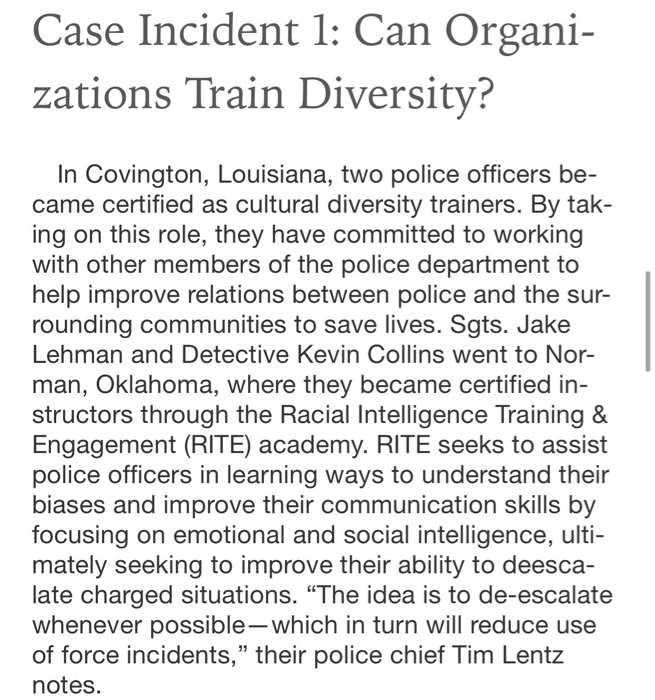
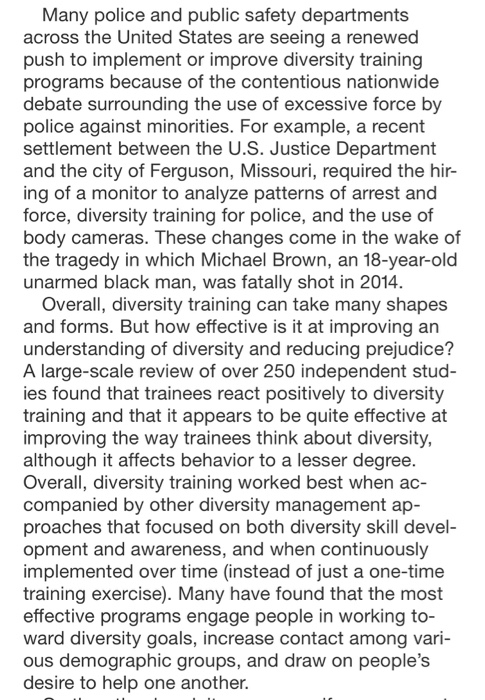
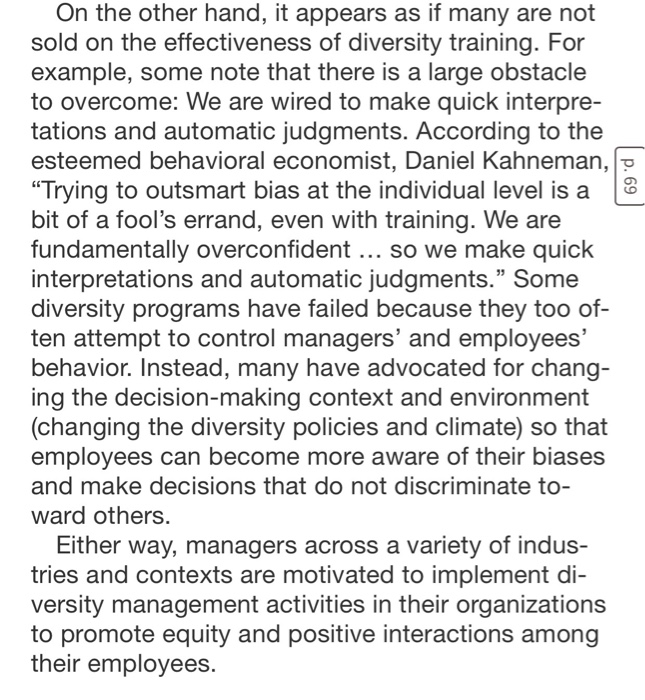
Case Incident 1: Can Organi- zations Train Diversity? In Covington, Louisiana, two police officers be- came certified as cultural diversity trainers. By tak- ing on this role, they have committed to working with other members of the police department to help improve relations between police and the sur- rounding communities to save lives. Sgts. Jake Lehman and Detective Kevin Collins went to Nor- man, Oklahoma, where they became certified in- structors through the Racial Intelligence Training & Engagement (RITE) academy. RITE seeks to assist police officers in learning ways to understand their biases and improve their communication skills by focusing on emotional and social intelligence, ulti- mately seeking to improve their ability to deesca- late charged situations. The idea is to de-escalate whenever possible, which in turn will reduce use of force incidents, their police chief Tim Lentz notes. Many police and public safety departments across the United States are seeing a renewed push to implement or improve diversity training programs because of the contentious nationwide debate surrounding the use of excessive force by police against minorities. For example, a recent settlement between the U.S. Justice Department and the city of Ferguson, Missouri, required the hir- ing of a monitor to analyze patterns of arrest and force, diversity training for police, and the use of body cameras. These changes come in the wake of the tragedy in which Michael Brown, an 18-year-old unarmed black man, was fatally shot in 2014. Overall, diversity training can take many shapes and forms. But how effective is it at improving an understanding of diversity and reducing prejudice? A large-scale review of over 250 independent stud- ies found that trainees react positively to diversity training and that it appears to be quite effective at improving the way trainees think about diversity, although it affects behavior to a lesser degree. Overall, diversity training worked best when ac- companied by other diversity management ap- proaches that focused on both diversity skill devel- opment and awareness, and when continuously implemented over time (instead of just a one-time training exercise). Many have found that the most effective programs engage people in working to- ward diversity goals, increase contact among vari- ous demographic groups, and draw on people's desire to help one another. p. 69 On the other hand, it appears as if many are not sold on the effectiveness of diversity training. For example, some note that there is a large obstacle to overcome: We are wired to make quick interpre- tations and automatic judgments. According to the esteemed behavioral economist, Daniel Kahneman, "Trying to outsmart bias at the individual level is a bit of a fool's errand, even with training. We are fundamentally overconfident ... so we make quick interpretations and automatic judgments. Some diversity programs have failed because they too of- ten attempt to control managers' and employees' behavior. Instead, many have advocated for chang- ing the decision-making context and environment (changing the diversity policies and climate) so that employees can become more aware of their biases and make decisions that do not discriminate to- ward others. Either way, managers across a variety of indus- tries and contexts are motivated to implement di- versity management activities in their organizations to promote equity and positive interactions among their employees