







Question: Does it clearly define the aim of the study and is this consistent with the rest of the manuscript? Is the research question clear and
Does it clearly define the aim of the study and is this consistent with the rest of the manuscript?
Is the research question clear and appropriate?
Is the literature review sufficient to cover previous studies related to the research problem?
Are the results presented clearly and accurately?
Do the results presented match the methods?
Do the authors logically explain the findings?
Do the authors compare the findings with current findings in the research field?
Are the suggestions for future research and potential applications discussed?
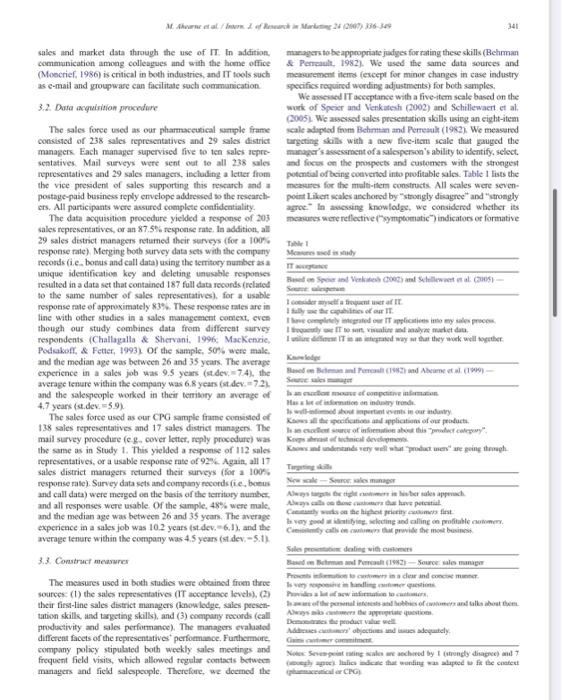
33A we discuss the results and implications of the study and provide selectively, of accurately reconfigured such that new informasuggestions for future research. thon is ereated. Information technologies aiso enable professionals to us and aceess electronic media at almost ary time 2. Cosceptual model aad hypotheses frotn any place and to communicate information in almost atry form (c.g. text, sound, image) (Bock \& Applegate, 1995; We propese that aceeptance of IT positively influences Jarvenpaa \& Ives, 1994). In summary. IT increases the richness, salesperson performance and that this positive relationship complexity, and mobility of information and knowledge between II acceptance and performance is a function of the because of increased communication speed, information mediating processes that involve enhanced call productivity and availability, bandwidth, connectivity, remote aceessibility, and expanded knowledge, along with imptoved targeting and salen computer mernory (Fulk \& DeSanctio, 1995, Jarvenpaa \& Ives, presentation skills, Our conceptual foundation was fommed by 1994). Not surprisingly, it is suggested that II increases integrating a rigorous hiterature search with multiple rounds of personal effectiveness (lgburia, 1990, Igburia \& Tan. 1997: qualitative infoemation gathering. Fint, we conducted six ane- Millmal \& Hartwick, 1987), improves the decision making on-one interviews with CRM and sales automation experts to process for middle managers (Buchanan \& MeCalman, 1988). explore the usage of differeat IT tools by salespeople and how it und enhances conumunication processes and. thus, the wook might affect work processes and performance. Second, we performed (Good k Stone, 1995). conducted a qualimative field study in the U.S. division of a mid- From the previous assertions, it might be assumed that sized multi-national pharmaceutical company. Data were salesperson use of II has similar effocts and ultimately collected by means of four one-0n-one interviens with sales improwes salenperson performanoe. Indeed, there are indications representatives and three additional field sales trips with sales that IT-sawy sales representatives can build stronger customer representatives, These field sales mips lasied an entire day and relationships, ptovide better customer service, and enhance their represented a "regular day in the life of each sales representa- productivity and sales effectiveness as a result of impreved tive," The field trips included intervicws, observation, and shoet information secess, management of custorner files, problemverbal protocols in which sales reps demonstrated and solving capabiltick, sales presentations, and commenication verbalized usage of their sales automation system (Ericcsom \& between the home office and the sales forve (Agency Sales Simon, 1980, Todd \& Benhasat, 1987). Subequenily, two sales Magarine, 1997: Colombo, 1994; Duncan \& Moriarty, 1998; managers wbo supervised the repesentatives that participated. Keilloe et al., 1997; Moncrief ef al., 1991). Information previously were interviewed. All interviews were recorded. techologies may have "aulonational" or efticiency effects transeribed, and subjected to a thematic content analysis that ( g, doing things noore quickly and cheaply) and informational was independently conducted by the rescarchers (Miles \& and transformational outcomes (eg., doing things mote Huberman, 1994). The preliminary results were corroborated in effectively, executing tasks that previously were not possible multiple rousds, and diserepancies were discessed until mutual withoat technology, developing new ceppabilities and skills) agrement was achieved. The dratt model was presented to the (Day, 1994; Grover, Teng. Segars, \&. Fodiec, 1998; Mocncy company in a group fecdback session. The company exocutives et al. 1996). This enhanced efficiency and effectiveness transconfirmed the research model, and mo major adjustments were lates into improved salesperson performance measures. made. H1. IT acceptance has a positive effect on salesperson 2.1. The IT-performince link for salespeople perfommance. In this study, we consider IT as a set of sottware applications 2.2. Morliating processes in support of salesperson activities. This implies that we assessed the impact of IT actoss a broad and integrated set of The previous discussion implies, however, that IT results in applications of toolk, beyoud specific hardware technologien. several intertelated and intermediate value-adding mechanisms Compared with traditional infonnation and communication that may (or may not) lead to increased end performance methods (c.g. face-to-face, telephone, written documents and (Brynjolissoe \& Yang. 1996; Mooncy et al, 1996; Ragowski, reports), electronic tools possess several different information Ahituv, \& Neumann, 1996). Thus, to better explain the telaand communication capabilities, Inspired by several authors, tionship between IT accepeance and salesperson performance, Huber (1990) theorizes that advanced information technologies our theorctical model includes internodiate benefits that are enable managers to stay informed and communicate with the potentially enhanced by a salesperwon's acoeptance of II and salesperson and to be iavelved in decision-making processes. that have previously been shown to be important determinaats Individuals tsisg technology are able to communicate more of perfotmance (Behrman \& Perreault, 1982; Brown \& easily across time and peographic locaticn, to communicate Peterwon, 1994; Churchill, Ford, Hartley, \& Walker, 1985; with greater precicion to targeted growps, and to record more Sujan, Weitz. A Kumar, 1904). reliably the conteat and nature of communication eventi. Decision making is facilitated by IT because, among other 2.2. Call puaducthib things, large amwounts of information about organizational We define "call productivity" as the number of sales calls or transactions can be stored and retheved more quickly, accessed visits a sales representative makes to his or ber eustomers over M. Ahnane o at / Bewes & of Rranuct in Markmitu 34 Rsot) 356.349 37 the numbet of bours worked daring a specified period for customer- and business-related infonmation and use that (Britkerhoff \& Dresler, 1990). Call productivity is a key information in cudomber interactions, This inplies that sales measure of salesperion efficiency because salespcople can representatives who exhibit high levels of II usage have access make more calls given a certain work effort. An important to a more expansive base of exiemal and ogganizational reason companies supply their salespeople with IT is to increase information sources, knowledge, and people than their lessthe efficiency of the sales staff. Advocates of sales technology thechnology-savy counterparts. In their updated review of propose thas technology redoees the time saleipeople spend on sales activities, Markall et al. (1999) suppert this teasuning repetitive suppont and non-selling tasks (e.g. administrative in stating that intelligence gathering and disseminatice protasks), and thus it frees up capacity for salespeople to make cesses occur more and more through the use of conpulers. more sales calls (Goldenberg. 1996: Monerief et al., 1991; lncenced knowledge acts as an enabler for salepoople in Moriarty \& Swartz, 1989). Samilarly, Sharda ct al. (1988) several ways, in particular as it relates to their targeting and propose that the use of decision support systems shertens presentation skilk. magagers' decision-making time. Finally, Good and Stone Two comments of sales representatives illustrate this, as (1995) assert that computer techrology improves and facilitates follows: information processing and comanunication, and thus the quantity of work performed increases. Evidence of this conses I use the computer to find out what bopics a castoener is from a sales manager who expressed the following during one interested in. I pull a lot from the intemet (e g, articies) and of our intervicws: sometimes put together binders for my customers. It gives Technology belps [saiespeople's] productivity and effi. me ammunition to support my arguments. ciency. Based on their cortputer analyses, what they knew about the customer, and determining the best time to see a In Information technology has brought information to use a lot specific customer, they can make eight calls a day. quicker. Information can be shared on specifics of products. In acneral, the numbers of calk made in telation to the. and there is mote commanication in the field betweer orked are accepted as being maxative of the allow better communication of what is happening in the effort a salesperson puts into his or her customer portfolio. ficid. All this has increased the knowledge of people Scveral coppirical studien in the sales literature support the logical relaticeship that stronger effont leads to heightened 2.2 .3 Turgerieg ahills performance (Brown \& Petersot. 1994: Churchill et al.. 19k5). Targeting refers to a salesperson's ability to identify and aclect the prospects and eustomers with high interest, potential. 2.2.2. Knowledge 2.2. Kmowiedse and ability to buy, so that by initiating sales contact, the Knowicdge pertais to tac technucal and thankct knowicdge salesperson can efficiently convert these (potential) cuatomen of a salesperson, such as expertise about product applicaticns, into actual sales. Information technology tools, such as sales specifications, customer use situations, and the industry in automation systems, help sales representatives decide which general (e.g. competition, trends) (Behrman \& Perrealt, customens to target at the right time by increasing their 1982). The importance of salesperson knowledge along with knowledge. Indeed, one of the principal purposes of IT is to information-gathering skills and activities is well recognized in provide the sales organiration with information that enables it to the personal selling liserature (e.e. Ineram \& LaForie. 1997. effectively and efficiently manage points of contact with Kriatuamocrthy, Misra, \& Prisad, 2005; Monerief, 1986; prospects and customers. With vam infotmation available at Rapp, Aheame, Mathucw, \& Schillewaert, 2006). Sujan, Sujan, his oe her fingertips, the salesperson can make decisions as to and Bettman (1988) suggest that a salesperson's effectiveness. which prospects and cusiomers to call on at any particular time and knowledse can be enhanced by providing market restarch and for whatever purpose. information and encouraging him or her to use that information. Salespeople develop a strong understanding of their portfolio To use their knowledge effectively, salespeople must be able by running spocific data quaries, sorting cusiomer lists hased en to akquire infomation about sales and market siruations (Le "business potential," analyzing purchase pattems, identifying Boo \& Merunka, 2006; Weitz, Sujan, \& Sujan, 1986), Because customer needk, classifying cusiomers, and using this knewiof its storage, retrieval, and network capacities, IT has the cilge to extend sales effart into the most profitable productpoteatial to enable and facilitate information acquisition, customer combinations, in doing so, salespeople can bether dissemination, and utilization (Glarer, 1991; Huber, 199I). assess which (candidate) custonaens mighth fow through the Information technology enables sales representatives to drsw sales funtel and result in a sale. As swech, salespeople also on an expansive (computerixed) organizational memory of acquire procodural knowlodge that eansists of action plans people and datubases and to use it to update their beliefs and (Weite et al. 1986) that ean belp in targeting. The salespenoe state of knowledye about business relationships (Day, 1904; experientially knows the products cusiomers find mest Huber, 1991; Sinkila, 1994). For example, electronic commu- attractive and can use this knowiedge lo ikentify whuch market nication media can link a salesperson to other profissionals segments are prone so buy and to target accordingly, In additicn, within and across onganirational boundaries. In addition, a salespeople cun actively moditor conpetitive campoigns and sales representative caa search online databases or the laterset fespond by tailoring their own targeting practices. 34it Although targeting skilts have not been included in previous behavional dimensioa of salesperwon performance. This contheoretical models of salesperson performance, they are a basic struct pertains to the role of the salesperson as an external part of marketing strategy (Kotler, 1994) and intuitively should representative of the firm and includes both the delivery of clear, have a positive impact oe sales performance. The importance of well thought-out presentations and the effective response to identifying and effectively screening potential customers is questions posed by the buyer. Behrman and Perreault demonwidely recognized as a prerequisie for sales success in direct straied that sales presentation skills were significantly cotrelaied marketing (Kotler, 1994) and personal selling (c.g. Kamakura. with a salesperson's overall performance. Ramaswanti, \& Srivastava, 1991; Stanton \& Spiro, 1999). Thus: 2.2.4. Sales presculation alds H2. The relationship between IT acceptance and salesperson Salespeople's increased knowlodge due to IT also affects periormance is explained by the following mediating processes: customer comminication. By managing their knowledge. H2a. IT aceeptance has a positive cffect on salesperson call repositories electronically. salespeople can improve their productivity, which in tum positively infleences salesperson presentation skills in several ways, Marshal et al. (1999) performance. show that sales representatives atribute a key role to conpuacrixed technologies in terms of the level and quality of H2b. IT aceeptance has a positive effect on saleserson information they are able to provide during sales calls. Other targeting and sales peesentation skills (which are both mediated authors (e.g. Agency Sales Magazine, 1997; Colombo, 1994; by knowledge), which in tam positively infleences salesperson. Duncan \& Moriarty, 1998: Keillor et al. 1997: Moocricf et al. performance. 1991) have argoed that sales tochnology may lead to (1) quicker aceess 10 better information. (2) faster response and answers vo 3. Method customern, (3) enhanced quality of customer interactions, and (4) increased persontalization and cuatomization of presentations We used a field study foemat io lest the effects of II and responses. By the same token, interpersonal commanication acceptance on salesperwon performance (Stonc, 197s). Data technologics (e.g., e-mail) enalle sales representatives to were collected in two separate companics with multiple respond to customers more pempely and knowledgeably, respondent surveys combined with data from company records. even when they are away from the custonset's site. The choice for a field study design within two separate In all, high marker and technical knowledge allows the companies and industries was inspired by our desire to establish jextaposing of product benefits with the weakncsses of greater levels of generalizability while controlling for concompetitive offerings to deliver strong compariseas. Salespeo- founding external effects due to varible market of organiraple can also convey the information in a more convincing tional contexts. Similar methods and identical meacures were manter. By presenting and using matket information to provide employed in both studies to ensure comparability. a coherent busincss and financial justification for the sale, the salesperson can better frame the value proposition to the buyer 3.1. Pharmedceutical and connamer pachaged goods research and make a stronger case for the sale. Knowlodge also enables sites: bockeround the salesperson to prepare for potentially adversarial buyer positions that might arise during the sales presentation. Stady panticipants were salespeople who worked for (1) a Salespeople who are high in technical knowledge can speak mid-sized U.S. division of a European multi-national pharmsintelligently about specific customer applications for a given ceutical coapany (the same firm froa which the qualitative data product, thus conveying a kevel of techaical expertise that is were obtained) and (2) a division of a large multi-aational assuring to the cusiomer. A salesperson illustrated this, as consumer packaged goods (CPG) firm based in the United follows: States. The pharmaccutical salespeople were responsible for If you know a lot about the buying behavior of your marketing and selling (in the industry referred to as "detailing") customers before you go in, you have an edge. I assemble two product lines directly to physicians. The CPGG salespeple each customer's prescribing behavior, look at the applica- were responsible for marketing and selling oee specific produst tion where 1 have my call notes, and determine what category with several different product lines directly io retail message I want to focus on this time. Instead of having a accounts. Both companies provided a good sample frame for generic message with my customer, I can go in and focus on - testing our empirical model because they fulfilled three major their necds and wants. It is up to each individual to gather all conditions necessary for our research: (t) there was a broad that iaformation and mold it into a good presentation. Also. array of IT applications available to the sakes force, (2) the use of if a customer has a question. I do a search on the web. for t techologies was voluatary sach that variance in II usage instance, and provide them a personalimed answer. sales force was large enough to allow for advanced statistical Sales presentation skills cmbrace factors that are related to the analyses. In addition, both firms operate in contexts that are interactions between the customer and the sales representative. highly information and data intensive (Aheame, Gruenc, \& Behrman and Perreault (1982) identify giving high quality sales Barke-larvis, 1999; DeSarbo, Degeratu, Ahearne, \& Saxon, presentationsandworkingwellwithcustomersasanimportant2002),enablingsalesrepresentativestomanipulateandanalyze 341 sales and market data through the use of IT. In addition. managersto beappmopriate jadyes for rating these skills (Behrman communication among colleagues and with the home office SE Perrault, 1982). We used the same data soures and (Moecrief, 1986) is critical in both industries, and IT fools such metsusement iterr (except for minoe changes in case industry as e-mail and groupware can facilitate such commanication. specifics required wording adjustments) for both samples. We ansesed IT aceeptance with a five-item scale based on the 3.2. Data acguisition procedure work of Speier and Verkatech (2002) and Schillewact et al. (3005). We assessed sales preseatation skills using an cight-item The sales foree used as our pharmaceutical sample frame seale adiped from Behrman and Pernealk (1982), We measared consished of 238 sales representatives and 29 sales district targeting skills with a acw flve-itern scale that gauged the managerk. Each manager supervised five to ten sales repre- mangen's assessment of a solesperwon's ability to identify, selsct. sentativer. Mail surveys were sent out to all 238 sules and foces on the porpeets and customen with the strongest reptesentatives and 29 sales managers, iscluding a letier from potential of being coevernod into poofitable sales. Tatble 1 lists the the vice presdent of sales supporting this research and a mezeres for the maltitien constrots. All sales were sevenpostage-paid business reply envelope addressed so the rescarch- point Likert males anchoned by "strongly dicagree" and "strongly ers. All participants were assured complete conflidentiality. agrec." In assesing knowlodgs, we considend whether its The dath acquisition procedure yielded a response of 203 meaures were reflective ('symptomatic") indicaton or formative sales repesentatives, of an 87.5% repense rate. In addition, all 29 sales destrict managens returned their surveys (for a 100N. response rate) Merging botb survey data sets with the company Takr 1 Mowne sol is alidy recosds (i.e. boecas and call data) using the temitory number as a unique identification key and deleting unesable revponses resulted in a data set that contained 187 foll data reconds (related to the same number of sales representatives). for a usable response rate of appooximately 83 . These feppoese mate are is line with other stadies in a sales management comext even though our study combines data from differeat survey respondeats (Challagalla \& Shervani. 1996. Mackenrie, Podakoff, \& Fetter, 1993). Of the sample, 50% were male. and the median age was between 26 and 35 years. The werage Keseleder experience in a sales job was 9.5 years ( 4 dev, m7.4 ). the average teruare within the cormpany was 6.8 years (at dev.=7.2 ). and the sakepeopie worked in their temisory an average of 4.7 years (s.dev, =5.9 ). The sales foree used as eur CPG sample frame consisied of Kams all the poifiction atd ppliction of our product. 138 sales representatives and 17 sales district managen. The mail survey procedure (e.g. cover letter, reply procedure) was Kirese derat of testaicil devileptowe. tbe same as in Study 1. This yielded a reponse of 112 sales representatives, of a usable response rate of 928 . Again, all 17 sales district managers refurned their parveys (for a 100% response rate) Survey data sets and company records (ie, boeus and call data) were mergod oe the basis of the territary aumber. and all rosponss were usable of the sumple, 48% were male. and the median age was between 26 and 35 years. The average experience in a sales job was 10.2 years ( st dev,=(6,1), and the average tenure within the company was 4.5 years (st dev -5.1 ). 342 ("causal") indicators. Given that market knowiedge and technical performance in the presence of other important variables, which knowledge tap distinct aspects of the knowledge constrict, they may also affect sales performance or intermediate variables. The should be viewed as formative rather thas reflective indicators of purpose of examining conariates is to nale eut rival explanations the construct (see Bolken \& Lemnox, 1991; Fometl \& Bookstcin, for our findings as well as to find the bounderies of the 1982; Jarvis, MacKenzie, \& Podsakeff, 2005). Therefore, rather hypothesired ctlects (Draper \& Smith, 19s0). The cuvariates than modeling knowledge as a latent construct with refloctive we used were as folloms: (I) the length of time a sales indicators, we modeled it as a scale score, with measurement emor representative had becn with the conpany. (2) the length of time terms fiued at one less the estimate of the seale's reliability. a sales reperentative had been working in bis er her territory. multiplied by the variance of the knowledge scale score (Nereikog and (3) total sales experience. Mcta-analyses of the sales \& Sarbom, 1982), respectively. We used a subjective cotimaite of lincrature have firund that these effocts significantly explain 85 (Nunnally \& Bemstein, 1994) to assess feliability rather than individual salesperson performance fe.g. Brown of Pelenon, Crobbach's alpha because Cronbach's alpha measures intemal 1994; Churhill et al. 1905). consistency reliability and there is no reason to expect these indsators to be intemally consistent (see Bollen \& Lenthox. 4. Results 1991). We clarify the objective measures and covariates in the following paraggrphs. 4.1. Monasarnmest modlel 3.3.1. Calf pouductivity Using the two-dep approach for testing struchural equation Productivity measures are traditionally expecsed as ratios of models (Andence & Gerbing. 19es; Benamgarner & Homburg. output divided by input. Here, the productivity meadute is 1996; Bentler \& Chond, 1987; Contner \& Schocnherg. 1973), we expressed as the number of ealls made in an aveeage woek condacted a series of coefirmatocy factor analyver on the (numerator=output) divided by the number of hours a sales conitret meakers so acses the prychometric properties of the repesentative worls in an average weck (denominator-input) scales with maltiple thems. Prior to combinting the CPG and (Brinkerhoff \& Dresslet, 1990). Goldenbers (1996) segeets pharmaceutical data sets for analyses, we standardiod both call using the same measure to assess a tangible benefit of sales. prodactivity and sales perfommance measures since measures automation. namely, that salespeople can spend more time selling from the two samples were on different scales. Following in the field and calling on customerx. We obsaised the measare of guidelines that Sezars (1997) and Kimt and Hagtvet (2003) number of calis made by a sales representative from comsany suggest, we also evaluated the fir of the single-facter models to records of, more specifically, the sales reporting systean. We casure item anidimensionality: After the teliability, validity, and obtained the number of houis a sales rep works in an average model fit within each castgory of constructs were established, week from the self-repont sales representative questionaiire. We conductod an overall confimmatory fictor analysis on the 2.3.1 Seliste sct of constracts using the maximum likelihood 3.2. Salder pcroformance eitimation procelune. Becamse the total number of measured reconds. We operotionalized performance using the total year variables was large (25). we aved item pareeling when bonusconmission per sales representative based on achievod Beal, \& Tealak, 2000). Models using parcels often are prefined sales levels. The bonus was calculated based on the volume of when sample sires are aclatively small (c.g. Bagorzi \& products sold (prescriptions or products) to customers (physi- Edwards. 1998: Bopoum \& Heatherton. 1994) asd, in addition cians or retail accounts) in a salesperson's territory (a company- to being more parsimonioes, tend to reduce various sources of defined set of physicians of specific geographic region) as sampling enor (MacCallum. Widman. Zhang, s. Hong. 1999). compared with a target quota that is set at the beginning of the To gavge model fit we ropoet the Standardirod Root Mean year by an extemal organiration specializing in sales force Square Residual (SRMRR) asd the Comparative Fit Index (CF1; compensation. Because preseription infomation in the phar- Beneler, 1900). We also report chi-dquare values thut provide a maceutical industry is accurately tracked at the physician level statistical basis for corepuring the relative fit of all models. The (because the industry as heavily negulated by the Food and Drug SRMR is a measare of the standandimd difference between the Administration). with more than 90% of all pharmacies observed cevariance and the prodicted covariance. and in reporting custonser-prescribing data to IMS Health, this general, SRMR values ,10 are considerod favorable (Kline, information repesents an accurate picture of a sales represen- 2005). The CFI is an incremental fit index that coetrasts the fit tative's performance. Similarly, the CPG company had accurate of a hypothesisod structural equation modeling model against a reconds tracking the salesperson's selling record, which lod to a baseline (uncorrelatod indicalon) model. Historically, incregood representation of overall sales performance. We assembled mental fit indices such as CF/ 90 in structural equation the bonus measure for both saruples four to six months after we modeling models have been considered less than desirable. cotnpleted the final survey data collection. Although there is wene controversy in the literutere as bo which fit indices are most appoperiate ander ditfcreat conditions, 3.3.3. Conevi foctors rescarchers sach as He and Bentler (1999) have proposed that We added control fictors to our model to lest the efficts of TI the use of combined cutoffx, sach as CFI- 295 and acceptance and the related information-based benefits on sales. SRMR .10, reselts in a better halance of Type I and Type
Step by Step Solution
There are 3 Steps involved in it

Get step-by-step solutions from verified subject matter experts
 Study Help