







Question: Does the data seem closer to being normal (empirical rule) or not? Use you answers from problems 1-5 above to explain. (Chapter 3) 6) Does
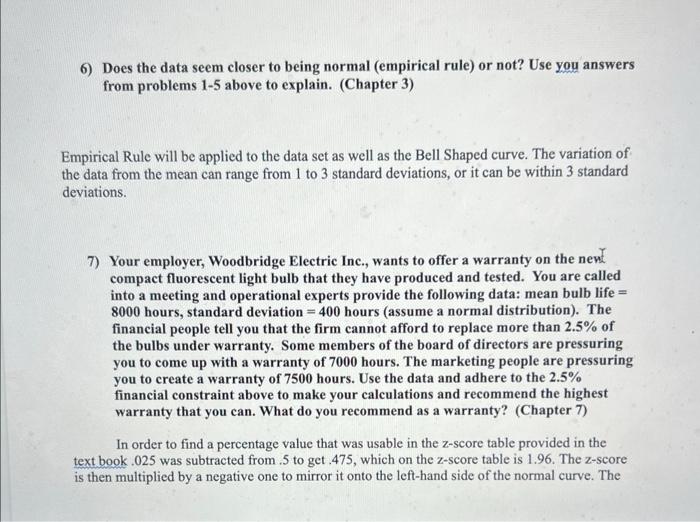
6) Does the data seem closer to being normal (empirical rule) or not? Use you answers from problems 1-5 above to explain. (Chapter 3 ) Empirical Rule will be applied to the data set as well as the Bell Shaped curve. The variation of the data from the mean can range from 1 to 3 standard deviations, or it can be within 3 standard deviations. 7) Your employer, Woodbridge Electric Inc., wants to offer a warranty on the nene compact fluorescent light bulb that they have produced and tested. You are called into a meeting and operational experts provide the following data: mean bulb life = 8000 hours, standard deviation =400 hours (assume a normal distribution). The financial people tell you that the firm cannot afford to replace more than 2.5% of the bulbs under warranty. Some members of the board of directors are pressuring you to come up with a warranty of 7000 hours. The marketing people are pressuring you to create a warranty of 7500 hours. Use the data and adhere to the 2.5% financial constraint above to make your calculations and recommend the highest warranty that you can. What do you recommend as a warranty? (Chapter 7) In order to find a percentage value that was usable in the z-score table provided in the text book. 025 was subtracted from .5 to get .475, which on the z-score table is 1.96. The z-score is then multiplied by a negative one to mirror it onto the left-hand side of the normal curve. The 6) Does the data seem closer to being normal (empirical rule) or not? Use you answers from problems 1-5 above to explain. (Chapter 3 ) Empirical Rule will be applied to the data set as well as the Bell Shaped curve. The variation of the data from the mean can range from 1 to 3 standard deviations, or it can be within 3 standard deviations. 7) Your employer, Woodbridge Electric Inc., wants to offer a warranty on the nene compact fluorescent light bulb that they have produced and tested. You are called into a meeting and operational experts provide the following data: mean bulb life = 8000 hours, standard deviation =400 hours (assume a normal distribution). The financial people tell you that the firm cannot afford to replace more than 2.5% of the bulbs under warranty. Some members of the board of directors are pressuring you to come up with a warranty of 7000 hours. The marketing people are pressuring you to create a warranty of 7500 hours. Use the data and adhere to the 2.5% financial constraint above to make your calculations and recommend the highest warranty that you can. What do you recommend as a warranty? (Chapter 7) In order to find a percentage value that was usable in the z-score table provided in the text book. 025 was subtracted from .5 to get .475, which on the z-score table is 1.96. The z-score is then multiplied by a negative one to mirror it onto the left-hand side of the normal curve. The
Step by Step Solution
There are 3 Steps involved in it

Get step-by-step solutions from verified subject matter experts
 Study Help