Question: Does the freedom, order, and equality framework discussed in the first chapter better account for the role of ideology in federalism than a liberal-conservative framework?
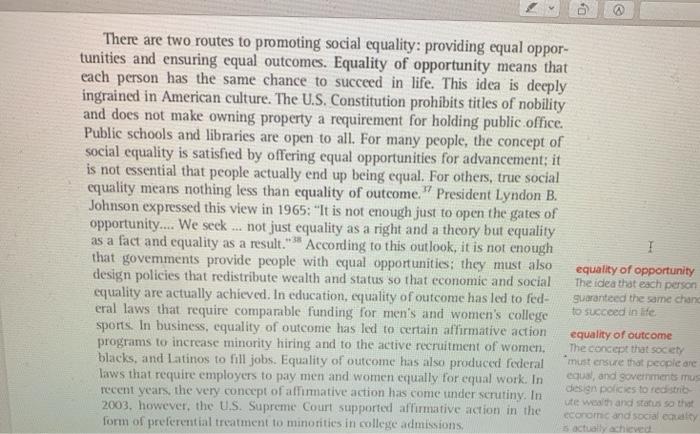
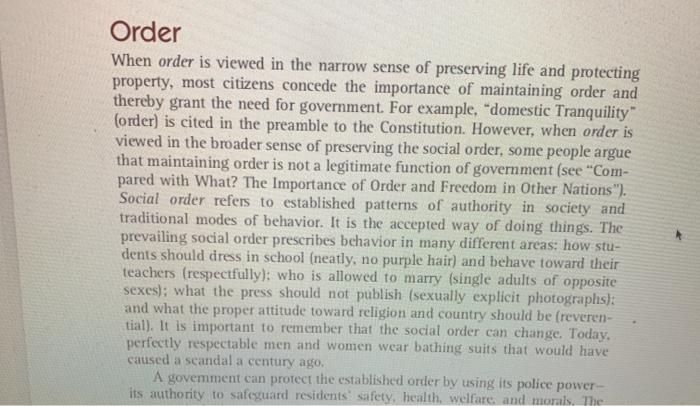
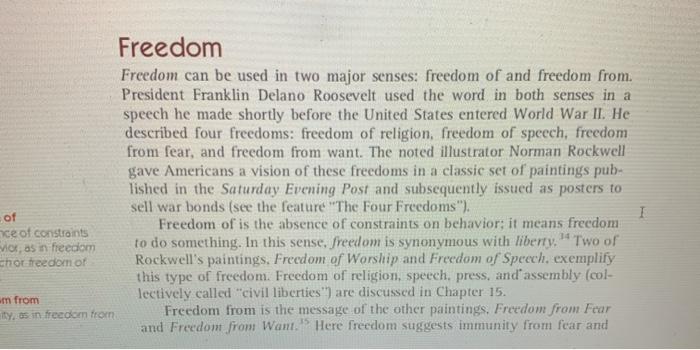
Does the freedom, order, and equality framework discussed in the first chapter better account for the role of ideology in federalism than a liberal-conservative framework? Chapter 1 @ There are two routes to promoting social equality: providing equal oppor- tunities and ensuring equal outcomes. Equality of opportunity means that each person has the same chance to succeed in life. This idea is deeply ingrained in American culture. The U.S. Constitution prohibits titles of nobility and does not make owning property a requirement for holding public office. Public schools and libraries are open to all. For many people, the concept of social equality is satisfied by offering equal opportunities for advancement; it is not essential that people actually end up being equal. For others, true social equality means nothing less than equality of outcome." President Lyndon B. Johnson expressed this view in 1965: "It is not enough just to open the gates of opportunity.... We seek ... not just equality as a right and a theory but equality as a fact and equality as a result. *** According to this outlook, it is not enough 1 that govemments provide people with equal opportunities; they must also equality of opportunity design policies that redistribute wealth and status so that economic and social The idea that each person equality are actually achieved. In education, equality of outcome has led to fed- guaranteed the same chane eral laws that require comparable funding for men's and women's college to succeed in life sports. In business, equality of outcome has led to certain affirmative action equality of outcome programs to increase minority hiring and to the active recruitment of women, The concept that society blacks, and Latinos to fill jobs. Equality of outcome has also produced federal must ensure that people are laws that require employers to pay men and women equally for equal work. In equal, and governments mus design policies to redistrib recent years, the very concept of ammative action has come under scrutiny. In ute wealth and status so that 2003, however, the U.S. Supreme Court supported affirmative action in the economic and social culty form of preferential treatment to minorities in college admissions is actually achieved Order When order is viewed in the narrow sense of preserving life and protecting property, most citizens concede the importance of maintaining order and thereby grant the need for government. For example, "domestic Tranquility" (order) is cited in the preamble to the Constitution. However, when order is viewed in the broader sense of preserving the social order, some people argue that maintaining order is not a legitimate function of government (see "Com- pared with What? The Importance of Order and Freedom in Other Nations"). Social order refers to established patterns of authority in society and traditional modes of behavior. It is the accepted way of doing things. The prevailing social order prescribes behavior in many different areas: how stu- dents should dress in school (neatly, no purple hair) and behave toward their teachers (respectfully): who is allowed to marry (single adults of opposite sexes): what the press should not publish (sexually explicit photographs): and what the proper attitude toward religion and country should be (reveren- tial). It is important to remember that the social order can change. Today. perfectly respectable men and women wear bathing suits that would have caused a scandal a century ago. A govemment can protect the established order by using its police power- its authority to safeguard residents' safety, health, welfare, and morals. The Freedom Freedom can be used in two major senses: freedom of and freedom from. President Franklin Delano Roosevelt used the word in both senses in a speech he made shortly before the United States entered World War II. He described four freedoms: freedom of religion, freedom of speech, freedom from fear, and freedom from want. The noted illustrator Norman Rockwell gave Americans a vision of these freedoms in a classic set of paintings pub- lished in the Saturday Evening Post and subsequently issued as posters to sell war bonds (see the feature "The Four Freedoms"). of 1 ce of constraints Freedom of is the absence of constraints on behavior; it means freedom vier, as in freedom to do something. In this sense, freedom is synonymous with liberty."* Two of chor freedom of Rockwell's paintings. Freedom of Worship and Freedom of Speech, exemplify this type of freedom Freedom of religion, speech, press, and assembly (col- lectively called "civil liberties") are discussed in Chapter 15. ity, as in freedom from Freedom from is the message of the other paintings. Freedom from Fear and Freedom from Want." Here freedom suggests immunity from fear and m from










 Study Help