







Question: Does the psychological environment affect the anatomy ofthe brain? This question was studied experimentally by Mark Rosenzweig and his associates. The subjects for the study
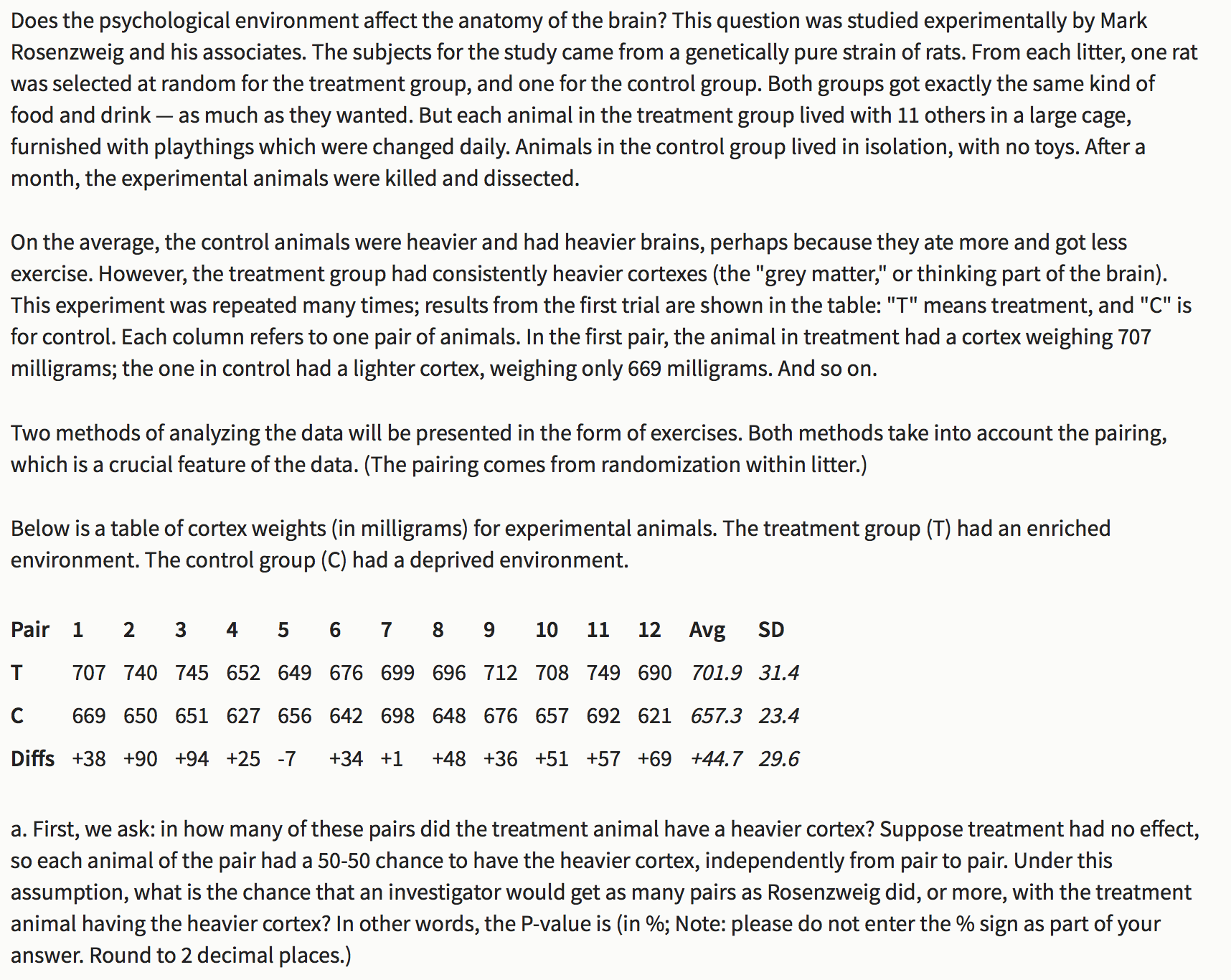
Does the psychological environment affect the anatomy ofthe brain? This question was studied experimentally by Mark Rosenzweig and his associates. The subjects for the study came from a genetically pure strain of rats. From each litter, one rat was selected at random for the treatment group, and one for the control group. Both groups got exactly the same kind of food and drink as much as they wanted. But each animal in the treatment group lived with 11 others in a large cage, furnished with playthings which were changed daily. Animals in the control group lived in isolation, with no toys. After a month, the experimental animals were killed and dissected. On the average, the control animals were heavier and had heavier brains, perhaps because they ate more and got less exercise. However, the treatment group had consistently heavier cortexes (the " grey matter," or thinking part of the brain). This experiment was repeated many times; results from the rst trial are shown in the table: "T" means treatment, and "C" is for control. Each column refers to one pair ofanimals. In the first pair, the animal in treatment had a cortex weighing 707 milligrams; the one in control had a lighter cortex, weighing only 669 milligrams. And so on. Two methods of analyzing the data will be presented in the form of exercises. Both methods take into account the pairing, which is a crucial feature ofthe data. (The pairing comes from randomization within litter.) Below is a table of cortex weights (in milligrams) for experimental animals. The treatment group (T) had an enriched environment. The control group (C) had a deprived environment. Pair 1 2 3 4 5 6 7 8 9 10 11 12 Avg SD T 707 740 745 652 649 676 699 696 712 708 749 690 701.9 31.4 C 669 650 651 627 656 642 698 648 676 657 692 621 657.3 23.4 Diffs +38 +90 +94 +25 -7 +34 +1 +48 +36 +51 +57 +69 +44.7 29.6 a. First, we ask: in how many ofthese pairs did the treatment animal have a heavier cortex? Suppose treatment had no effect, so each animal of the pair had a 50-50 chance to have the heavier cortex, independently from pair to pair. Under this assumption, what is the chance that an investigator would get as many pairs as Rosenzweig did, or more, with the treatment animal having the heavier cortex? In other words, the P-value is (in %; Note: please do not enter the % sign as part of your answer. Round to 2 decimal places.)
Step by Step Solution
There are 3 Steps involved in it

Get step-by-step solutions from verified subject matter experts
 Study Help