Question: Does this writting sample demonstrate acceptable graduate-level writing? Why or why not? Business curriculums are offered at universities the world over. Outside of philosophy, few
- Does this writting sample demonstrate acceptable graduate-level writing? Why or why not?
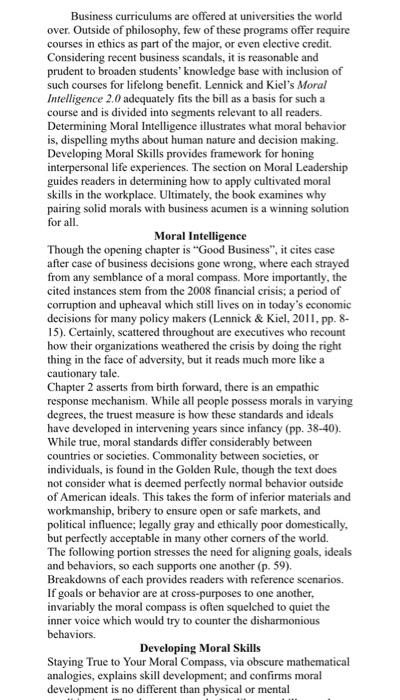
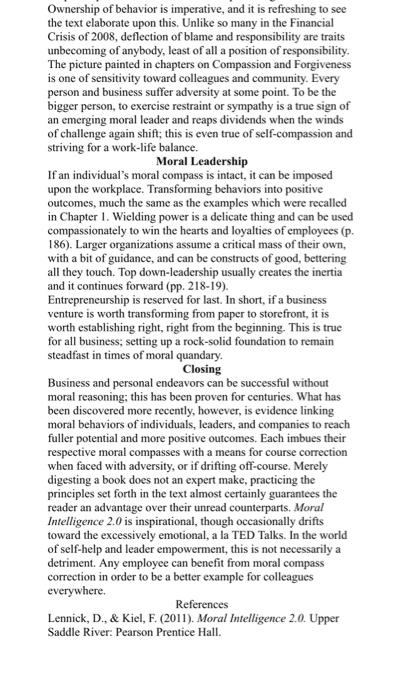
Business curriculums are offered at universities the world over. Outside of philosophy, few of these programs offer require courses in ethics as part of the major, or even elective credit. Considering recent business scandals, it is reasonable and prudent to broaden students' knowledge base with inclusion of such courses for lifelong benefit. Lennick and Kiel's Moral Intelligence 2.0 adequately fits the bill as a basis for such a course and is divided into segments relevant to all readers. Determining Moral Intelligence illustrates what moral behavior is, dispelling myths about human nature and decision making. Developing Moral Skills provides framework for honing interpersonal life experiences. The section on Moral Leadership guides readers in determining how to apply cultivated moral skills in the workplace. Ultimately, the book examines why pairing solid morals with business acumen is a winning solution for all. Moral Intelligence Though the opening chapter is "Good Business", it cites case after case of business decisions gone wrong, where each strayed from any semblance of a moral compass. More importantly, the cited instances stem from the 2008 financial crisis, a period of corruption and upheaval which still lives on in today's economic decisions for many policy makers (Lennick & Kiel, 2011, pp. 8- 15). Certainly, scattered throughout are executives who recount how their organizations weathered the crisis by doing the right thing in the face of adversity, but it reads much more like a cautionary tale Chapter 2 asserts from birth forward, there is an empathic response mechanism. While all people possess morals in varying degrees, the truest measure is how these standards and ideals have developed in intervening years since infancy (pp. 38-40). While true, moral standards differ considerably between countries or societies. Commonality between societies, or individuals, is found in the Golden Rule, though the text does not consider what is deemed perfectly normal behavior outside of American ideals. This takes the form of inferior materials and workmanship, bribery to ensure open or safe markets, and political influence; legally gray and ethically poor domestically, but perfectly acceptable in many other corners of the world. The following portion stresses the need for aligning goals, ideals and behaviors, so each supports one another (p. 59). Breakdowns of each provides readers with reference scenarios. If goals or behavior are at cross-purposes to one another. invariably the moral compass is often squelched to quiet the inner voice which would try to counter the disharmonious behaviors. Developing Moral Skills Staying True to Your Moral Compass, via obscure mathematical analogies, explains skill development; and confirms moral development is no different than physical or mental Ownership of behavior is imperative, and it is refreshing to see the text elaborate upon this. Unlike so many in the Financial Crisis of 2008, deflection of blame and responsibility are traits unbecoming of anybody, least of all a position of responsibility. The picture painted in chapters on Compassion and Forgiveness is one of sensitivity toward colleagues and community. Every person and business suffer adversity at some point. To be the bigger person, to exercise restraint or sympathy is a true sign of an emerging moral leader and reaps dividends when the winds of challenge again shift; this is even true of self-compassion and striving for a work-life balance. Moral Leadership If an individual's moral compass is intact, it can be imposed upon the workplace. Transforming behaviors into positive outcomes, much the same as the examples which were recalled in Chapter 1. Wielding power is a delicate thing and can be used compassionately to win the hearts and loyalties of employees (p. 186). Larger organizations assume a critical mass of their own, with a bit of guidance, and can be constructs of good, bettering all they touch. Top down-leadership usually creates the inertia and it continues forward (pp. 218-19). Entrepreneurship is reserved for last. In short, if a business venture is worth transforming from paper to storefront, it is worth establishing right, right from the beginning. This is true for all business, setting up a rock-solid foundation to remain steadfast in times of moral quandary. Closing Business and personal endeavors can be successful without moral reasoning: this has been proven for centuries. What has been discovered more recently, however, is evidence linking moral behaviors of individuals, leaders, and companies to reach fuller potential and more positive outcomes. Each imbues their respective moral compasses with a means for course correction when faced with adversity, or if drifting off-course. Merely digesting a book does not an expert make, practicing the principles set forth in the text almost certainly guarantees the reader an advantage over their unread counterparts. Moral Intelligence 2.0 is inspirational, though occasionally drifts toward the excessively emotional, a la TED Talks. In the world of self-help and leader empowerment, this is not necessarily a detriment. Any employee can benefit from moral compass correction in order to be a better example for colleagues everywhere. References Lennick, D., & Kiel, F. (2011). Moral Intelligence 2.0. Upper Saddle River: Pearson Prentice Hall. Closing Business and personal endeavors can be successful without moral reasoning; this has been proven for centuries. What has been discovered more recently, however, is evidence linking moral behaviors of individuals, leaders, and companies to reach fuller potential and more positive outcomes. Each imbues their respective moral compasses with a means for course correction when faced with adversity, or if drifting off-course. Merely digesting a book does not an expert make, practicing the principles set forth in the text almost certainly guarantees the reader an advantage over their unread counterparts. Moral Intelligence 2.0 is inspirational, though occasionally drifts toward the excessively emotional, a la TED Talks. In the world of self-help and leader empowerment, this is not necessarily a detriment. Any employee can benefit from moral compass correction in order to be a better example for colleagues everywhere. References Lennick, D., & Kiel, F. (2011). Moral Intelligence 2.0. Upper Saddle River: Pearson Prentice Hall