



Question: Donald and Stuart bargain over a price for a second hand car. Donald is selling the car and values it at 2000. Stuart would be
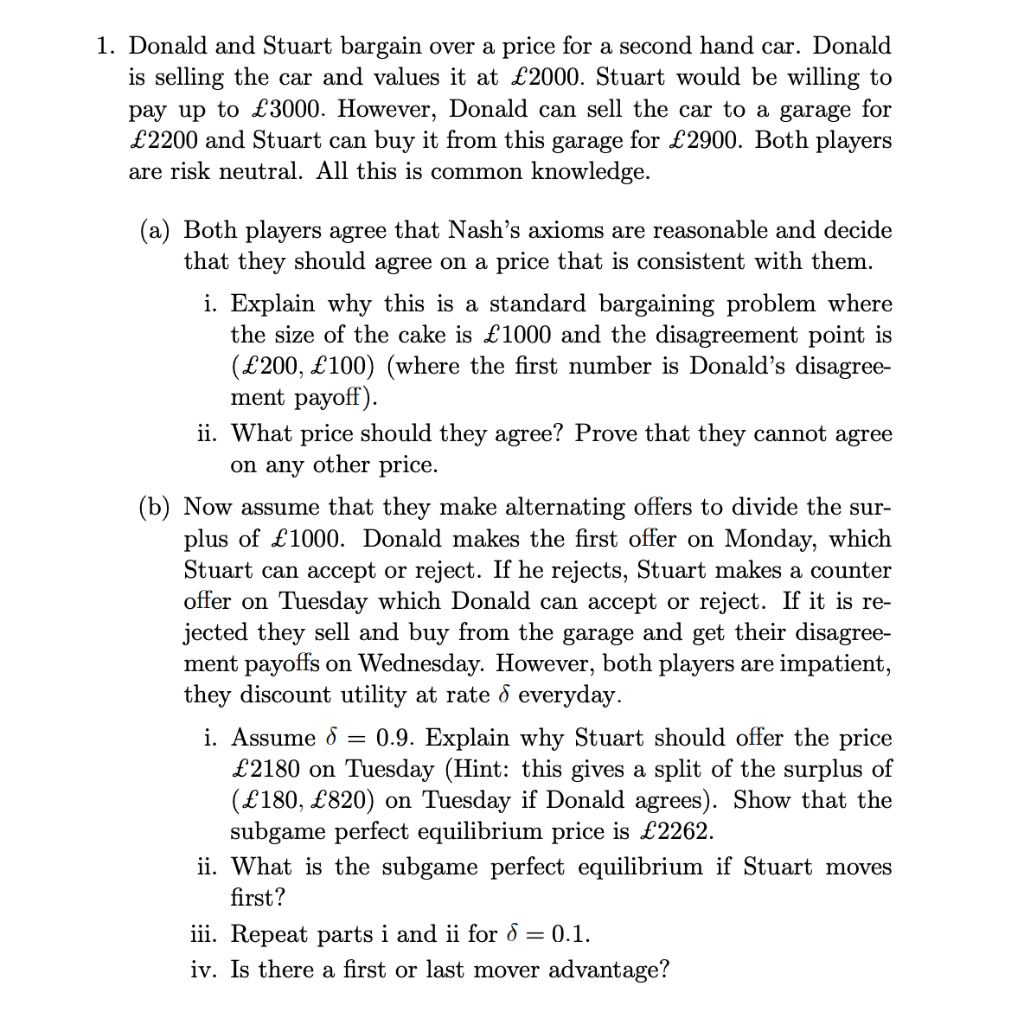
Donald and Stuart bargain over a price for a second hand car. Donald is selling the car and values it at 2000. Stuart would be willing to pay up to 3000. However, Donald can sell the car to a garage for 2200 and Stuart can buy it from this garage for 2900. Both players are risk neutral. All this is common knowledge. (a) Both players agree that Nash's axioms are reasonable and decide that they should agree on a price that is consistent with them. i. Explain why this is a standard bargaining problem where the size of the cake is 1000 and the disagreement point is (200,100) (where the first number is Donald's disagreement payoff). ii. What price should they agree? Prove that they cannot agree on any other price. (b) Now assume that they make alternating offers to divide the surplus of 1000. Donald makes the first offer on Monday, which Stuart can accept or reject. If he rejects, Stuart makes a counter offer on Tuesday which Donald can accept or reject. If it is rejected they sell and buy from the garage and get their disagreement payoffs on Wednesday. However, both players are impatient, they discount utility at rate everyday. i. Assume =0.9. Explain why Stuart should offer the price 2180 on Tuesday (Hint: this gives a split of the surplus of (180,820) on Tuesday if Donald agrees). Show that the subgame perfect equilibrium price is 2262. ii. What is the subgame perfect equilibrium if Stuart moves first? iii. Repeat parts i and ii for =0.1. iv. Is there a first or last mover advantage? Donald and Stuart bargain over a price for a second hand car. Donald is selling the car and values it at 2000. Stuart would be willing to pay up to 3000. However, Donald can sell the car to a garage for 2200 and Stuart can buy it from this garage for 2900. Both players are risk neutral. All this is common knowledge. (a) Both players agree that Nash's axioms are reasonable and decide that they should agree on a price that is consistent with them. i. Explain why this is a standard bargaining problem where the size of the cake is 1000 and the disagreement point is (200,100) (where the first number is Donald's disagreement payoff). ii. What price should they agree? Prove that they cannot agree on any other price. (b) Now assume that they make alternating offers to divide the surplus of 1000. Donald makes the first offer on Monday, which Stuart can accept or reject. If he rejects, Stuart makes a counter offer on Tuesday which Donald can accept or reject. If it is rejected they sell and buy from the garage and get their disagreement payoffs on Wednesday. However, both players are impatient, they discount utility at rate everyday. i. Assume =0.9. Explain why Stuart should offer the price 2180 on Tuesday (Hint: this gives a split of the surplus of (180,820) on Tuesday if Donald agrees). Show that the subgame perfect equilibrium price is 2262. ii. What is the subgame perfect equilibrium if Stuart moves first? iii. Repeat parts i and ii for =0.1. iv. Is there a first or last mover advantage
Step by Step Solution
There are 3 Steps involved in it

Get step-by-step solutions from verified subject matter experts