







Question: dont solve by excel Use forward and backward pass X Weekly Content - IE 100 du.tr/bbcswebdav/pid-457282-dt-content-rid-3940047_1/courses/TRIBE Solve for the ID 118203009 Dorinals20sinavi.pdf 3. The data
dont solve by excel
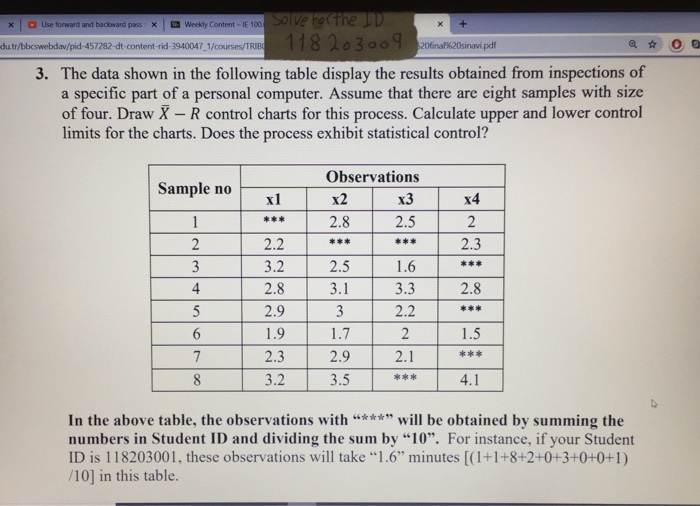
Use forward and backward pass X Weekly Content - IE 100 du.tr/bbcswebdav/pid-457282-dt-content-rid-3940047_1/courses/TRIBE Solve for the ID 118203009 Dorinals20sinavi.pdf 3. The data shown in the following table display the results obtained from inspections of a specific part of a personal computer. Assume that there are eight samples with size of four. Draw X R control charts for this process. Calculate upper and lower control limits for the charts. Does the process exhibit statistical control? Sample no x1 Observations x2 x3 2.8 2.5 1 x4 2 2.3 *** *** 1.6 *** 2.8 2 3 4 5 6 7 8 2.2 3.2 2.8 2.9 1.9 2.3 3.2 2.5 3.1 3 1.7 2.9 3.5 3.3 2.2 2 2.1 1.5 *** *** 4.1 In the above table, the observations with "***" will be obtained by summing the numbers in Student ID and dividing the sum by "10". For instance, if your Student ID is 118203001, these observations will take "1.6" minutes ((1+1+8+2+0+3+0+0+1) /10] in this table. Use forward and backward pass X Weekly Content - IE 100 du.tr/bbcswebdav/pid-457282-dt-content-rid-3940047_1/courses/TRIBE Solve for the ID 118203009 Dorinals20sinavi.pdf 3. The data shown in the following table display the results obtained from inspections of a specific part of a personal computer. Assume that there are eight samples with size of four. Draw X R control charts for this process. Calculate upper and lower control limits for the charts. Does the process exhibit statistical control? Sample no x1 Observations x2 x3 2.8 2.5 1 x4 2 2.3 *** *** 1.6 *** 2.8 2 3 4 5 6 7 8 2.2 3.2 2.8 2.9 1.9 2.3 3.2 2.5 3.1 3 1.7 2.9 3.5 3.3 2.2 2 2.1 1.5 *** *** 4.1 In the above table, the observations with "***" will be obtained by summing the numbers in Student ID and dividing the sum by "10". For instance, if your Student ID is 118203001, these observations will take "1.6" minutes ((1+1+8+2+0+3+0+0+1) /10] in this table
Step by Step Solution
There are 3 Steps involved in it
1 Expert Approved Answer
Step: 1 Unlock

Question Has Been Solved by an Expert!
Get step-by-step solutions from verified subject matter experts
Step: 2 Unlock
Step: 3 Unlock
 Study Help