







Question: DOW CORNING B2B Segmentation Dow Corning, in 2000, despite a 40% worldwide market share in silicones, was facing many low cost competitors that were undercutting
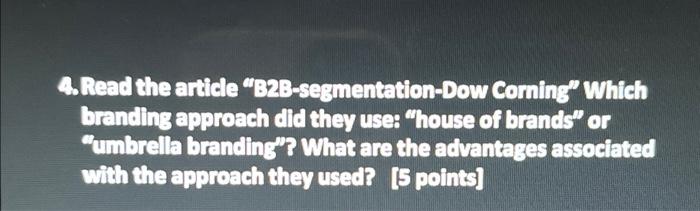
DOW CORNING B2B Segmentation
Dow Corning, in 2000, despite a 40% worldwide market share in
silicones, was facing many low cost competitors that were undercutting
the firms prices. Rather than try to match their prices and lose the price
premium across its entire volume, Dow Corning decided to research
what customers truly value.
http://thinkers50.com/blog/two-biggest-lies-marketing/
Customer Segments
They uncovered the following four customer segments:
1. Customers Seeking to Innovate Customers inventing state-of-the-art
products, creating advanced technologies, or developing new markets.
Innovation-focused customers were committed to being first-to-market
with new applications and revolutionary products.
2. Customers Seeking Productivity Increase Customers seeking off-the-
shelf products with proven performance. They needed help with
improving the acquisition, use, and disposal of products.
3. Customers Seeking to Reduce Total Cost Customers seeking supply
chain optimization for cost reduction or customer service improvement.
Other areas of support included vendor-managed inventory, custom
packaging, cost-in-use studies, and supply-chain analysis.
4. Customers Seeking Better Prices Customers in mature industries
wanted materials and services at the best price they could get. They
bought mature products in large quantities and did not require service
but instead sought quality, reliability, and low prices to make them more
cost-effective.
This customer research led to the insight that the last segment did not
value the supplementary services that Dow Corning offered. However,
since the supplementary services were bundled with the product and
provided free to all customers and their costs had to be recovered, it
made the naked solution too expensive for the last segment.
Understandably, this segment refused to pay for the services they did
not value and put pressure for lower prices. But lowering prices for this
segment without changing the fundamental market offer was problematic
because then the customers from the other three segments, which truly
valued the supplementary services, would also demand the same lower
prices.
The Xiameter Value Proposition
In 2002, to serve this low price-seeking segment, Dow Corning launched
a wholly-owned subsidiary called Xiameter. Xiameter realized they
needed to cut their prices by 15-20 percent, which was very significant in
the business markets they were serving. This could only be done
profitably, though, if the costs to serve the customer were also reduced
by a proportionate amount. Furthermore, it had to be launched in such a
manner that it did not just cannibalize existing sales in the other three
segments. The result: Xiameter was targeted to price-driven
convenience buyers of mature silicone-based products that spend over
$50,000/p.a. on silicone materials. To be both cost efficient and
attractive only to price buyers, the market offering and value proposition
were tightly defined in the following manner:
Instead of Dow Cornings fast delivery promise, Xiameter promised a
shipping date 7-20 days from date of order. This allowed Xiameter to slot
orders when there was spare capacity at Dow Corning.
No technical service. This meant Xiameter did not have to invest in an
expensive service capability.
No order size flexibility for the customer. Depending on the product,
customers must order full truck, tank, or pallet loads. This enabled
Xiameter to run efficient logistics.
Customers could enter their own orders on the website, but if they
wished to send the order by email or phone, there was a $250 charge
per order. This reduced customer interface costs.
The shipping date, once set, could not be changed unless the customer
was willing to pay a 5% surcharge. A rush order incurred a 10%
surcharge penalty, while the order cancellation fee was 5%. All of this
made production planning more predictable.
The credit terms were very tight 30 day net, 18%. This reduced
required working capital.
Product variety available was limited to 350 mature products in contrast
to the 7000 products available through Dow Corning. This limited
cannibalization as only mature products were offered, where Dow
Corning faced price competition from low cost players.
Product returns were accepted only if the goods were damaged.
The worldwide pricing was only in six major currencies so that the
currency risk and exchange was limited.
The Two Biggest Marketing Lies
To emphasize what was identical, Xiameter provided certificates of
chemical equivalency for customers to demonstrate that its newly
branded products were equivalent to the Dow Corning products. But
when this was proposed, the sales people said all Dow would do is
cannibalize sales for the full-service option. By arguing this, salespeople
revealed the two biggest lies that marketers are often trapped into:
First, despite all the power point presentations on segmentation, when
pushed, the salespeople did not believe that four segments existed. If
cannibalization was going to be such a large problem, then clearly there
is only one segment and all it cares about is price.
Second, that despite spending millions on providing so many
supplementary services to customers that marketers call value-added
services, if push comes to shove, the customer would trade them all off
for cheaper prices. If companies themselves do not believe in the value-
added nature of the services they provide for free to customers, then
customers can hardly be blamed for seeing them as simply additional
costs loaded on by suppliers into the price.
What is fascinating about the Xiameter example is that the core product
is an exact commodity. It is in the supplementary services that the
variation in tailoring the market offering is being delivered. The results for
Xiameter were excellent. The cannibalization in the first year after
launch was half of what they had projected. While the prices were 15-
20% lower, by having a web only model, they had eliminated several
cost factors like technical service, sales force and inventory costs, and
optimized other costs like logistics and production. In addition, the
working capital requirements were low as the accounts receivable are
lower and inventory is minimal. Taken together, these cost savings
yielded an attractive return on assets. Furthermore, by using the spare
capacity of the Dow Corning production lines, Xiameter also made Dow
Corning operations more efficient.
Step by Step Solution
There are 3 Steps involved in it
1 Expert Approved Answer
Step: 1 Unlock

Question Has Been Solved by an Expert!
Get step-by-step solutions from verified subject matter experts
Step: 2 Unlock
Step: 3 Unlock
 Study Help