







Question: please answer the 6 question I will leave a thumbs up is this better? these are much clear. I don't know what ref means? 2
please answer the 6 question I will leave a thumbs up 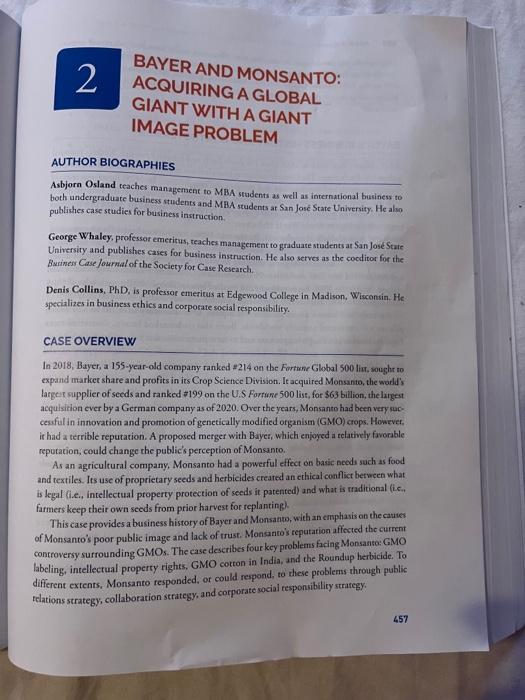
is this better? 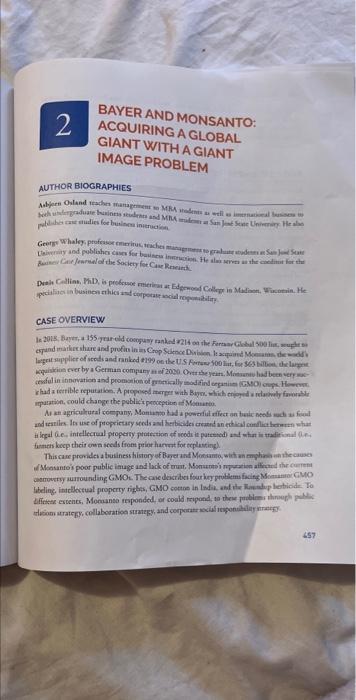
these are much clear. I don't know what ref means? 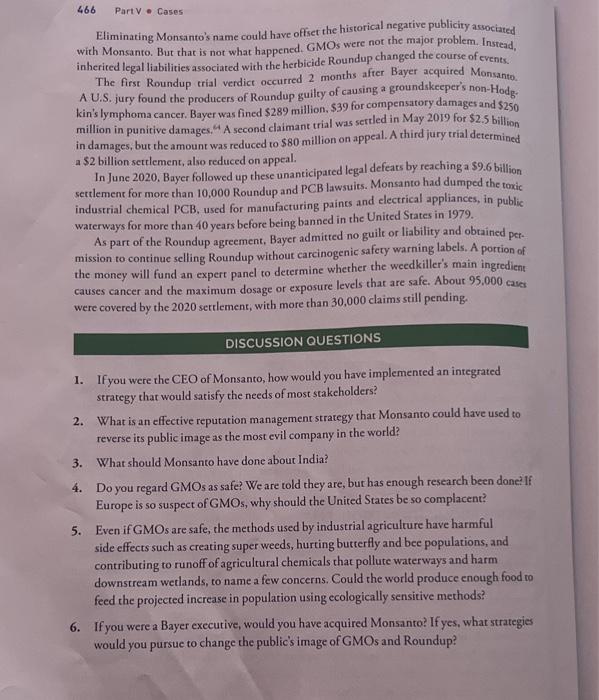
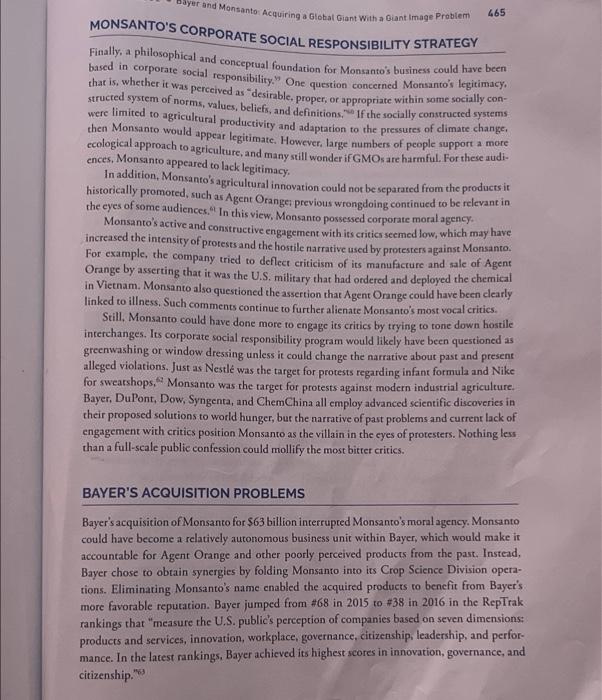
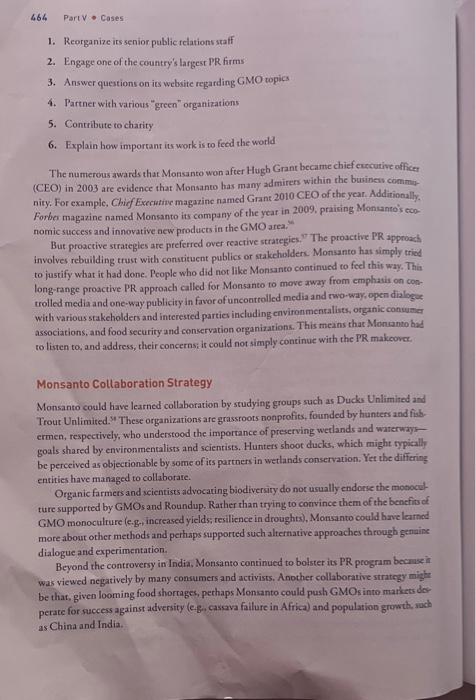
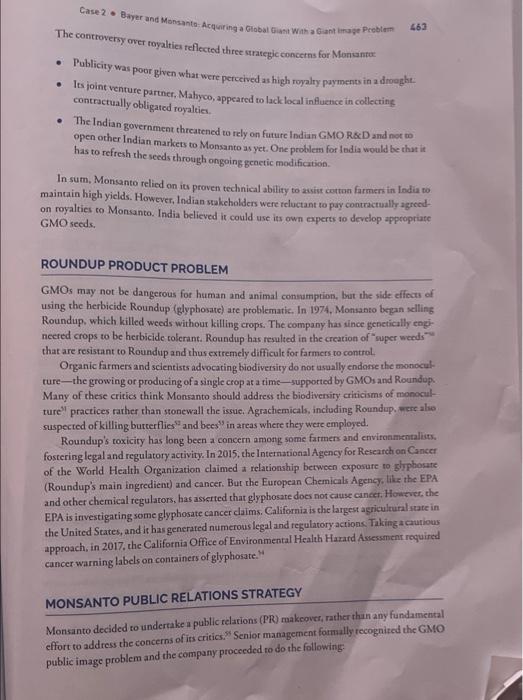
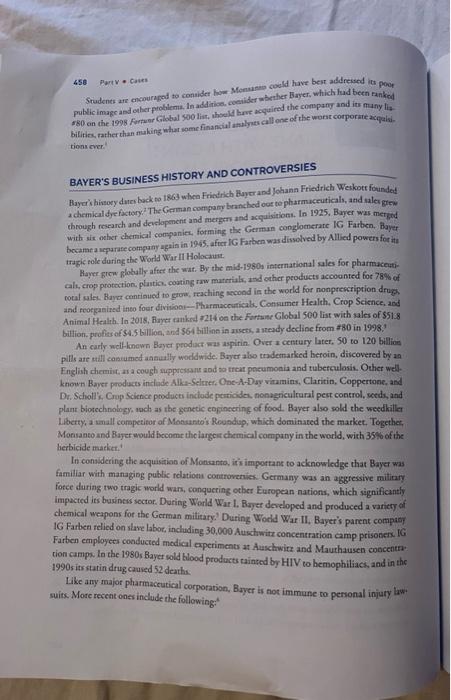
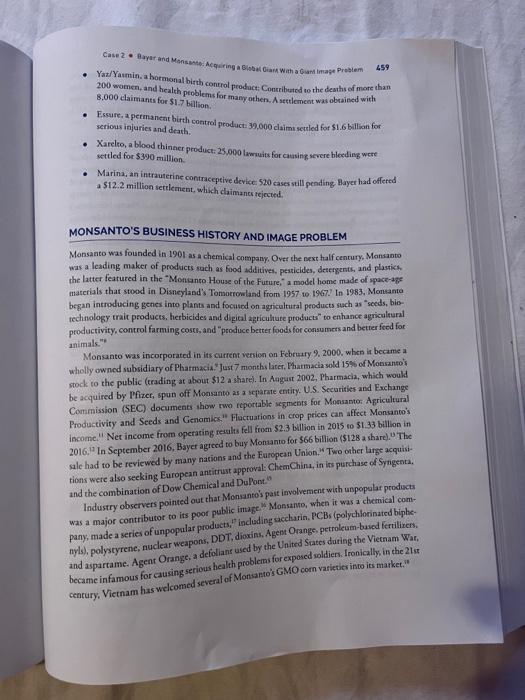
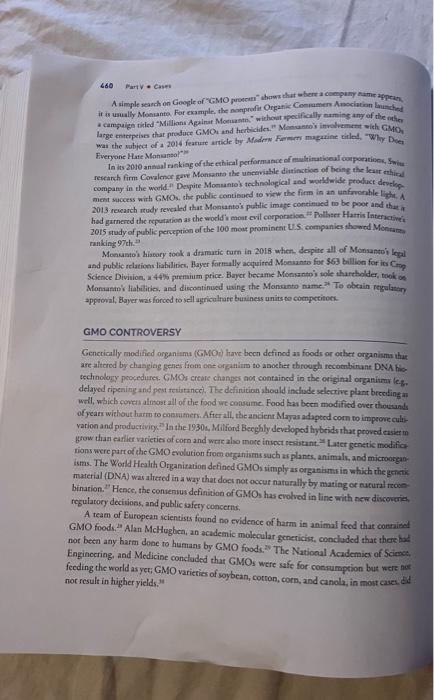
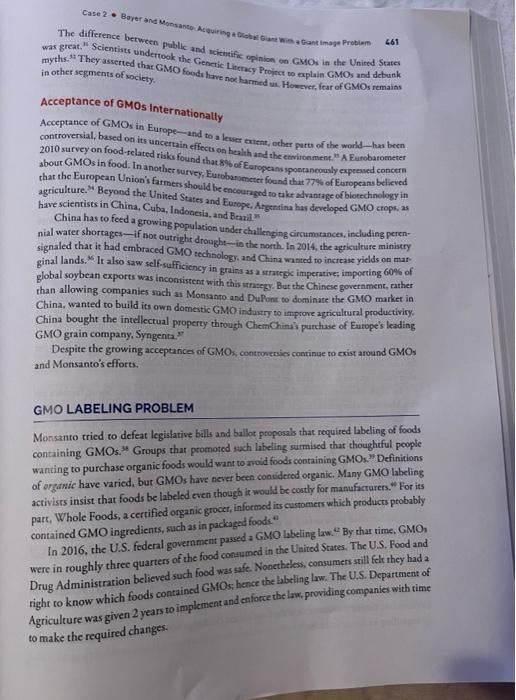
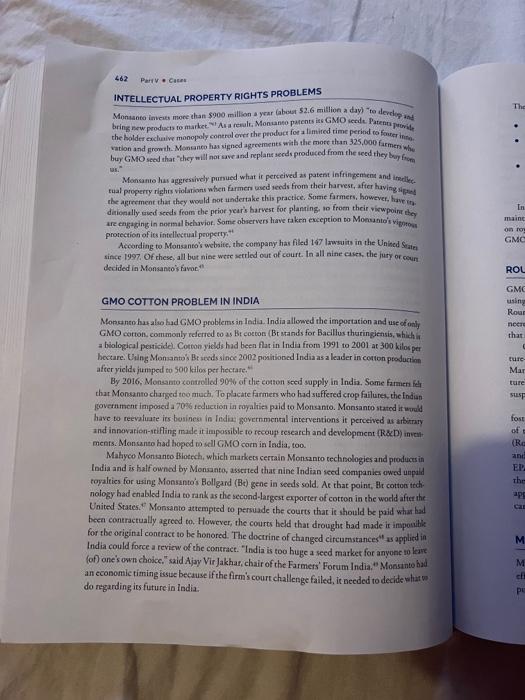
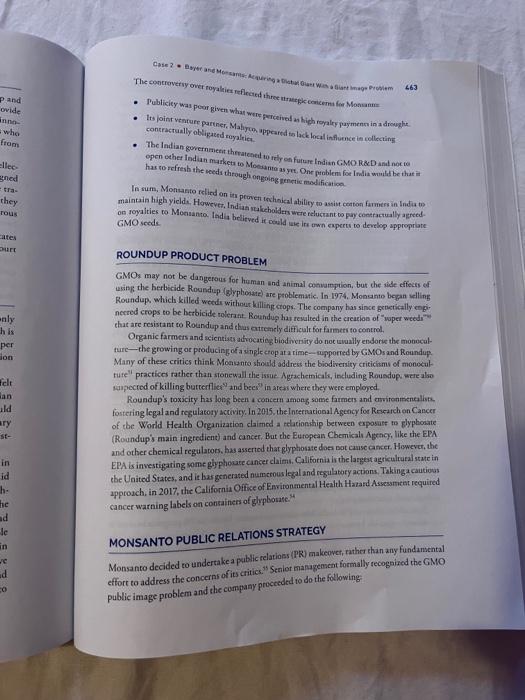
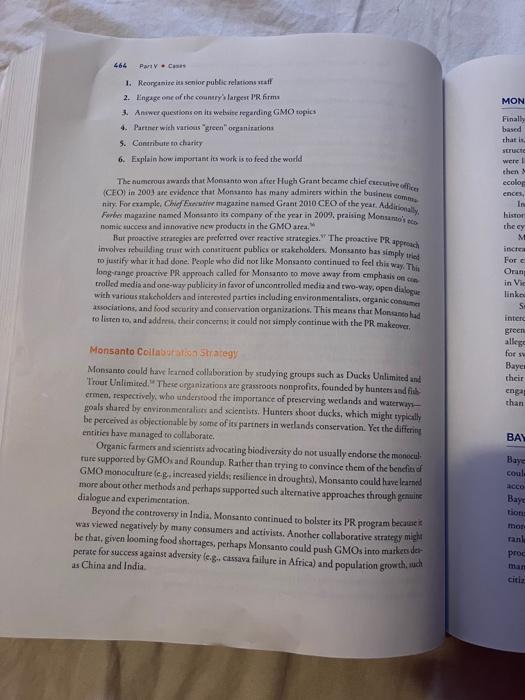
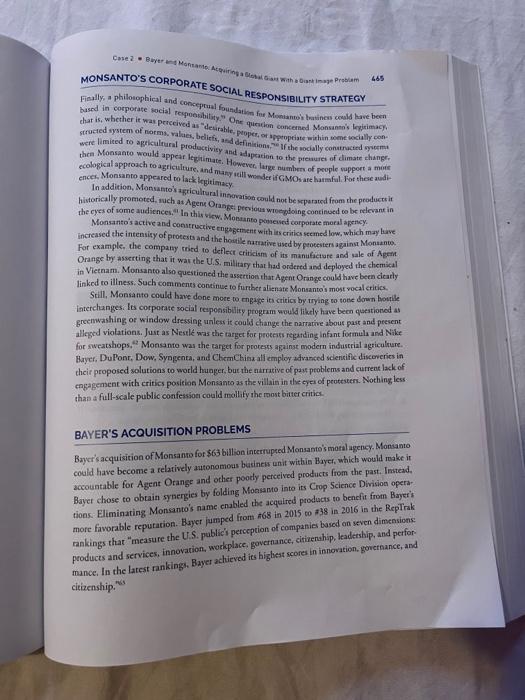
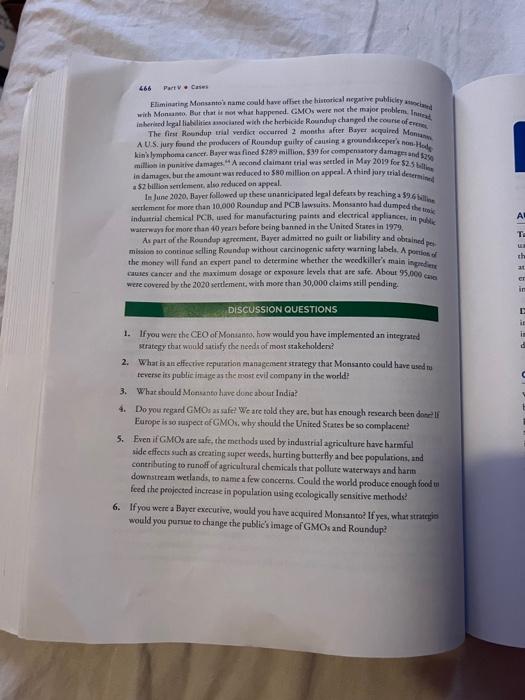
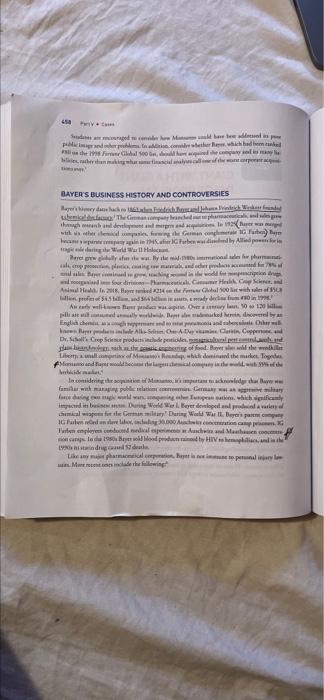
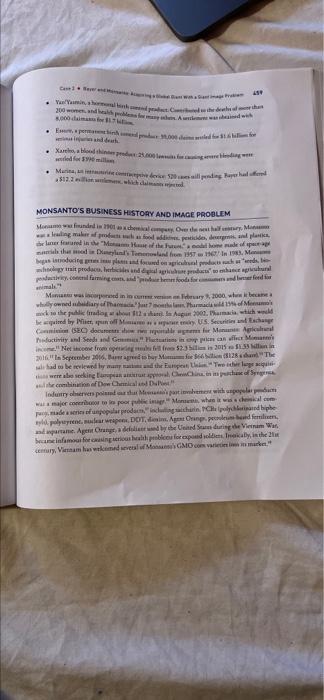
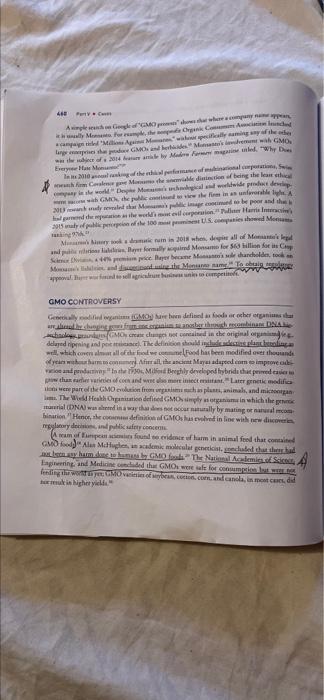
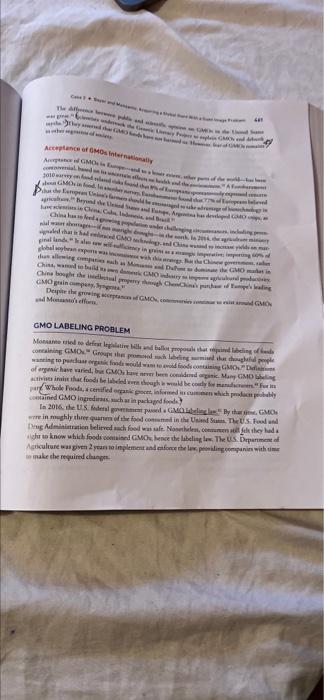
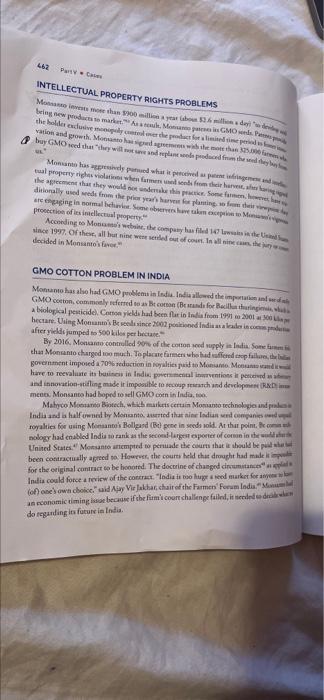
2 BAYER AND MONSANTO: ACQUIRING A GLOBAL GIANT WITH A GIANT IMAGE PROBLEM AUTHOR BIOGRAPHIES Asbjorn Osland teaches management to MBA students as well as international business to both undergraduate business students and MBA students at San Jos State University. He also publishes case studies for business instruction. George Whaley, professor emeritus, teaches management to graduate students at San Jos State University and publishes cases for business instruction. He also serves as the coeditor for the Business Case Journal of the Society for Case Research. Denis Collins, PhD, is professor emeritus at Edgewood College in Madison, Wisconsin. He specializes in business ethics and corporate social responsibility. CASE OVERVIEW In 2018, Bayer, a 155-year-old company ranked #214 on the Fortune Global 500 list, sought to expand market share and profits in its Crop Science Division. It acquired Monsanto, the world's largest supplier of seeds and ranked #199 on the U.S Fortune 500 list, for $63 billion, the largest acquisition ever by a German company as of 2020. Over the years, Monsanto had been very suc cessful in innovation and promotion of genetically modified organism (GMO) crops. However, it had a terrible reputation. A proposed merger with Bayer, which enjoyed a relatively favorable reputation, could change the public's perception of Monsanto. As an agricultural company, Monsanto had a powerful effect on basic needs such as food and textiles. Its use of proprietary seeds and herbicides created an ethical conflict between what is legal (i.e., intellectual property protection of seeds it patented) and what is traditional (i.c.. farmers keep their own seeds from prior harvest for replanting). This case provides a business history of Bayer and Monsanto, with an emphasis on the causes of Monsanto's poor public image and lack of trust. Monsanto's reputation affected the current controversy surrounding GMOs. The case describes four key problems facing Monsanto: GMO labeling, intellectual property rights, GMO cotton in India, and the Roundup herbicide. To different extents, Monsanto responded, or could respond, to these problems through public collaboration strategy, and corporate social responsibility strategy. relations: strategy, 457 458 Part Cases Students are encouraged to consider how Monsano could have best addressed its poor public image and other problems. In addition, consider whether Bayer, which had been ranked #80 on the 1998 Fortuar Global 500 list, should have acquired the company and its many lia bilities, rather than making what some financial analyses call one of the worst corporate acquisi tions ever. BAYER'S BUSINESS HISTORY AND CONTROVERSIES grew Bayer's history dates back to 1863 when Friedrich Bayer and Johann Friedrich Weskott founded a chemical dye factory. The German company branched out to pharmaceuticals, and sales p through research and development and mergers and acquisitions. In 1925, Bayer was merged with six other chemical companies, forming the German conglomerate IG Farben. Bayer became a separate company again in 1945, after IG Farben was dissolved by Allied powers for its tragic role during the World War II Holocaust. Bayer grew globally after the wat. By the mid-1980s international sales for pharmaceuti cals, crop protection, plastics, coating raw materials, and other products accounted for 78% of total sales. Bayer continued to grow, reaching second in the world for nonprescription drugs, and reorganized into four divisions-Pharmaceuticals, Consumer Health, Crop Science, and Animal Health. In 2018, Bayer canked #214 on the Fortune Global 500 list with sales of $51.8 billion, profics of $4.5 billion, and $64 billion in assets, a steady decline from #80 in 1998, An carly well-known Bayer product was aspirin. Over a century later. 50 to 120 billion pills are still consumed annually worldwide. Bayer also trademarked heroin, discovered by an English chemist, as a cough suppressant and to treat pneumonia and tuberculosis. Other well- known Bayer products include Alka-Seltzer. One-A-Day vitamins, Claritin, Coppertone, and Dr. Scholl's, Crop Science products include pesticides, nonagricultural pest control, seeds, and plant biotechnology, such as the genetic engineering of food. Bayer also sold the weedkiller Liberty, a small competitor of Monsanto's Roundup, which dominated the market. Together, Monsanto and Bayer would become the largest chemical company in the world, with 35% of the herbicide marker. In considering the acquisition of Monsanto, it's important to acknowledge that Bayer was familiar with managing public relations controversies. Germany was an aggressive military force during two tragic world wars, conquering other European nations, which significantly impacted its business sector. During World War I. Bayer developed and produced a variety of chemical weapons for the German military. During World War II, Bayer's parent company IG Farben relied on slave labor, including 30,000 Auschwitz concentration camp prisoners. IG Farben employees conducted medical experiments at Auschwitz and Mauthausen concentra tion camps. In the 1980s Bayer sold blood products tainted by HIV to hemophiliacs, and in the 1990s its statin drug caused 52 deaths. Like any major pharmaceutical corporation, Bayer is not immune to personal injury law suits. More recent ones include the following: Case 2 Bayer and Monsante; Acquiring a Global Giant With a Giant Image Problem 459 Yaz/Yasmin, a hormonal birth control product Contributed to the deaths of more than 200 women, and health problems for many others. A settlement was obtained with 8,000 claimants for $1.7 billion. Essure, a permanent birth control product: 39,000 claims settled for $1.6 billion for serious injuries and death. Xarelto, a blood thinner product: 25,000 lawsuits for causing severe bleeding were settled for $390 million. Marina, an intrauterine contraceptive device: 520 cases still pending, Bayer had offered a $12.2 million settlement, which claimants rejected. MONSANTO'S BUSINESS HISTORY AND IMAGE PROBLEM Monsanto was founded in 1901 as a chemical company. Over the next half century, Monsanto was a leading maker of products such as food additives, pesticides, detergents, and plastics, the latter featured in the "Monsanto House of the Future," a model home made of space-age materials that stood in Disneyland's Tomorrowland from 1957 to 1967. In 1983, Monsanto began introducing genes into plants and focused on agricultural products such as "seeds, bio- technology trait products, herbicides and digital agriculture products" to enhance agricultural productivity, control farming costs, and "produce better foods for consumers and better feed for animals." Monsanto was incorporated in its current version on February 9, 2000, when it became a wholly owned subsidiary of Pharmacia." Just 7 months later, Pharmacia sold 15% of Monsanto's stock to the public (trading at about $12 a share). In August 2002, Pharmacia, which would be acquired by Pfizer, spun off Monsanto as a separate entity. U.S. Securities and Exchange Commission (SEC) documents show two reportable segments for Monsanto: Agricultural Productivity and Seeds and Genomics." Fluctuations in crop prices can affect Monsanto's income." Net income from operating results fell from $2.3 billion in 2015 to $1.33 billion in 2016. In September 2016, Bayer agreed to buy Monsanto for $66 billion ($128 a share)." The sale had to be reviewed by many nations and the European Union." Two other large acquisi- tions were also seeking European antitrust approval: ChemChina, in its purchase of Syngenta. and the combination of Dow Chemical and DuPont." Industry observers pointed out that Monsanto's past involvement with unpopular products was a major contributor to its poor public image." Monsanto, when it was a chemical com- pany, made a series of unpopular products, including saccharin, PCBs (polychlorinated biphe- nyls), polystyrene, nuclear weapons, DDT, dioxins, Agent Orange, petroleum-based fertilizers, and aspartame. Agent Orange, a defoliant used by the United States during the Vietnam War, became infamous for causing serious health problems for exposed soldiers. Ironically, in the 21st century, Vietnam has welcomed several of Monsanto's GMO corn varieties into its marker." 660 Part Cases A simple search on Google of "GMO protes" shows that where a company name appea it is usually Monsanto, For example, the nonprofit Organic Consumers Association launched large enterprises that produce GMOs and herbicides." Monsanto's involvement with GMO a campaign titled "Millions Against Monsant" without specifically naming any of the other was the subject of a 2014 feature article by Modern Fermen magazine titled, "Why Does Everyone Hate Monsanto In its 2000 annual ranking of the ethical performance of multinational corporations, Swi research firm Covalence gave Monsanto the uncoviable distinction of being the least ethical company in the world." Despite Monsanto's technological and worldwide product develop ment success with GMOs, the public continued to view the firm in an unfavorable light 2013 research study revealed that Monsanto's public image continued to be poor and that a had garnered the reputation as the world's most evil corporation." Pollster Harris Interactives 2015 study of public perception of the 100 most prominent U.S. companies showed Monsan ranking 97th Monsanto's history took a dramatic turn in 2018 when, despite all of Monsanto's legal and public relations liabilities, Bayer formally acquired Monsanto for $63 billion for its Crop Science Division, a 44% premium price. Bayer became Monsanto's sole shareholder, took on Monsanto's liabilities, and discontinued using the Monsanto name." To obtain regulatory approval, Bayer was forced to sell agriculture business units to competitors. GMO CONTROVERSY Genetically modified organisms (GMO) have been defined as foods or other organisms that are altered by changing genes from one organism to another through recombinant DNA hi technology procedures. GMOs create changes not contained in the original organisms (eg. delayed ripening and pest resistance). The definition should include selective plant breeding as well, which covers almost all of the food we consume. Food has been modified over thousands of years without harm to consumers. After all, the ancient Mayas adapted corn to improve culti- vation and productivity. In the 1930s, Milford Beeghly developed hybrids that proved easier to grow than earlier varieties of corn and were also more insect resistant. Later genetic modifica tions were part of the GMO evolution from organisms such as plants, animals, and microorgan isms. The World Health Organization defined GMOs simply as organisms in which the genetic material (DNA) was altered in a way that does not occur naturally by mating or natural recom bination. Hence, the consensus definition of GMOs has evolved in line with new discoveries, regulatory decisions, and public safety concerns. A team of European scientists found no evidence of harm in animal feed that contained GMO foods. Alan McHughen, an academic molecular geneticist, concluded that there had not been any harm done to humans by GMO foods. The National Academies of Scienc Engineering, and Medicine concluded that GMOs were safe for consumption but were not feeding the world as yet, GMO varieties of soybean, cotton, corn, and canola, in most cases, did not result in higher yields." Case 2 Bayer and Monsanto: Acquiring a Global Giant With a Giant Image Problem 461 The difference between public and scientific opinion on GMOs in the United States was great." Scientists undertook the Genetic Literacy Project to explain GMOs and debunk myths. They asserted that GMO foods have not harmed us. However, fear of GMOs remains in other segments of society. Acceptance of GMOS Internationally Acceptance of GMOs in Europe-and to a lesser extent, other parts of the world-has been controversial, based on its uncertain effects on health and the environment." A Eurobarometer 2010 survey on food-related risks found that 8% of Europeans spontaneously expressed concern about GMOs in food. In another survey, Eurobarometer found that 77% of Europeans believed that the European Union's farmers should be encouraged to take advantage of biotechnology in agriculture." Beyond the United States and Europe, Argentina has developed GMO crops, as have scientists in China, Cuba, Indonesia, and Brazil. China has to feed a growing population under challenging circumstances, including peren- nial water shortages-if not outright drought-in the north. In 2014, the agriculture ministry signaled that it had embraced GMO technology, and China wanted to increase yields on mar ginal lands. It also saw self-sufficiency in grains as a strategic imperative; importing 60% of global soybean exports was inconsistent with this strategy. But the Chinese government, rather than allowing companies such as Monsanto and DuPont to dominate the GMO market in China, wanted to build its own domestic GMO industry to improve agricultural productivity. China bought the intellectual property through ChemChina's purchase of Europe's leading GMO grain company, Syngenta." Despite the growing acceptances of GMOs, controversies continue to exist around GMOs and Monsanto's efforts. GMO LABELING PROBLEM Monsanto tried to defeat legislative bills and ballot proposals that required labeling of foods containing GMOs." Groups that promoted such labeling surmised that thoughtful people wanting to purchase organic foods would want to avoid foods containing GMOs." Definitions of organic have varied, but GMOs have never been considered organic. Many GMO labeling activists insist that foods be labeled even though it would be costly for manufacturers. For its part, Whole Foods, a certified organic grocer, informed its customers which products probably contained GMO ingredients, such as in packaged foods. In 2016, the U.S. federal government passed a GMO labeling law." By that time, GMO were in roughly three quarters of the food consumed in the United States. The U.S. Food and Drug Administration believed such food was safe. Nonetheless, consumers still felt they had a right to know which foods contained GMOs; hence the labeling law. The U.S. Department of Agriculture was given 2 years to implement and enforce the law, providing companies with time to make the required changes. 462 Part V Cases INTELLECTUAL PROPERTY RIGHTS PROBLEMS Monsanto invests more than $900 million a year (about $2.6 million a day) "to devdog and the holder exclusive monopoly control over the product for a limited time period to foster bring new products to market. As a result, Monsanto patents its GMO seeds. Patents provide vation and growth. Monsanto has signed agreements with the more than 325,000 farmers wh buy GMO seed that "they will not save and replane seeds produced from the seed they buy from us. Monsanto has aggressively pursued what it perceived as patent infringement and inc tual property rights violations when farmers used seeds from their harvest, after having s the agreement that they would not undertake this practice. Some farmers, however, have ditionally used seeds from the prior year's harvest for planting, so from their viewpoint they are engaging in normal behavior. Some observers have taken exception to Monsanto's vigorous protection of its intellectual property." According to Monsanto's website, the company has filed 147 lawsuits in the United States since 1997. Of these, all but nine were settled out of court. In all nine cases, the jury or coun decided in Monsanto's favor GMO COTTON PROBLEM IN INDIA Monsanto has also had GMO problems in India. India allowed the importation and use of only GMO cotton, commonly referred to as Bt cotton (Bt stands for Bacillus thuringiensis, which is a biological pesticide). Cotton yields had been flat in India from 1991 to 2001 at 300 kilos per hectare. Using Monsanto's Be seeds since 2002 positioned India as a leader in cotton production after yields jumped to 500 kilos per hectare." By 2016, Monsanto controlled 90% of the cotton seed supply in India. Some farmers fel that Monsanto charged too much. To placate farmers who had suffered crop failures, the Indian government imposed a 70% reduction in royalties paid to Monsanto. Monsanto stated it would have to reevaluate its business in India: governmental interventions it perceived as arbitrary and innovation-stifling made it impossible to recoup research and development (R&D) invent ments. Monsanto had hoped to sell GMO corn in India, too. Mahyco Monsanto Biotech, which markets certain Monsanto technologies and products in India and is half owned by Monsanto, asserted that nine Indian seed companies owed unpaid royalties for using Monsanto's Bollgard (Be) gene in seeds sold. At that point, Be cotton tech- nology had enabled India to rank as the second-largest exporter of cotton in the world after the United States. Monsanto attempted to persuade the courts that it should be paid what had been contractually agreed to. However, the courts held that drought had made it impossible for the original contract to be honored. The doctrine of changed circumstances as applied in India could force a review of the contract. "India is too huge a seed market for anyone to leave (of) one's own choice," said Ajay Vir Jakhar, chair of the Farmers' Forum India." Monsanto had an economic timing issue because if the firm's court challenge failed, it needed to decide what do regarding its future in India. The In maint on roy GMC ROL GMC using Roun necre that ture Mar ture susp fost of (Ra and EP the app can M C M pu Pand ovide nno- who from llec ned they rous cates Curt only h is per ion felt an ald ry st- in id h- the nd le in ve d CO Case 2 Bayer and Monsams: Acquiring a Dibat Gant What meg The controversy over royalties reflected three strategic concerns for Monsan 463 . Publicity was poor given what were perceived as high royalty payments in a drought Its joint venture partner, Mabyco, appeared to lack local influence in collecting contractually obligated royalties. The Indian government threatened to rely on future Indian GMO R&D and no open other Indian markets to Monsanto as yet. One problem for India would be that it has to refresh the seeds through ongoing genetic modification In sum, Monsanto relied on its proven technical ability to assist cotton farmers in India to maintain high yields. However, Indian stakeholders were reluctant to pay contractually agreed on royalties to Monsanto. India believed it could use its own experts to develop appropriate GMO seeds. ROUNDUP PRODUCT PROBLEM GMOs may not be dangerous for human and animal consumption, but the side effects of using the herbicide Roundup (glyphosate) are problematic. In 1974, Monsanto began selling Roundup, which killed weeds without killing crops. The company has since genetically engi- neered crops to be herbicide tolerant. Roundup has resulted in the creation of "super weeds" that are resistant to Roundup and thus extremely difficult for farmers to control. Organic farmers and scientists advocating biodiversity do not usually endorse the monocul ture-the growing or producing of a single crop at a time-supported by GMOs and Roundup Many of these critics think Monsanto should address the biodiversity criticisms of monocul ture" practices rather than stonewall the issue. Agrachemicals, including Roundup, were also suspected of killing butterflies and bees" in areas where they were employed. Roundup's toxicity has long been a concern among some farmers and environmentalists. fostering legal and regulatory activity. In 2015, the International Agency for Research on Cancer of the World Health Organization claimed a relationship between exposure to glyphosate (Roundup's main ingredient) and cancer. But the European Chemicals Agency, like the EPA and other chemical regulators, has asserted that glyphosate does not cause cancer. However, the EPA is investigating some glyphosate cancer claims. California is the largest agricultural state in the United States, and it has generated numerous legal and regulatory actions. Taking a cautious approach, in 2017, the California Office of Environmental Health Hazard Assessment required cancer warning labels on containers of glyphosate. MONSANTO PUBLIC RELATIONS STRATEGY Monsanto decided to undertake a public relations (PR) makeover, rather than any fundamental effort to address the concerns of its critics." Senior management formally recognized the GMO public image problem and the company proceeded to do the following 464 Party Cases 1. Reorganize its senior public relations staff 2. Engage one of the country's largest PR firms 3. Answer questions on its website regarding GMO topics 4. Partner with various "green" organizations 5. Contribute to charity 6. Explain how important its work is to feed the world The numerous awards that Monsanto won after Hugh Grant became chief executive officer (CEO) in 2003 are evidence that Monsanto has many admirers within the business comme nity. For example, Chief Executive magazine named Grant 2010 CEO of the year. Additionally, Forbes magazine named Monsanto its company of the year in 2009, praising Monsanto's to nomic success and innovative new products in the GMO area. But proactive strategies are preferred over reactive strategies. The proactive PR approach involves rebuilding trust with constituent publics or stakeholders. Monsanto has simply tried to justify what it had done. People who did not like Monsanto continued to feel this way. This long-range proactive PR approach called for Monsanto to move away from emphasis on c trolled media and one-way publicity in favor of uncontrolled media and two-way, open dialogue with various stakeholders and interested parties including environmentalists, organic consumer associations, and food security and conservation organizations. This means that Monsanto had to listen to, and address, their concerns; it could not simply continue with the PR makeover, Monsanto Collaboration Strategy Monsanto could have learned collaboration by studying groups such as Ducks Unlimited and Trout Unlimited." These organizations are grassroots nonprofits, founded by hunters and fish ermen, respectively, who understood the importance of preserving wetlands and waterways goals shared by environmentalists and scientists. Hunters shoot ducks, which might typically be perceived as objectionable by some of its partners in wetlands conservation. Yet the differing entities have managed to collaborate. Organic farmers and scientists advocating biodiversity do not usually endorse the monocul ture supported by GMOs and Roundup. Rather than trying to convince them of the benefits of GMO monoculture (eg, increased yields; resilience in droughts), Monsanto could have learned more about other methods and perhaps supported such alternative approaches through genuine dialogue and experimentation. Beyond the controversy in India, Monsanto continued to bolster its PR program because it was viewed negatively by many consumers and activists. Another collaborative strategy might be that, given looming food shortages, perhaps Monsanto could push GMOs into markets de perate for success against adversity (eg, cassava failure in Africa) and population growth, such as China and India. MON Finally based that is structe were L then M ecolog ences, Ins histor the ey M increa For c Orang in Vie linkes S interc green allege for sw Bayes their engag than BAY Baye coul- acco Baye tions more rank proc man citiz 465 Case 2 Bayer and Monsanto Acquiring a Slobal Giant with a Diant Image Problem MONSANTO'S CORPORATE SOCIAL RESPONSIBILITY STRATEGY Finally, a philosophical and conceptual foundation for Monsanto's business could have been based in corporate social responsibility. One question concerned Monsanto's legitimacy. that is, whether it was perceived as "desirable, peoper, or appropriate within some socially con structed system of norms, values, beliefs, and definitions. If the socially constructed system were limited to agricultural productivity and adaptation to the pressures of climate change. then Monsanto would appear legitimate. However, large numbers of people support mo ecological approach to agriculture, and many still wonder if GMOs are harmful. For these di ences, Monsanto appeared to lack legitimacy In addition, Monsanto's agricultural innovation could not be separated from the product it historically promoted, such as Agent Orange previous wrongdoing continued to be relevant in the eyes of some audiences." In this view, Monsanto possessed corporate moral agency. Monsanto's active and constructive engagement with its critics seemed low, which may have increased the intensity of protests and the hostile narrative used by protesters against Monsanto For example, the company tried to deflect criticism of its manufacture and sale of Agent Orange by asserting that it was the U.S. military that had ordered and deployed the chemical in Vietnam. Monsanto also questioned the assertion that Agent Orange could have been clearly linked to illness. Such comments continue to further alienate Monsanto's most vocal critics. Still, Monsanto could have done more to engage its critics by trying to tone down hostile interchanges. Its corporate social responsibility program would likely have been questioned as greenwashing or window dressing unless it could change the narrative about past and present alleged violations. Just as Nestl was the target for protests regarding infant formula and Nike for sweatshops, Monsanto was the target for protests against modern industrial agriculture. Bayer, DuPont, Dow, Syngenta, and ChemChina all employ advanced scientific discoveries in their proposed solutions to world hunger, but the narrative of past problems and current lack of engagement with critics position Monsanto as the villain in the eyes of protesters. Nothing less than a full-scale public confession could mollify the most bitter critics. BAYER'S ACQUISITION PROBLEMS Bayer's acquisition of Monsanto for $63 billion interrupted Monsanto's moral agency. Monsanto could have become a relatively autonomous business unit within Bayer, which would make it accountable for Agent Orange and other poorly perceived products from the past. Instead, Bayer chose to obtain synergies by folding Monsanto into its Crop Science Division opera- tions. Eliminating Monsanto's name enabled the acquired products to benefit from Bayer's more favorable reputation. Bayer jumped from #68 in 2015 to #38 in 2016 in the RepTrak rankings that "measure the U.S. public's perception of companies based on seven dimensions: products and services, innovation, workplace, governance, citizenship, leadership, and perfor mance. In the latest rankings, Bayer achieved its highest scores in innovation, governance, and citizenship, 466 Part Cases Eliminating Monsanto's name could have offset the historical negative publicity with Monsanto, Bur that is not what happened. GMOs were not the major problem. Intial inherited legal liabilities associated with the herbicide Roundup changed the course of evenEL The first Roundup trial verdict occurred 2 months after Bayer acquired Mona kin's lymphoma cancer. Bayer was fined $289 million, $39 for compensatory damages and $250 AU.S. jury found the producers of Roundup guilty of causing a groundskeeper's non-Hole million in punitive damages" A second claimant trial was settled in May 2019 for $2.5 billi in damages, but the amount was reduced to $80 million on appeal. A thind jury trial determin a $2 billion settlement, also reduced on appeal. In June 2020, Bayer followed up these unanticipated legal defeats by reaching a $9.6 settlement for more than 10.000 Roundup and PCB lawsuits. Monsanto had dumped the tric industrial chemical PCB, used for manufacturing paints and electrical appliances, in public waterways for more than 40 years before being banned in the United States in 1979, As part of the Roundup agreement, Bayer admitted no guilt or liability and obtained pe mission to continue selling Roundup without carcinogenic safety warning labels. A portion of the money will fund an expert panel to determine whether the weedkiller's main ingredient causes cancer and the maximum dosage or exposure levels that are safe. About 95,000 ca were covered by the 2020 settlement, with more than 30,000 claims still pending DISCUSSION QUESTIONS 1. If you were the CEO of Monsanto, how would you have implemented an integrated strategy that would satisfy the needs of most stakeholders? 2. What is an effective reputation management strategy that Monsanto could have used mu reverse its public image as the most evil company in the world? 3. What should Monsanto have done about India? 4. 5. Do you regard GMOs as safe? We are told they are, but has enough research been done? If Europe is so suspect of GMOs, why should the United States be so complacent? Even if GMOs are safe, the methods used by industrial agriculture have harmful side effects such as creating super weeds, hurting butterfly and bee populations, and contributing to runoff of agricultural chemicals that pollute waterways and harm downstream wetlands, to name a few concerns. Could the world produce enough food feed the projected increase in population using ecologically sensitive methods? 6. If you were a Bayer executive, would you have acquired Monsanto? If yes, what strategies would you pursue to change the public's image of GMOs and Roundup? AI SANFERR T the at er in D LE in L 2 BAYER AND MONSANTO: ACQUIRING A GLOBAL GIANT WITH A GIANT IMAGE PROBLEM AUTHOR BIOGRAPHIES Asbjern Osland teaches management so MBA solens a well imernacional busines both graduate business students and MBA dan San Jos Sone University Heal pobles case studies for business instruction Georgs Whaley, professor emeritus, waches manage to graduate students in San Jual Scat Uity and publishes cases for business incrction. He also serves as the cand for the B Car Jernal of the Society for Case Research Denis Collins, PhD), is professor emeries at Edgewood College in Madison, Wacomin. He specializes in businen ethics and corporase ancial roponibiley CASE OVERVIEW In 2018 Bayer, a 155-year old company ranked #214 on the Ferman Global 500 light espand market share and profits in its Crop Science Division. It acquired Monsans, the world's largest supplier of seeds and ranked #199 on the US Fortune 500 list, for $63 billion, the largest acquision ever by a German company as of 2020. Over the years. Monsuno had been very suc cessful in innovation and promotion of genetically modifind organism (GMO) cups. However had a terrible reputation. A proposed merger with Bayer, which enjoyed a relatively favorable paration, could change the public's perception of Monaco As an agricultural company, Moniamo had a powerful effect on basic needs such as food and textiles. Its use of proprietary seeds and herbicides created an ethical conflict between what ilegal e intellectual property protection of seeds in paressed) and what is traditional ( farmers keep their own seeds from prior harvest for replanting) This case provides a business history of Bayer and Monsanto, with an emphasis on the causes of Monsanto's poor public image and lack of must. Monsanto's reputation affected the current controversy surrounding GMOs. The case describes four key problems facing Momamor GMO labeling, intellectual property rights, GMO cotton in India, and the Roundup berbicide. To different extents, Monsanto responded, or could respond, to these problems through public lations strategy, collaboration strategy, and corporate social responsibility mangy 457 450 Pay Ca draged to conde hare Mald have bee addressed i public image ander problems. In addition code whether Reper, which had head on the 1995 For Global 500 m, d her squired the company and its many l Mlkies, rather than making what itinancial analys wont corporate ac BAYER'S BUSINESS HISTORY AND CONTROVERSIES Bayer'shinery date hack to 1863am FoodshBostand John Frindrich Weke fund hemicala The Cimman company branched pharmaceuticals and sales g theagh march and develop and merge and acquisitions le 1925er was d with us other chemical companies, forming the German complimerale IG Farben) capre company again in 1945, after IG Farben was dided by All tragice during the World Warloc 7% Global 5001 with sales of $5 Bayer grew globally after the wat. By the mid-1980s international sales for pharma cals, crop poi, platics, a cing.com maal, and other pros Bernd greaching in the world f scription drugs ndogind four dir-Pamatical, Came Health Coup, and Animal Heal, In 2018 In 2018 Bayed 214 on the allion prof of $4.51 4 Stallion and S 3564 ble in asady decline fum 80 in 199 Au cathy well-known for produs wasapitin. Over arry lau. 50 so 120 b pillare att und ally worldwide. Beper ale madenacked herein, discovered by an Engli chenagheppan and to pan and rabosisi Ocher wil knew Bayer pes include Alka Ses Our A-Day amin, Clarin Coppen Dr. Scholl's Crop Scien products include pesticides, garapentemerland pa bansach as the peastic anghering of food. Buyer als sol the end Liberall contine of Mons Roundups, which dominued the market. Toge Mander would become the largest chemical company in the world with 99% of the berbicide maket In considering the acquisition of Mananso, it's important to acknowledge that Ba familar with managing public relation comes Germany was a very le ding wag world warning Tusopean nations, which significandy impacted its bus During World War I. Bayer developed and produced a variety of chemical weapers for the German military During World War II, Bayer's paieme company IG Farben reed en slave labos, including 30.000 Auch conceration cap pris K Farben employen conducted medical experiments at Auschwitz and Mahasen concentre, on camps In de 1980s Beyer sold blood products rained by HIV so hemophilies, and in the 1990s drug caused 2 da Like any ma pharmacnical corporation, Bayeris Mies include the following immune to petusnal injury Ca . minbikend profect Contr 200 women and health problems for many chers Awa perp000 $1 and death Xarel, a blood thindepend led for $990 mill 25.000 Marina, pove device 120 cases will pending Paper had affred $12.2lem, which claiman 459 MONSANTO'S BUSINESS HISTORY AND IMAGE PROBLEM Moramo wa founded in 1901 as a chemical company Over the next half century M leading maker of products such as food addies, pesticides, devergos, and plantic the lanter featured in the "Mata Hause of the Furenta oodal home made of space-age marial that moodin Duneyland's Tenenosland from 1957 a 1967 In 1983. M begas introducing gesiu plants and focused on agricultural products such an "ands, hogy trait prodaco, herbicides and digical agriduse products to enhance agricultural pedacityconal farming es, and "pedir hemet foods formers and I feed for Monat was incorpored in in cuest version on February 9, 2000, when it became wholly owned subsidiary of Pharmacie Jast 7 months las Pharmacia wild 15% of Men's mock to the public trading about $12 a shart. In Augun 2002. Pharmacia, which would bequired by Miser, spun off Mare a separar endry US. Securities and Exchange Commision (SEC) documents show ne portable agems for Menns Agricul Productivity and Seeds and Genmes" Huctuations in cop prices can affect Mom's income. Net income from operacing meals fill from $2.3 billion in 2015 $1.33 lin 2016"In September 2006. Barer agreed to buy Minu fie 366 billion (8128 a hand" The sal had to be reviewed by many natin and the Europest UiTwo other lange squi ts were also seeking tampan arust approval, ChiChina, in its purchase of Syngen and the combination of Dow Chemical and Dale Industry observers poiad una dut Messas paot involvement with unpopular pats was a major contributor to in poor public image" Monse, when it was a chesical com pay, made a series of unpopular products, including saccharin, PCH (polychlorinated hiphe syld polyyrent, nudlear weapons, DDT, desin. Agent Orangs, pecouleum bend fertilisers, and apartame. Agent Orange, a defoliaer used by the United States during the Vietnam Wa became infamous for causing serious health probices for exposed soldiers Imically, in the 21 century, Vietnam has welcomed several of Monsans's GMO com varieties marke 460 C simple search on Google of GMO p shows that where a company name appen ly Mont For example, the nonpa Cheganic Com Asociation Inched campaign tiled "Millions Again Mann wishet spesifically naming say of the other lange pises shapde GMOs and herbicides Mansa's invement with GMO water subject of 2014 ae by Made Formen magasine unled, "Why Des Everyone Hate Mon In 2010 al king of the ethical performance of makinational corporations, S each form Covalence e Monum the ancialde distinction of being the least ethical company in the world Dephe Mos uchnological and worldwide product desc with GMO the public continued to view the firm in an unfavorable light A 2013 andy revealed that Mosamma's public image continued to be poor and the had garmend the reporation as the world's most evil corporation Polluter Harris Interac 2015 anady of public percepcion of the 100 most prominent U.S. companies showed Monsan king 97 M's history took a dramatic rum in 2018 when, despite all of Man's legal and public in aldes, Beyer formally acquired Monsamo for $63 billion for its Cap SD44% premis price Bayer became Monsanto's sole thancholdes, took an Mom's and disanding the Menanam To obja approval. Bu fond to sell agriculture business unies to competito GMO CONTROVERSY Generally modified vegani GMO have been defined as foods or other organises that are alcand be shinging from organisms anosher through recombinan DNA halosprandas GMOs crease changes not contained in the original organi delayed ripening and pot ateinance). The definicion should include adecting plant betolinga well, which covers almost all of the food we conmmelFood has been modified over thousands of years without harm to come. After all, the ancient Mayas adapted.com to improve c vation and productivity. In the 1930s, Millesd Beeghly developed hybrids that pesmed easier to grow than earlier varieties of con and went also more insect existant."Later genetic modifica ons were part of the GMO evolusion from organisms much as planes, animals, and microorgan lams. The Wild Health Organisation defined GMOs simply as organisme in which the ge material (DNA) was altered in a way that does not occar naturally by mating or natural mom binarion Hence, the consentes definition of GMOs hus evolved in line with new discoverin regulatory decisions, and public safety concer A team of Eumpean acimits found so dence of harm in animal feed that contained GMO food Alas McHughes, an academic molecular geneticist, gencluded that there had as been any harm done to hamasa by GMO fonds The National Academies of Scienc Engineering, and Medicine concluded that GMOs were safe for consumption for wo fending the words yet GMO varieties of sybean, coon, come and canola, in most cases, did horreuk in higher yield" 4 The Afp and d www.the Gay Perw layed the Cha - explain GC and deb Acceptance of GMOs Internationally ACC in and o conversial bud 2010 survey on And about GMOs ini conflu Awadh "A Fa Campus the Eampen Unis beyond the end Topleved Irage of dig developed C A lavescens in Chene Cala Indennis and Back China allenging sinumanues, including th, In 2004 agrade mini Chine wand o incids on ma s strangu imperative; in feel growing population under la slight ed harde GMO gial land als w self-allaciency in grains global phe experts was inc dan allewing companies such as Man and Define so dominate the GMO main with this gs B dhe Chinese par China, wa to build town dic GMO industry to ingem agrund p China bough the al propery though ChenChina's puhaf pealing CMO grain company, Synges GMO Despite the growing acceptances of GMO, come and Moto's effort GMO LABELING PROBLEM people Monsanto ried to defeat legalative bills and ballon proposals that id labeling of hands containing GMOs Groups that promosol suck being med the dough wanting to purchase organic foods would want to avoid foods containing GMOD of ergenic have varied, but GMOs have never been considend organic Many CMO activists insist that foods be labeled even though is would be conly be mandou par Whole Foods, a cenified organic pocet, informed its cummen which proda contained GMO ingredienss, such as in packaged foods ling For ins obably GMOs In 2016, the US federal government passed a GMO labeling lam" By that were in roughly three quares of the food consumed in the Uniend St. The US Food and Drug Administration believed such food was safe. Nonetheless, consumer att folk they had a ght to know which foods contained GMO hence the labeling lew. The US Department of Agriculture was given 2 years to implement and enfonce the lew, providing companies with time to make the required changes herp of de w 462 Party Ca INTELLECTUAL PROPERTY RIGHTS PROBLEMS Mon invests more than $900 million a year (aboun 52.6 million a day) devida being new products to market. As a resul, Monsan pas is GMO P the holder exclusive monopoly control over the product for a limited time period vation and growth. Monsanto has signed agreements with the more than 325.000 fa buy GMO seed that they will not save and replane soods produced from the send they Monsanto has aggressively punued what it perceived as patent infringemene and tual property rights violations when farmen und sends from their harvest, after having the agreement that they would not undertake this practice. Some farmen, however dicionally used seeds from the prior year's harvest for planting, so from their vi are engaging in normal behavior. Some observers have taken exception to Monas protection of les intellectual property According to Monum's website, the company has filed 147 lawsuits int since 1997. Of these, all but nine were sended out of court. In all nine ca, the Unid decided in Monsanto's fo GMO COTTON PROBLEM IN INDIA Monsanto has also had GMO problems in India India allowed the importation and werd a GMO corton, commonly referred to as Be coon (Be stands for Bacillus thuringii whats a biological pesticide). Comon yields had been flar in India from 1991 ao 2001 a 300 hectare. Using Monsanto's Be seeds since 2002 positioned India as a leader in compro after yields jumped to 500 kilos per hectare. By 2016, Monsanno controlled 90% of the cotton seed supply in India. Some that Monsanto charged too much. To placare farmers who had suffered crop failes, the government imposed a 70% reduction in royalties paid to Monsanto Monsans and have to reevaluate its business in Indis, governmental inventions it perceived a and innovation-stifling made it impossible to secoup mesranch and development (R&D ments. Monsanto had hoped to sell GMO corn in India, too. Malyco Monsanto Biotech, which markets certain Momanto technologies and pres India and is half owned by Monsanto, asserted that aine Indian send companies owed w royalties for using Monsanto's Bollgard (Be) gene in seeds sold. At that point. Becom nology had enabled India to rank as the second-largest exporter of corson in the woda United States. Monsanto attempted to persuade the courts that it should be paid wh been contractually agreed to However, the courts held that drought had made it imp for the original contract to be honored. The doctrine of changed circumstances" a plads India could force a review of the contract. "India is too huge a seed market for any lo (of) one's own choice," said Ajay Vir Jakhar, chair of the Farmers Forum India. Mu an economic timing issue because if the firm's court challenge failed, it seeded so decide wha do regarding its future in India. Casey Ang tawa The coversy over alles reflected showegic concerns for Mem Publicity was pose given what we perved as highly payme 643 . In joint venture partney, Malyon, appeared to lach local in collecting contractually obligand soyalties The Indian government seemed no rely on fare Indies GMO RAD opre other Indian madkasso Mensaver. One poblem for india wld be has to refresh the weeds through angsing gets modfion In sum. Monsanto relied on its proven tohnical shility on a maintain high yields. However, Indian nakeholders we can pay actually pre on royalties to Monsanto India believed could use in own experts sa devchap appropria GMO seeds. fin d ROUNDUP PRODUCT PROBLEM GMOs may not be dangerous for human and animal consumption, but the side effects of using the herbicide Roundup grphone) are problematic. In 1974, Menans began selling Roundup, which killed weeds without killing crops. The company has since genetically eng neered crops en be herbicide tolerant. Roundup has resulted in the cmation of "super wends that are resistant to Roundup and thus extremely difficul for farmers to com Organic farmers and scientists advocating biodiversity do not anually done the ure-the growing or producing of a single cop at a time-supported by GMO and R Many of these critics think Monsans should adds the biodivenity crics of cal ture" practices rather than soonewall the issue. Agrochemicals, including Round suspected of killing butterflies" and bers" in amas where they were employed. Roundup's toxicity has long been a concern among some farmers and environmentalists fostering legal and regulatory activity. In 2015, the International Agency for Researd on Cancer of the World Health Organization claimed a relationship between exposure so glyphosat (Roundup's main ingredient) and cancer. But the European Chemicals Agency, like the EPA and other chemical regulators, has anerted that glyphosate does not cause cane However, the EPA is investigating some glyphosate cancer claims. California is the larges agricultural state in the United States, and it has generated numerous legal and regulatory actions. Taking a cautious approach, in 2017, the California Office of Environmental Health Hasard Ammens requiand cancer warning labels on containers of glyphosate MONSANTO PUBLIC RELATIONS STRATEGY Monsanto decided to undertake a public relations (PR) enakeover, rather than any fundamental effort to address the concerts of its critics." Senior management finally recognized the GMO public image problem and the company proceeded to do the following 464 Par C 1. Morgen senior public relations f 2. Engage one of the coury's largest PR m 3. Aner questions on ins web ganding GMO pic 4. Pare with various "green" organisations 5. Courbure to charity 6. Explain how imponane its work is to feed the world The sum wands that Moman won after Hugh Grant became chief executive office (CEO) in 2005 are evidence that Monsanne has many admirers within the business co ity For example, Chief Executive magazine named Grant 2010 CEO of the year. Addition Fore magazine and Mimaan its company of the year in 2009, praising Monsanto's nomic succes and innovative new products in the GMO area But proactive strategies are preferred over reactive strategies. The proactive PR appa ines rebuilding trus with constant publics or stakeholders Monsanto has simply tried justify what it had done. People who did not like Monuanco continued to feel this way. This long-range proactive PR approach called for Monsanto to move away from emphasis on con wolled media and one-way publicity in favor of uncontrolled media and two-way, open dialogue with various stakeholders and interessed parties including environmentalists, organic consumer asociations, and food security and conservation organizations. This means that Monsanto had solinen so and address, their concern is could not simply continue with the PR makeover Mons. Csation Strategy Monsant could have learned collaboration by arudying groups such as Ducks Unlimited and Trout Unlimited." These organizations are grassroots nonprofits, founded by hunters and fish ermen, respectively, who understood the importance of preserving wetlands and waterways goals shared by environmentalions and scientists. Hunters shoot ducks, which might typically be perceived an objectionable by some of its partners in wetlands conservation. Yet the differing entities have managed in collaborate Organic farmers and scientists advocating biodiversity do not usually endorse the monocul ture supported by GMO and Roundup, Rather than trying to convince them of the benefits of GMO monoculture (eg, increased yields resilience in droughes), Monsanto could have learned more about other methods and perhaps supported such alternative approaches through graine dialogue and experimentation. Beyond the controversy in India, Monsanto continued to bolster its PR program because it was viewed negatively by many consumers and activists. Another collaborative strategy might be that, given looming food shortages, perhaps Monsanto could push GMOs into markets de perate for success against adversity (eg. cassava failure in Africa) and population growth, sich as China and India. Case 2 and get a With Diet P MONSANTO'S CORPORATE SOCIAL RESPONSIBILITY STRATEGY Finally, a philosophical and conceprual foundation for Mom's new could have b based in corporate social responibiley" One questions concerned Mosame's legitimacy. that is, whether it was perceived as "desirable, proper, or appropriate within some socially com structed synem of norms, valur, beliefs, and definitions the scially conducted system were limited so agricultural productivity and adaptation to the pressurs of climate change. then Monsanto would appear legitimant. However, large numbers of people support amo ecological approach so agriculture, and many will wonder if GMO are harmful. For theur audi ences, Monas appeared to lack legitimacy In addition, Mona's agricultural innovation uld not be separated from the prod historically promoted, such as Agent Orange pengcond be ent the eyes of some audiences. In this view. Mped corpore moral p Monsann's active and constructive engagement with its critics seemed low, which may have increased the intensity of poems and the hostile narrative and by peotesers against Mon For example, the company tried to deflect criticism of its manufacture and sale of Age Orange by asserting that it was the US military that had ondered and deployed the chemical in Vietnam Monsanto also questioned the assertion than Agree Orange could have been clearly nked to illors. Such comments continue to further alienate Monsanto's most vocal critic Still, Monsanto could have done moer to page is critics by trying to time down ho interchanges. In corporate social responsibility program would likely have been questioned greenwashing or window dressing unless it could change the narrative about past and p alleged violations. Just as Nestle was the target for protests mganding infant formula and Nike for sweatshops, Monsanto was the target for protests again modern industrial agricul Bayer, DuPont, Dow, Syngenta, and ChemChina all employ advanced scientific discoveries in their proposed solutions to world hunger, but the narrative of past problems and current lack of engagement with critics position Monsanto as the villain in the eyes of processen. Nothing less than a full-scale public confession could mollify the most bitter critics BAYER'S ACQUISITION PROBLEMS Bayer's acquisition of Momanto for $63 billion interrupted Monsano's moral agency. Monsanto could have become a relatively autonomous business unit within Bayer, which would make it accountable for Agent Orange and other poodly perceived products from the past. Instead. Bayer chose to obtain synergies by folding Monsanto into its Crop Science Division opera tions. Eliminating Monsanto's name enabled the acquired peoducts to benefit from Bayer's more favorable reputation. Bayer jumped from #68 in 2015 to #38 in 2016 in the RepTrak rankings that "measure the U.S. public's perception of companies based on seven dimension products and services, innovation, workplace, governance, citizenship, leadership, and perfor mance. In the latest rankings, Bayer achieved its highest scores in innovation, governance, and citizenship. Part V Cases Eliminating Mom's name could have offset the histical negative publicity and with Momann Bur that is not what happened GMOs were not the major probion. In inherited legal liabilities acred with the herbicide Roundup changed the course of even The first Roundp trial vendicet occurred 2 months after Bayer acquired M AUS jury found the producers of Roundup guilty of causing a groundskeeper's non-Hole kin's lymphoma cancet. Bayer was fined $289 million, 539 for compensatory damages and million in punitive damages." A second claimant reial was settled in May 2019 for $2.5 in damages, but the amount was reduced to $80 million on appeal. A third pery trial d $2 billion settlement, also reduced on appeal. In June 2020, Bayer followed up these unanticipated legal defeats by reaching a $9 element for more than 10.000 Roundup and PCB lawsuits. Monsanto had dumped the ma industrial chemical PCB, sed for manufacturing paints and electrical appliances, in pub waterways fee more than 40 years before being banned in the United States in 1979. As part of the Roundup agreement, Bayer admitted no guilt or liability and obtained per mission to continue selling Roundup without carcinogenic safety warning labels. A persion of the money will fand an expert panel to determine whether the weedkiller's main ingredie causes cancer and the maximum douge or exposure levels that are safe. About 95.000 were covered by the 2020 settlement, with more than 30,000 claims still pending DISCUSSION QUESTIONS 1. If you were the CEO of Monsanto, how would you have implemented an integrated strategy that would satisfy the needs of most stakeholders! 2. What is an effective reputation management strategy that Monsanto could have used so reverse its public image as the most evil company in the world? 3. What should Monsanto have done about India? 4. Do you regard GMOs as safe! We are told they are, but has enough research been done! If Europe is so suspect of GMOs why should the United States be so complacent? 5. Even if GMOs are safe, the methods used by industrial agriculture have harmful side effects such as creating super weeds, hurting butterfly and bee populations, and contributing to runoff of agricultural chemicals that pollute waterways and harm downstream wetlands, to name a few concerns. Could the world produce enough food t feed the projected increase in population using ecologically sensitive methods 6. If you were a Bayer executive, would you have acquired Monsanto? If yes, what strategies would you pursue to change the public's image of GMOs and Roundup 466 Part V Cases Eliminating Monsanto's name could have offset the historical negative publicity associated with Monsanto. But that is not what happened. GMOs were not the major problem. Instead, inherited legal liabilities associated with the herbicide Roundup changed the course of events. The first Roundup trial verdict occurred 2 months after Bayer acquired Monsanto. A U.S. jury found the producers of Roundup guilty of causing a groundskeeper's non-Hodg kin's lymphoma cancer. Bayer was fined $289 million, $39 for compensatory damages and $250 million in punitive damages." A second claimant trial was settled in May 2019 for $2.5 billion in damages, but the amount was reduced to $80 million on appeal. A third jury trial determined a $2 billion settlement, also reduced on appeal. In June 2020, Bayer followed up these unanticipated legal defeats by reaching a $9.6 billion settlement for more than 10,000 Roundup and PCB lawsuits. Monsanto had dumped the toxic industrial chemical PCB, used for manufacturing paints and electrical appliances, in public waterways for more than 40 years before being banned in the United States in 1979. As part of the Roundup agreement, Bayer admitted no guilt or liability and obtained per- mission to continue selling Roundup without carcinogenic safety warning labels. A portion of the money will fund an expert panel to determine whether the weedkiller's main ingredient causes cancer and the maximum dosage or exposure levels that are safe. About 95,000 cases were covered by the 2020 settlement, with more than 30,000 claims still pending. DISCUSSION QUESTIONS 1. If you were the CEO of Monsanto, how would you have implemented an integrated that would satisfy the needs of most stakeholders? strategy 2. What is an effective reputation management strategy that Monsanto could have used to reverse its public image as the most evil company in the world? 3. What should Monsanto have done about India? 4. Do you regard GMOs as safe? We are told they are, but has enough research been done? If Europe is so suspect of GMOs, why should the United States be so complacent? 5. Even if GMOs are safe, the methods used by industrial agriculture have harmful side effects such as creating super weeds, hurting butterfly and bec populations, and contributing to runoff of agricultural chemicals that pollute waterways and harm downstream wetlands, to name a few concerns. Could the world produce enough food to feed the projected increase in population using ecologically sensitive methods? 6. If you were a Bayer executive, would you have acquired Monsanto? If yes, what strategies would you pursue to change the public's image of GMOs and Roundup? 465 ayer and Monsanto: Acquiring a Global Giant With a Giant Image Problem MONSANTO'S CORPORATE SOCIAL RESPONSIBILITY STRATEGY Finally, a philosophical and conceptual foundation for Monsanto's business could have been based in corporate social responsibility." One question concerned Monsanto's legitimacy. that is, whether it was perceived as "desirable, proper, or appropriate within some socially con- system of norms, values, beliefs, and definitions. If the socially constructed systems were limited to agricultural productivity and adaptation to the pressures of climate change. then Monsanto would appear legitimate. However, large numbers of people support a more ecological approach to agriculture, and many still wonder if GMOs are harmful. For these audi- ences, Monsanto appeared to lack legitimacy. structed In addition, Monsanto's agricultural innovation could not be separated from the products it historically promoted, such as Agent Orange: previous wrongdoing continued to be relevant in the eyes of some audiences. In this view, Monsanto possessed corporate moral agency. Monsanto's active and constructive engagement with its critics seemed low, which may have increased the intensity of protests and the hostile narrative used by protesters against Monsanto. For example, the company tried to deflect criticism of its manufacture and sale of Agent Orange by asserting that it was the U.S. military that had ordered and deployed the chemical in Vietnam. Monsanto also questioned the assertion that Agent Orange could have been clearly linked to illness. Such comments continue to further alienate Monsanto's most vocal critics. Still, Monsanto could have done more to engage its critics by trying to tone down hostile interchanges. Its corporate social responsibility program would likely have been questioned as greenwashing or window dressing unless it could change the narrative about past and present alleged violations. Just as Nestl was the target for protests regarding infant formula and Nike for sweatshops, Monsanto was the target for protests against modern industrial agriculture. Bayer, DuPont, Dow, Syngenta, and ChemChina all employ advanced scientific discoveries in their proposed solutions to world hunger, but the narrative of past problems and current lack of engagement with critics position Monsanto as the villain in the eyes of protesters. Nothing less than a full-scale public confession could mollify the most bitter critics. BAYER'S ACQUISITION PROBLEMS Bayer's acquisition of Monsanto for $63 billion Step by Step Solution
There are 3 Steps involved in it
1 Expert Approved Answer
Step: 1 Unlock

Question Has Been Solved by an Expert!
Get step-by-step solutions from verified subject matter experts
Step: 2 Unlock
Step: 3 Unlock
 Study Help