







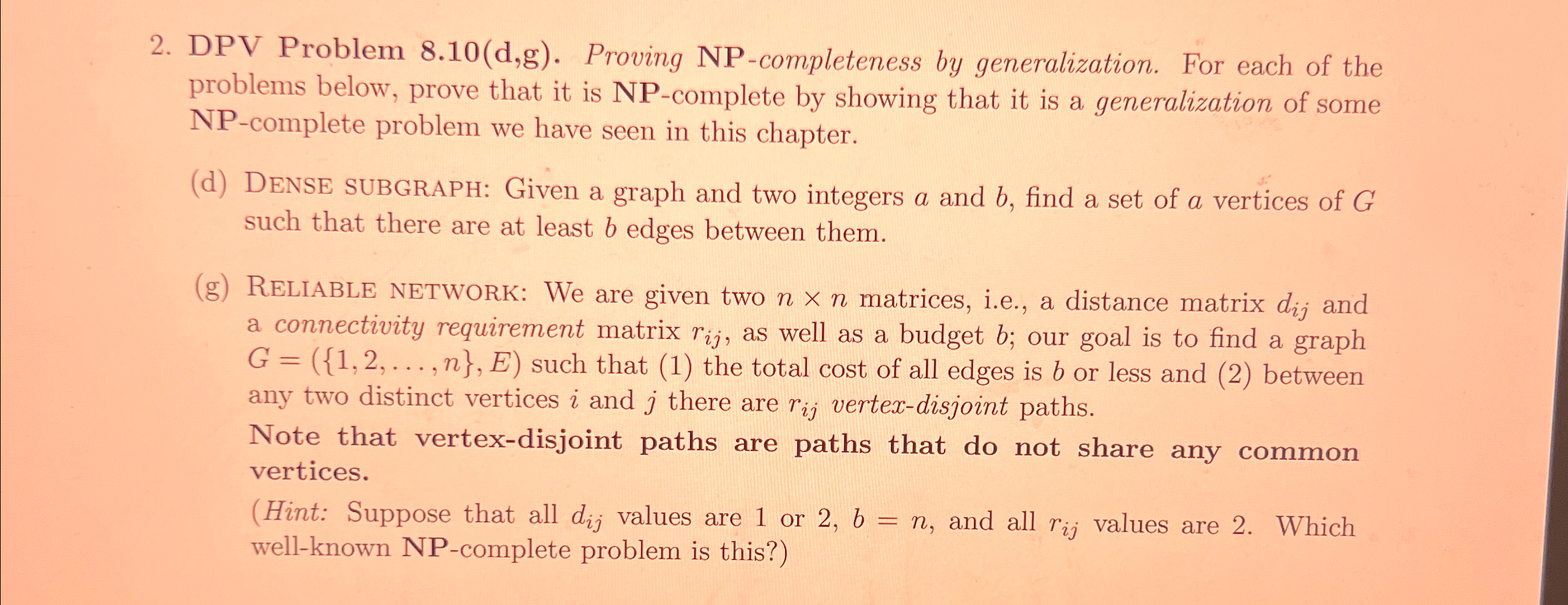
Question: DPV Problem 8 . 1 0 ( d , g ) . Proving NP - completeness by generalization. For each of the problems below, prove
DPV Problem Proving NPcompleteness by generalization. For each of the problems below, prove that it is NPcomplete by showing that it is a generalization of some NPcomplete problem we have seen in this chapter.
d DENSE SUBGRAPH: Given a graph and two integers a and find a set of a vertices of such that there are at least edges between them.
g Reliable network: We are given two matrices, ie a distance matrix and a connectivity requirement matrix as well as a budget ; our goal is to find a graph dots, such that the total cost of all edges is or less and between any two distinct vertices i and there are vertexdisjoint paths.
Note that vertexdisjoint paths are paths that do not share any common vertices.
Hint: Suppose that all values are or and all values are Which wellknown NPcomplete problem is this?
Step by Step Solution
There are 3 Steps involved in it
1 Expert Approved Answer
Step: 1 Unlock

Question Has Been Solved by an Expert!
Get step-by-step solutions from verified subject matter experts
Step: 2 Unlock
Step: 3 Unlock
 Study Help