







Question: Draw up a flow chart with the following experimental procedure to be followed: 1.Two reagent feed flows ( 70 and 100ml/min ) will be used.
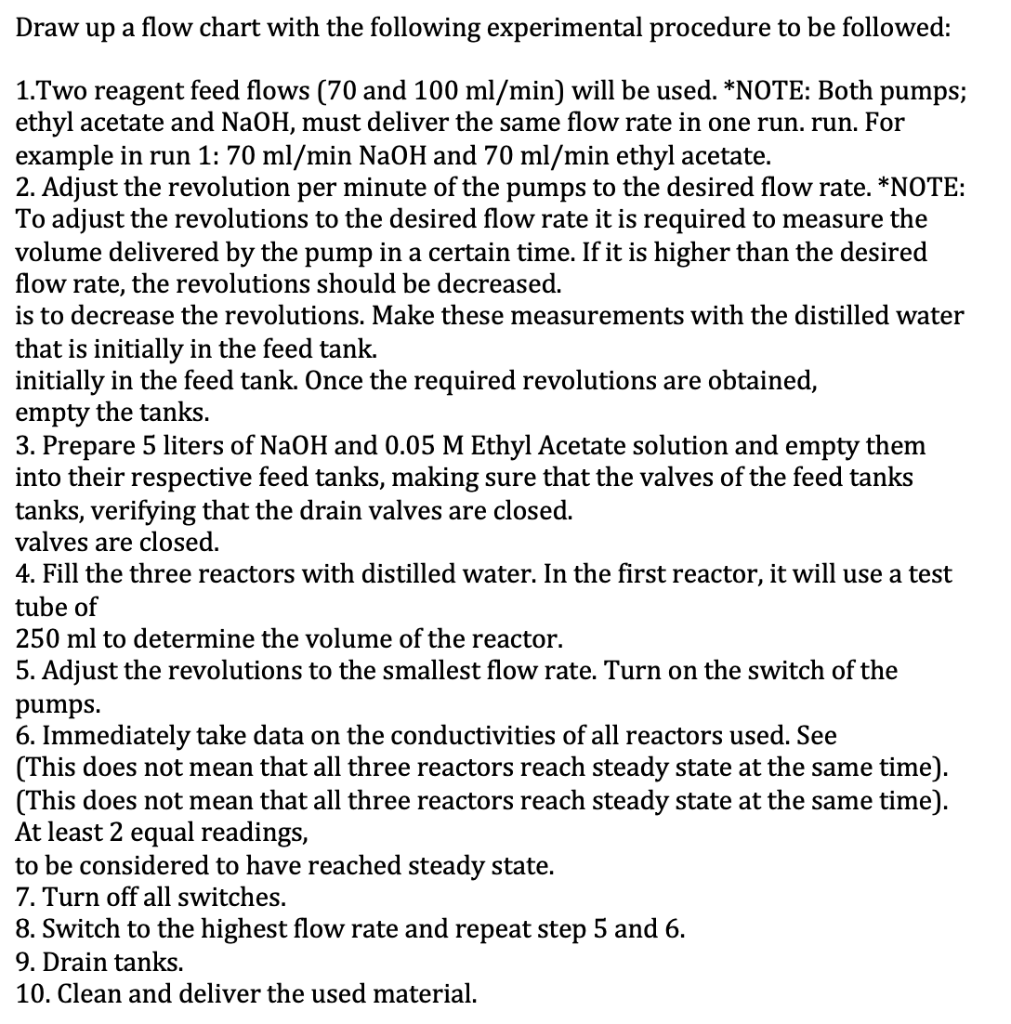
Draw up a flow chart with the following experimental procedure to be followed: 1.Two reagent feed flows ( 70 and 100ml/min ) will be used. *NOTE: Both pumps; ethyl acetate and NaOH, must deliver the same flow rate in one run. run. For example in run 1:70ml/minNaOH and 70ml/min ethyl acetate. 2. Adjust the revolution per minute of the pumps to the desired flow rate. *NOTE: To adjust the revolutions to the desired flow rate it is required to measure the volume delivered by the pump in a certain time. If it is higher than the desired flow rate, the revolutions should be decreased. is to decrease the revolutions. Make these measurements with the distilled water that is initially in the feed tank. initially in the feed tank. Once the required revolutions are obtained, empty the tanks. 3. Prepare 5 liters of NaOH and 0.05M Ethyl Acetate solution and empty them into their respective feed tanks, making sure that the valves of the feed tanks tanks, verifying that the drain valves are closed. valves are closed. 4. Fill the three reactors with distilled water. In the first reactor, it will use a test tube of 250ml to determine the volume of the reactor. 5. Adjust the revolutions to the smallest flow rate. Turn on the switch of the pumps. 6. Immediately take data on the conductivities of all reactors used. See (This does not mean that all three reactors reach steady state at the same time). (This does not mean that all three reactors reach steady state at the same time). At least 2 equal readings, to be considered to have reached steady state. 7. Turn off all switches. 8. Switch to the highest flow rate and repeat step 5 and 6. 9. Drain tanks. 10. Clean and deliver the used material
Step by Step Solution
There are 3 Steps involved in it

Get step-by-step solutions from verified subject matter experts
 Study Help