







Question: DROP DOWN OPTIONS 1. (how they compare to one another, the absolute values, how they have changed over a period) 2. (DIJA, NYSE Index, NYSE
DROP DOWN OPTIONS
1. (how they compare to one another, the absolute values, how they have changed over a period)
2. (DIJA, NYSE Index, NYSE Euronext, NASDAQ OMX, S&P 500, NASDAQ-100)
3. (DIJA, NYSE Index, NYSE Euronext, NASDAQ OMX, S&P 500, NASDAQ-100)
4. (DIJA, NYSE Index, NYSE Euronext, NASDAQ OMX, S&P 500, NASDAQ-100)
5. (DIJA, NYSE Index, NYSE Euronext, NASDAQ OMX, S&P 500, NASDAQ-100)
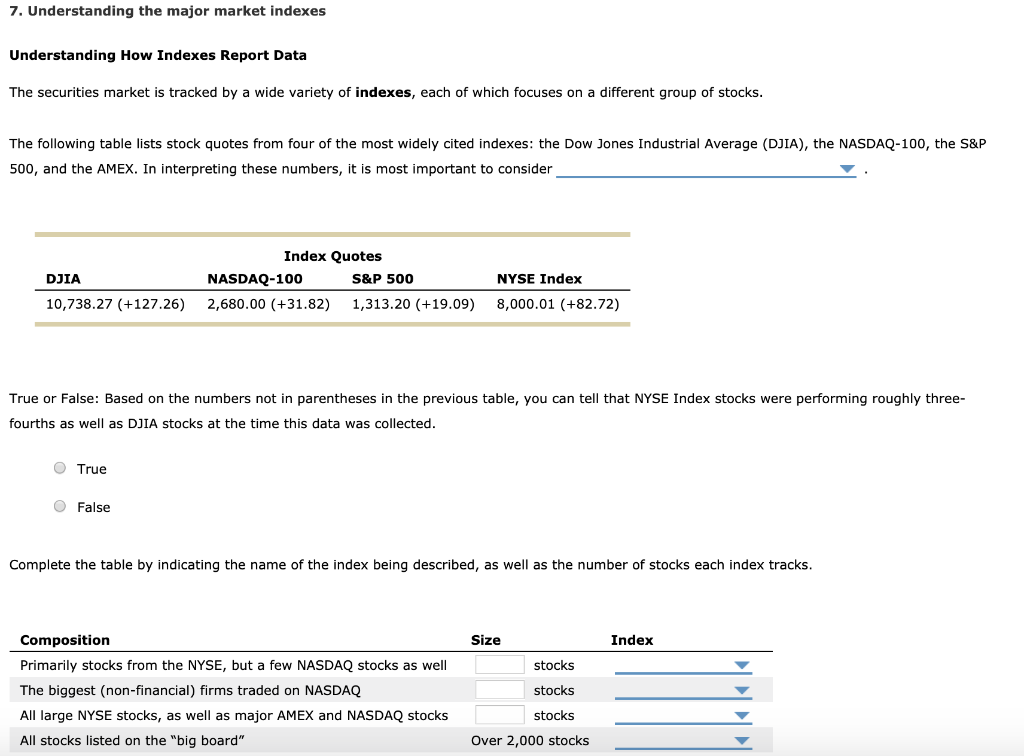

7. Understanding the major market indexes Understanding How Indexes Report Data different group of stocks. The securities market is tracked by a wide variety of indexes, each of which focuses on The following table lists stock quotes from four of the most widely cited indexes: the Dow Jones Industrial Average (DJIA), the NASDAQ-100, the S&P 500, and the AMEX. In interpreting these numbers, it is most important to consider Index Quotes DJIA NASDAQ-100 S&P 500 NYSE Index 2,680.00 (31.82) 10,738.27 (+127.26) 1,313.20 (+19.09) 8,000.01 (82.72) True or False: Based on the numbers not in parentheses in the previous table, you can tell that NYSE Index stocks were performing roughly three- fourths as well as DJIA stocks at the time this data was collected. True False Complete the table by indicating the name of the index being described, as well as the number of stocks each index tracks. Size Index Composition Primarily stocks from the NYSE, but a few NASDAQ stocks as well stocks The biggest (non-financial) firms traded on NASDAQ stocks All large NYSE stocks, as well as major AMEX and NASDAQ stocks stocks All stocks listed on the "big board" Over 2,000 stocks All stocks listed on the "big board" Over 2,000 stocks
Step by Step Solution
There are 3 Steps involved in it

Get step-by-step solutions from verified subject matter experts
 Study Help