







Question: Drop-down Options: 1. Projected , Embedded , Marginal , or Historical 2. Subtracted or Added 3. The cost of debt capital The cost of debt
Drop-down Options:
1. Projected, Embedded, Marginal, or Historical
2. Subtracted or Added
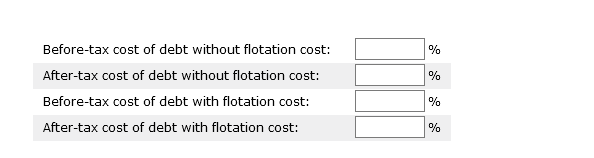
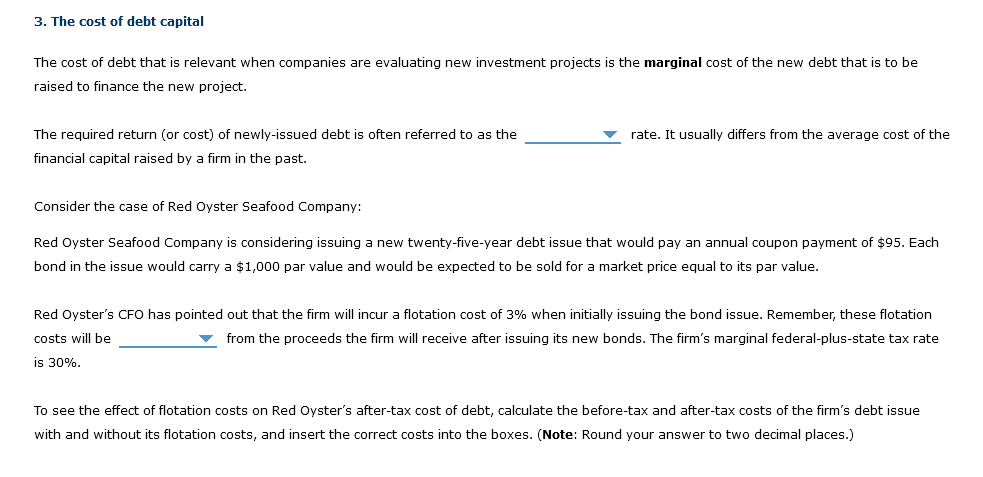
3. The cost of debt capital The cost of debt that is relevant when companies are evaluating new investment projects is the marginal cost of the new debt that is to be raised to finance the new project. rate. It usually differs from the average cost of the The required return (or cost) of newly-issued debt is often referred to as the financial capital raised by a firm in the past. Consider the case of Red Oyster Seafood Company: Red Oyster Seafood Company is considering issuing new twenty-five-year debt issue that would pay an annual coupon payment of $95. Each bond in the issue would carry a $1,000 par value and would be expected to be sold for a market price equal to its par value. Red Oyster's CFO has pointed out that the firm will incur a flotation cost of 3% when initially issuing the bond issue. Remember, these flotation costs will be from the proceeds the firm will receive after issuing its new bonds. The firm's marginal federal-plus-state tax rate is 30%. To see the effect of flotation costs on Red Oyster's after-tax cost of debt, calculate the before-tax and after-tax costs of the firm's debt issue with and without its flotation costs, and insert the correct costs into the boxes. (Note: Round your answer to two decimal places.) % % Before-tax cost of debt without flotation cost: After-tax cost of debt without flotation cost: Before-tax cost of debt with flotation cost: After-tax cost of debt with flotation cost: % %
Step by Step Solution
There are 3 Steps involved in it

Get step-by-step solutions from verified subject matter experts
 Study Help