



Question: DTFT time-Shift property. Explain in details. = num = = H2 clf; W = linspace(0, pi, 256); D=4; [1 2 2 1]; H1 freqz (num,
DTFT time-Shift property. Explain in details.
![W = linspace(0, pi, 256); D=4; [1 2 2 1]; H1 freqz](https://dsd5zvtm8ll6.cloudfront.net/si.experts.images/questions/2024/09/66f4ef1c0e73e_02766f4ef1b83da4.jpg)
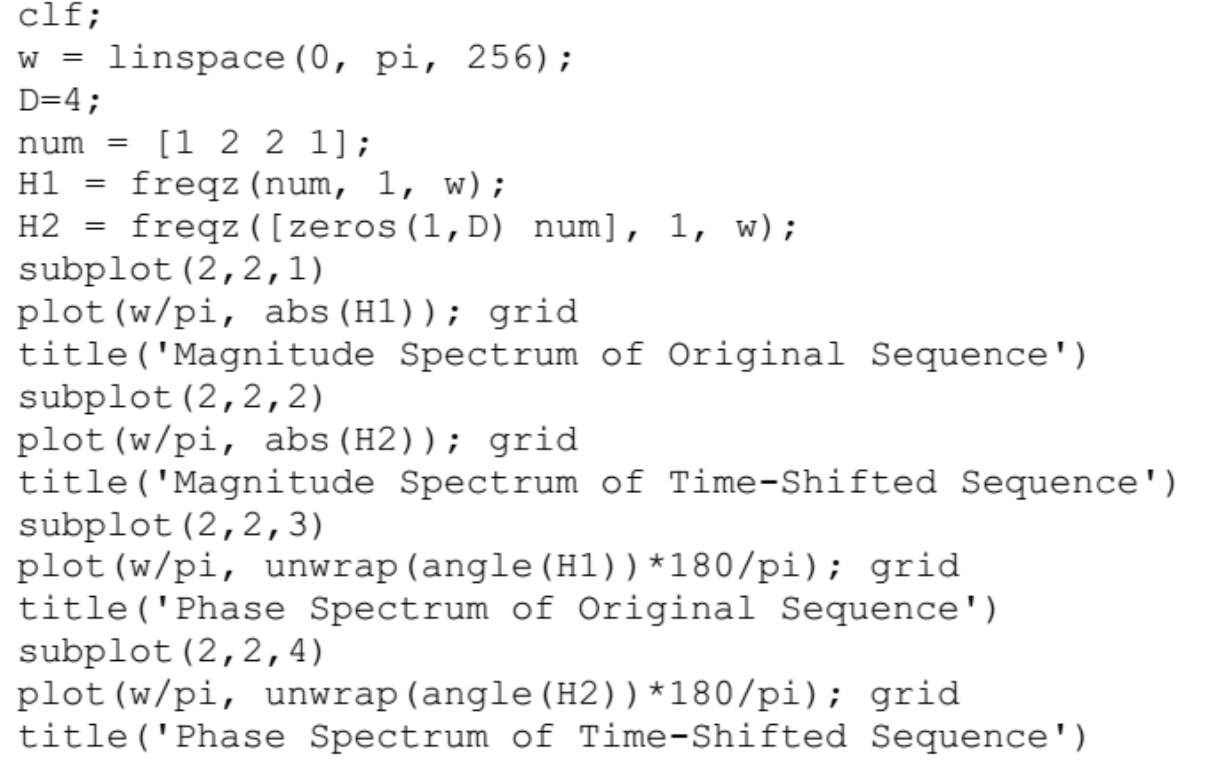
= num = = H2 clf; W = linspace(0, pi, 256); D=4; [1 2 2 1]; H1 freqz (num, 1, w); freqz ([zeros (1,D) num], 1, w); subplot (2,2,1) plot (w/pi, abs (H1)); grid title ('Magnitude Spectrum of Original Sequence') subplot (2,2,2) plot (w/pi, abs (H2)); grid title ('Magnitude Spectrum of Time-Shifted Sequence') subplot (2,2,3) plot (w/pi, unwrap (angle (H1)) *180/pi); grid title('Phase Spectrum of Original Sequence') subplot (2,2,4) plot (w/pi, unwrap (angle (H2)) *180/pi); grid title('Phase Spectrum of Time-Shifted Sequence') e) Challenge: If the phase of the DTFT of a real sequence x[n] is a constant that does not change with frequency (e.g. ZX(el) = a constant vs. something like ZX(el) = o), what can you say about the sequence x[n]? What values could the phase be? =
Step by Step Solution
There are 3 Steps involved in it

Get step-by-step solutions from verified subject matter experts