







Question: Due: 0 5 / 2 5 / 2 0 2 4 , 1 1 : 5 9 PM PDT 2 . 1 7 LAB: Musical
Due: : PM PDT
LAB: Musical note frequencies
On a piano, a key has a frequency, say fo Each higher key black or white has a frequency of where is the distance number of keys from that key, and is Given an initial key frequency, output that frequency and the next higher key frequencies.
Output each floatingpoint value with two digits after the decimal point, then the units then a newline, using the following statement: print fyourvalue:f Hz
Ex: If the input is:
which is the A key near the middle of a pi
keyboard the output is:
Note: To compute the next higher key frequencies, use one statement to compute using the pow function remember to import the math module Then use that in subsequent statements that use the formula with being and finally
qxzqy
LAB
ACTIVITY
: LAB: Musical note frequencies
main.py
Load default template...
Type your code here.
Latest submission : PM PDT on
Only show failing tests
:A above middle
Output differs. See highlights below.
Special character legend
:A below middle
Output differs. See highlights below.
Special character legend
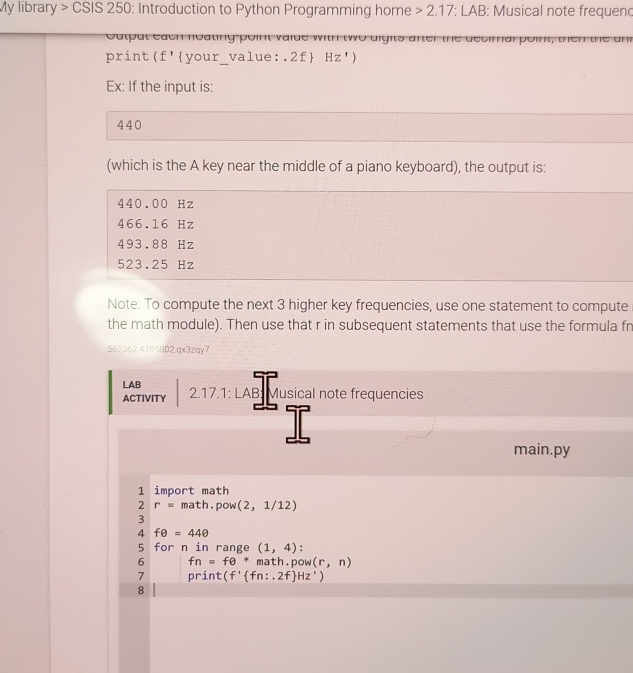
My library CSIS : Introduction to Python Programming home : LAB: Musical note frequend
print fyourvalue:f Hz
Ex: If the input is:
which is the A key near the middle of a piano keyboard the output is:
Note: To compute the next higher key frequencies, use one statement to compute the math module Then use that in subsequent statements that use the formula fn
qxy
tablemain.pytabletableimport math math. pow
Step by Step Solution
There are 3 Steps involved in it
1 Expert Approved Answer
Step: 1 Unlock

Question Has Been Solved by an Expert!
Get step-by-step solutions from verified subject matter experts
Step: 2 Unlock
Step: 3 Unlock
 Study Help