





Question: DURATION GAP ANALYSIS (Chapter 9) 1. Consider a $1,000 bond that pays a semiannual coupon of 10 percent and trades at a yield of 14
DURATION GAP ANALYSIS (Chapter 9) 1. Consider a
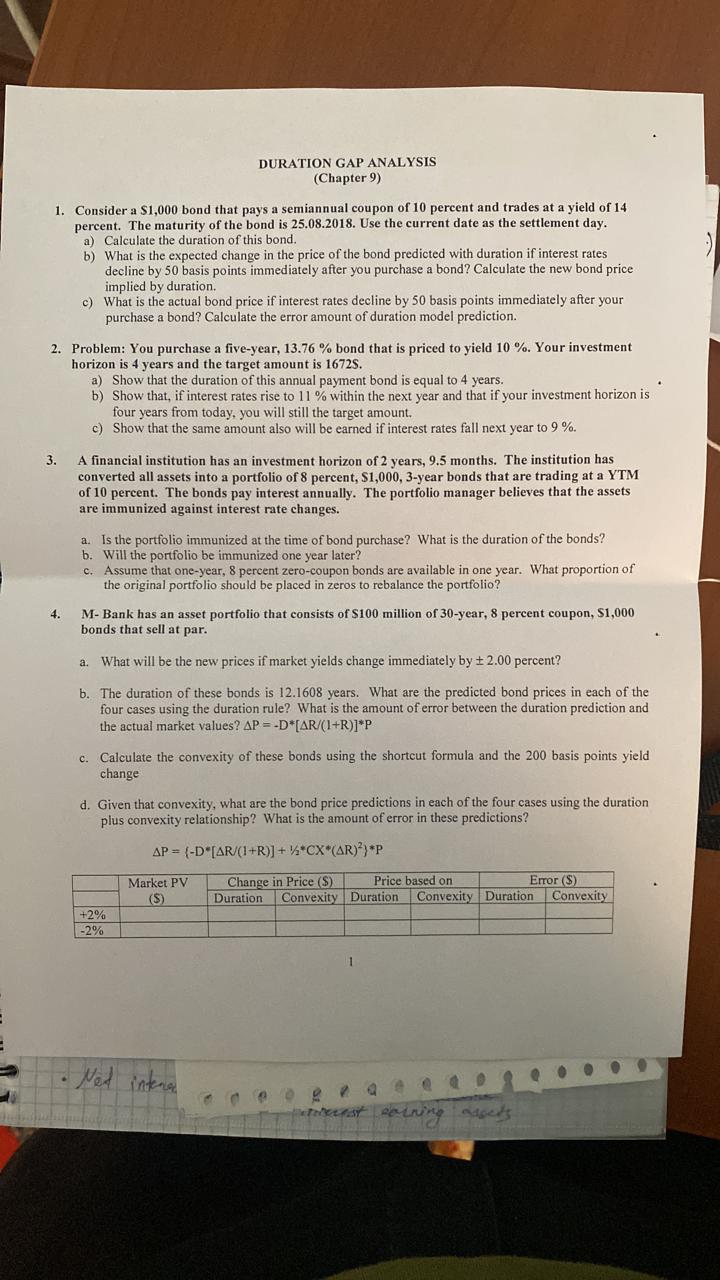
DURATION GAP ANALYSIS (Chapter 9) 1. Consider a $1,000 bond that pays a semiannual coupon of 10 percent and trades at a yield of 14 percent. The maturity of the bond is 25.08.2018. Use the current date as the settlement day. a) Calculate the duration of this bond. b) What is the expected change in the price of the bond predicted with duration if interest rates decline by 50 basis points immediately after you purchase a bond? Calculate the new bond price implied by duration. c) What is the actual bond price if interest rates decline by 50 basis points immediately after your purchase a bond? Calculate the error amount of duration model prediction. 2. Problem: You purchase a five-year, 13.76 % bond that is priced to yield 10 %. Your investment horizon is 4 years and the target amount is 16725. a) Show that the duration of this annual payment bond is equal to 4 years. b) Show that, if interest rates rise to 11 % within the next year and that if your investment horizon is four years from today, you will still the target amount. c) Show that the same amount also will be earned if interest rates fall next year to 9 %. 3. A financial institution has an investment horizon of 2 years, 9.5 months. The institution has converted all assets into a portfolio of 8 percent, $1,000, 3-year bonds that are trading at a YTM of 10 percent. The bonds pay interest annually. The portfolio manager believes that the assets are immunized against interest rate changes. a. Is the portfolio immunized at the time of bond purchase? What is the duration of the bonds? b. Will the portfolio be immunized one year later? c. Assume that one-year, 8 percent zero-coupon bonds are available in one year. What proportion of the original portfolio should be placed in zeros to rebalance the portfolio? 4. M- Bank has an asset portfolio that consists of $100 million of 30-year, 8 percent coupon, $1,000 bonds that sell at par. a. What will be the new prices if market yields change immediately by + 2.00 percent? b. The duration of these bonds is 12.1608 years. What are the predicted bond prices in each of the four cases using the duration rule? What is the amount of error between the duration prediction and the actual market values? AP = -D*[AR/(1+R)]*P c. Calculate the convexity of these bonds using the shortcut formula and the 200 basis points yield change d. Given that convexity, what are the bond price predictions in each of the four cases using the duration plus convexity relationship? What is the amount of error in these predictions? AP = (-D*[AR/(1+R)] + 1/*CX*(AR)?)*P Market PV Change in Price ($) Price based on Error ($) (S) Duration Convexity Duration Convexity Duration Convexity +2% -2% . Net intera

Step by Step Solution

There are 3 Steps involved in it

1 Expert Approved Answer
Step: 1 Unlock blur-text-image

Question Has Been Solved by an Expert!

Get step-by-step solutions from verified subject matter experts

Step: 2 Unlock
Step: 3 Unlock

Students Have Also Explored These Related Finance Questions!