







Question: E 2 - 1 LO 2 - 1 , 2 - 2 , 2 - 3 , ubrace ( ? ? ? ? u b
E
LO ubrace
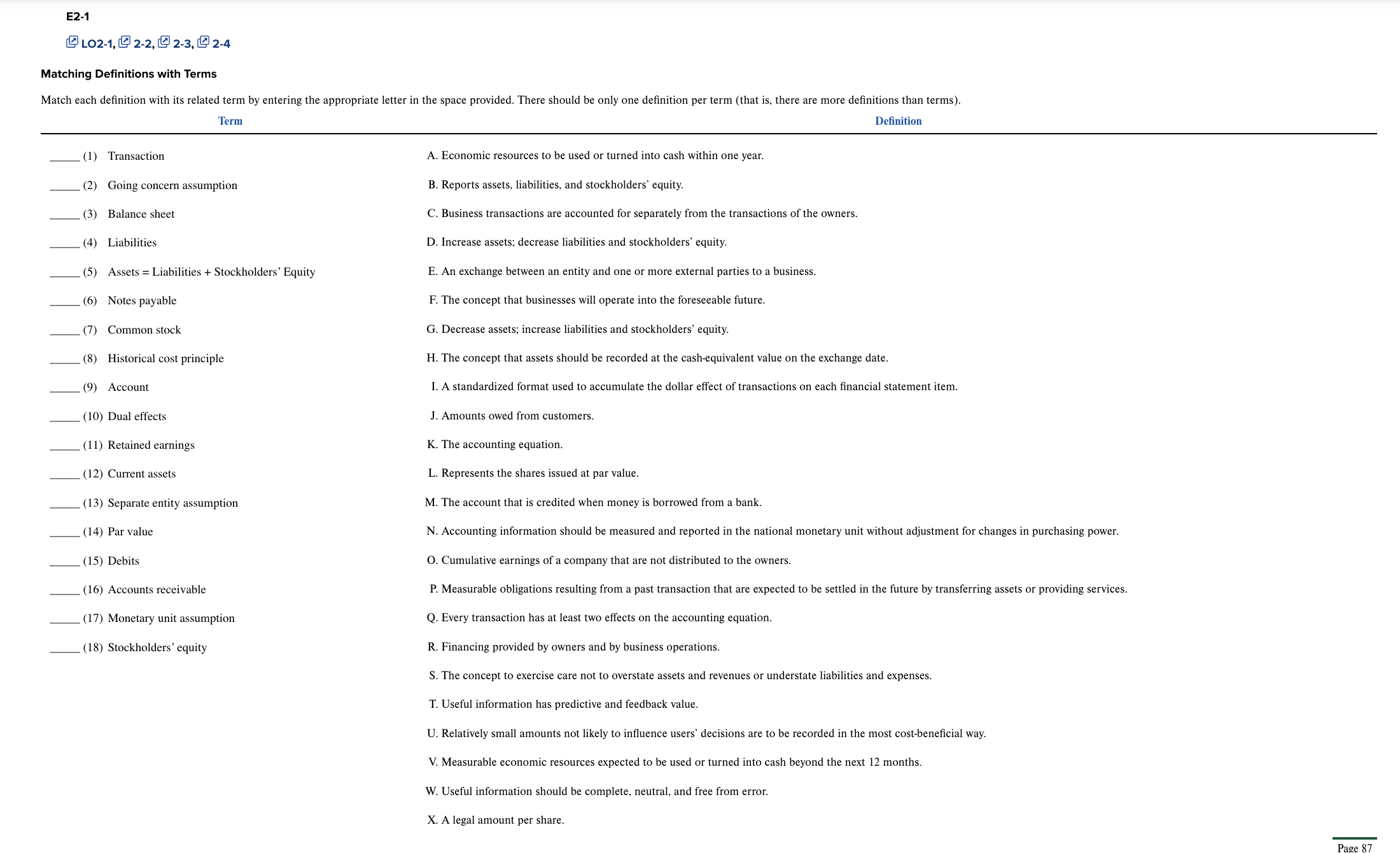
Matching Definitions with Terms
Match each definition with its related term by entering the appropriate letter in the space provided. There should be only one definition per term that is there are more definitions than terms
Term
Definition
Transaction
Going concern assumption
Balance sheet
Liabilities
Assets Liabilities Stockholders' Equity
Notes payable
Common stock
Historical cost principle
Account
Dual effects
Retained earnings
Current assets
Separate entity assumption
Par value
Debits
Accounts receivable
Monetary unit assumption
Stockholders' equity
A Economic resources to be used or turned into cash within one year.
B Reports assets, liabilities, and stockholders' equity.
C Business transactions are accounted for separately from the transactions of the owners.
D Increase assets; decrease liabilities and stockholders' equity.
E An exchange between an entity and one or more external parties to a business.
F The concept that businesses will operate into the foreseeable future.
G Decrease assets; increase liabilities and stockholders' equity.
H The concept that assets should be recorded at the cashequivalent value on the exchange date.
I. A standardized format used to accumulate the dollar effect of transactions on each financial statement item.
J Amounts owed from customers.
K The accounting equation.
L Represents the shares issued at par value.
M The account that is credited when money is borrowed from a bank.
N Accounting information should be measured and reported in the national monetary unit without adjustment for changes in purchasing power.
O Cumulative earnings of a company that are not distributed to the owners.
P Measurable obligations resulting from a past transaction that are expected to be settled in the future by transferring assets or providing services.
Q Every transaction has at least two effects on the accounting equation.
R Financing provided by owners and by business operations.
S The concept to exercise care not to overstate assets and revenues or understate liabilities and expenses.
T Useful information has predictive and feedback value.
U Relatively small amounts not likely to influence users' decisions are to be recorded in the most costbeneficial way.
V Measurable economic resources expected to be used or turned into cash beyond the next months.
W Useful information should be complete, neutral, and free from error.
X A legal amount per share.
Step by Step Solution
There are 3 Steps involved in it
1 Expert Approved Answer
Step: 1 Unlock

Question Has Been Solved by an Expert!
Get step-by-step solutions from verified subject matter experts
Step: 2 Unlock
Step: 3 Unlock
 Study Help