Question: e case study Harbour Community College Food Service Program is located Page 240 and 241; of our textbook tructions to Students: 1. Read the case
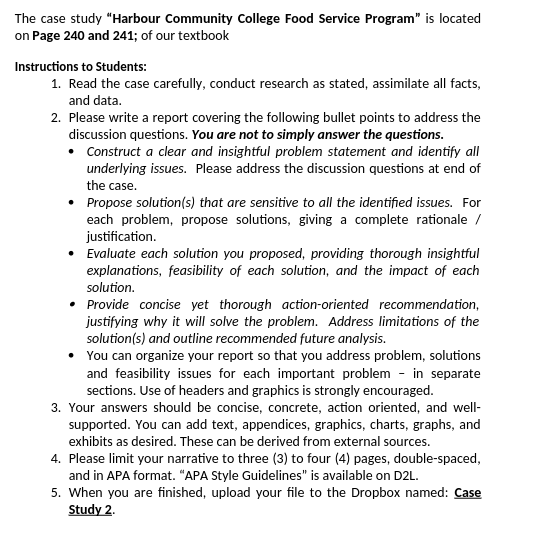
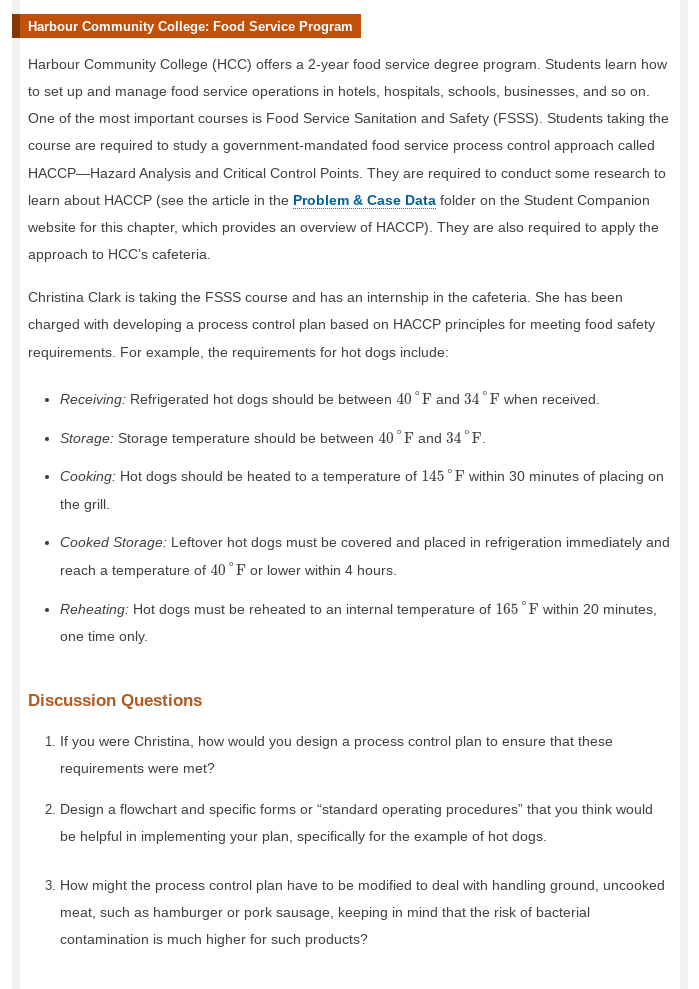
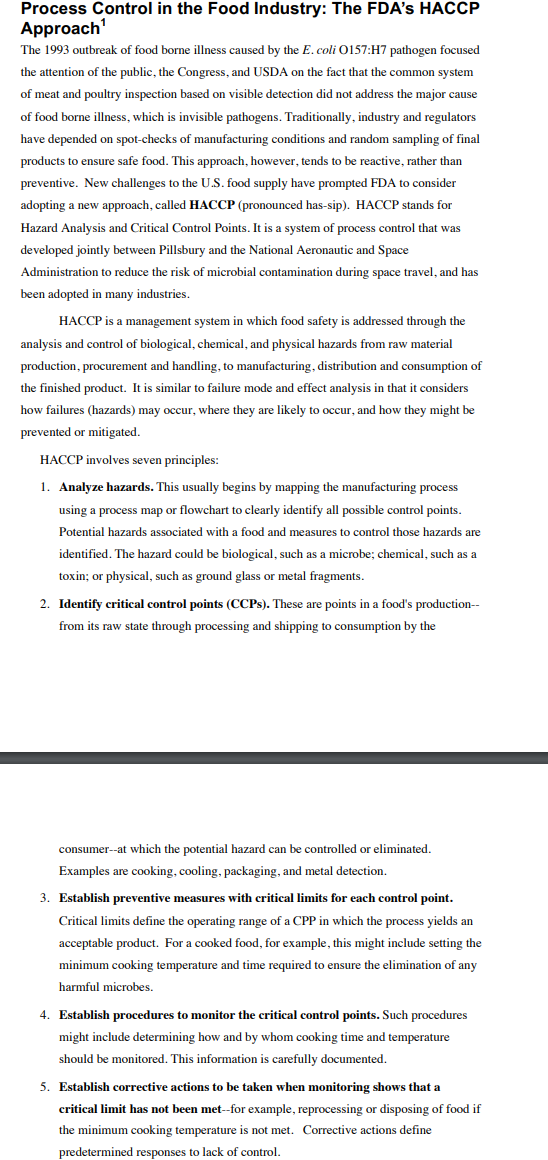
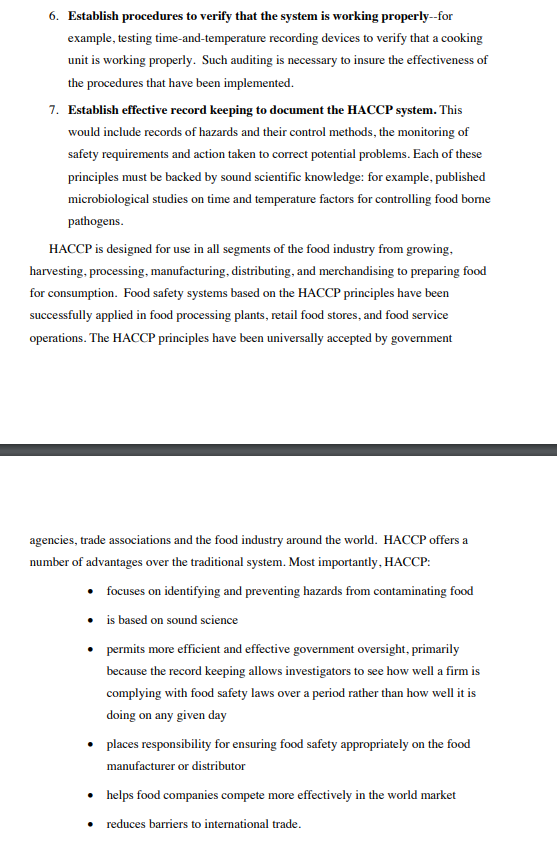
e case study "Harbour Community College Food Service Program" is located Page 240 and 241; of our textbook tructions to Students: 1. Read the case carefully, conduct research as stated, assimilate all facts, and data. 2. Please write a report covering the following bullet points to address the discussion questions. You are not to simply answer the questions. - Construct a clear and insightful problem statement and identify all underlying issues. Please address the discussion questions at end of the case. - Propose solution(s) that are sensitive to all the identified issues. For each problem, propose solutions, giving a complete rationale / justification. - Evaluate each solution you proposed, providing thorough insightful explanations, feasibility of each solution, and the impact of each solution. - Provide concise yet thorough action-oriented recommendation, justifying why it will solve the problem. Address limitations of the solution(s) and outline recommended future analysis. - You can organize your report so that you address problem, solutions and feasibility issues for each important problem - in separate sections. Use of headers and graphics is strongly encouraged. 3. Your answers should be concise, concrete, action oriented, and wellsupported. You can add text, appendices, graphics, charts, graphs, and exhibits as desired. These can be derived from external sources. 4. Please limit your narrative to three (3) to four (4) pages, double-spaced, and in APA format. "APA Style Guidelines" is available on D2L. 5. When you are finished, upload your file to the Dropbox named: Case Study 2. Harbour Community College (HCC) offers a 2-year food service degree program. Students learn how to set up and manage food service operations in hotels, hospitals, schools, businesses, and so on. One of the most important courses is Food Service Sanitation and Safety (FSSS). Students taking the course are required to study a government-mandated food service process control approach called HACCP-Hazard Analysis and Critical Control Points. They are required to conduct some research to learn about HACCP (see the article in the Problem \& Case Data folder on the Student Companion website for this chapter, which provides an overview of HACCP). They are also required to apply the approach to HCC's cafeteria. Christina Clark is taking the FSSS course and has an internship in the cafeteria. She has been charged with developing a process control plan based on HACCP principles for meeting food safety requirements. For example, the requirements for hot dogs include: - Receiving: Refrigerated hot dogs should be between 40F and 34F when received. - Storage: Storage temperature should be between 40F and 34F. - Cooking: Hot dogs should be heated to a temperature of 145F within 30 minutes of placing on the grill. - Cooked Storage: Leftover hot dogs must be covered and placed in refrigeration immediately and reach a temperature of 40F or lower within 4 hours. - Reheating: Hot dogs must be reheated to an internal temperature of 165F within 20 minutes, one time only. Discussion Questions 1. If you were Christina, how would you design a process control plan to ensure that these requirements were met? 2. Design a flowchart and specific forms or "standard operating procedures" that you think would be helpful in implementing your plan, specifically for the example of hot dogs. 3. How might the process control plan have to be modified to deal with handling ground, uncooked meat, such as hamburger or pork sausage, keeping in mind that the risk of bacterial contamination is much higher for such products? Process Control in the Food Industry: The FDA's HACCP Approach 1 The 1993 outbreak of food borne illness caused by the E. coli O157:H7 pathogen focused the attention of the public, the Congress, and USDA on the fact that the common system of meat and poultry inspection based on visible detection did not address the major cause of food borne illness, which is invisible pathogens. Traditionally, industry and regulators have depended on spot-checks of manufacturing conditions and random sampling of final products to ensure safe food. This approach, however, tends to be reactive, rather than preventive. New challenges to the U.S. food supply have prompted FDA to consider adopting a new approach, called HACCP (pronounced has-sip). HACCP stands for Hazard Analysis and Critical Control Points. It is a system of process control that was developed jointly between Pillsbury and the National Aeronautic and Space Administration to reduce the risk of microbial contamination during space travel, and has been adopted in many industries. HACCP is a management system in which food safety is addressed through the analysis and control of biological, chemical, and physical hazards from raw material production, procurement and handling, to manufacturing, distribution and consumption of the finished product. It is similar to failure mode and effect analysis in that it considers how failures (hazards) may occur, where they are likely to occur, and how they might be prevented or mitigated. HACCP involves seven principles: 1. Analyze hazards. This usually begins by mapping the manufacturing process using a process map or flowchart to clearly identify all possible control points. Potential hazards associated with a food and measures to control those hazards are identified. The hazard could be biological, such as a microbe; chemical, such as a toxin; or physical, such as ground glass or metal fragments. 2. Identify critical control points (CCPs). These are points in a food's productionfrom its raw state through processing and shipping to consumption by the consumer-at which the potential hazard can be controlled or eliminated. Examples are cooking, cooling, packaging, and metal detection. 3. Establish preventive measures with critical limits for each control point. Critical limits define the operating range of a CPP in which the process yields an acceptable product. For a cooked food, for example, this might include setting the minimum cooking temperature and time required to ensure the elimination of any harmful microbes. 4. Establish procedures to monitor the critical control points. Such procedures might include determining how and by whom cooking time and temperature should be monitored. This information is carefully documented. 5. Establish corrective actions to be taken when monitoring shows that a critical limit has not been met-for example, reprocessing or disposing of food if the minimum cooking temperature is not met. Corrective actions define predetermined responses to lack of control. 6. Establish procedures to verify that the system is working properly-for example, testing time-and-temperature recording devices to verify that a cooking unit is working properly. Such auditing is necessary to insure the effectiveness of the procedures that have been implemented. 7. Establish effective record keeping to document the HACCP system. This would include records of hazards and their control methods, the monitoring of safety requirements and action taken to correct potential problems. Each of these principles must be backed by sound scientific knowledge: for example, published microbiological studies on time and temperature factors for controlling food borne pathogens. HACCP is designed for use in all segments of the food industry from growing, harvesting, processing, manufacturing, distributing, and merchandising to preparing food for consumption. Food safety systems based on the HACCP principles have been successfully applied in food processing plants, retail food stores, and food service operations. The HACCP principles have been universally accepted by government agencies, trade associations and the food industry around the world. HACCP offers a number of advantages over the traditional system. Most importantly, HACCP: - focuses on identifying and preventing hazards from contaminating food - is based on sound science - permits more efficient and effective government oversight, primarily because the record keeping allows investigators to see how well a firm is complying with food safety laws over a period rather than how well it is doing on any given day - places responsibility for ensuring food safety appropriately on the food manufacturer or distributor - helps food companies compete more effectively in the world market - reduces barriers to international trade




