







Question: E Chapter 1: Why Organizational Behavior Matters Describe the key role of managing human capital in creating a sustainable competitive advantage for organizations Organizations
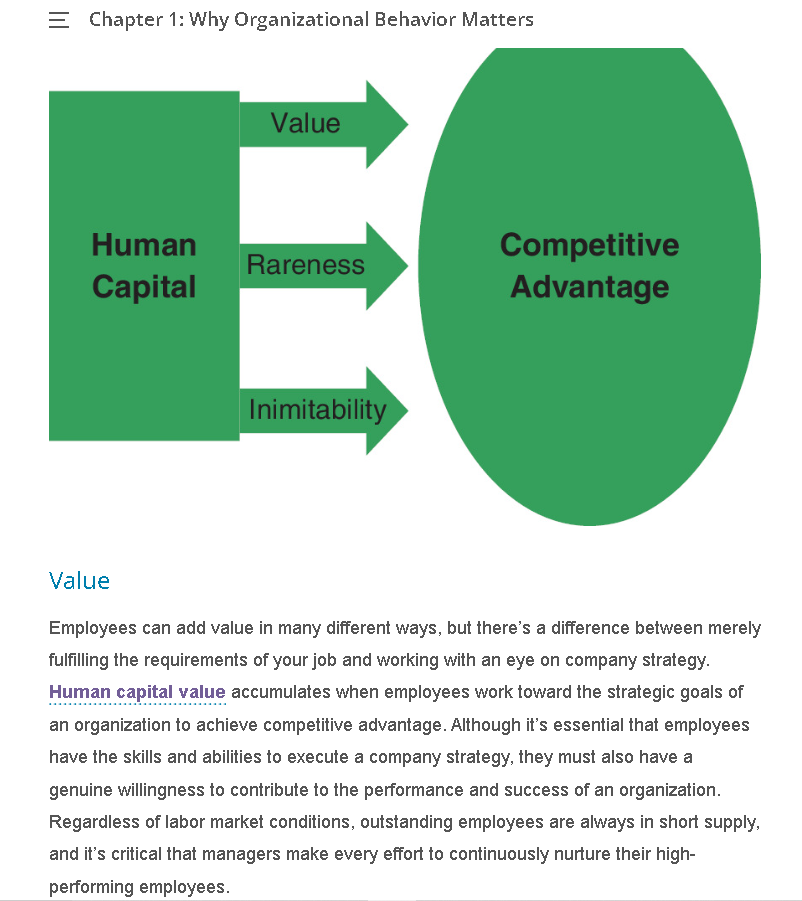
E Chapter 1: Why Organizational Behavior Matters Describe the key role of managing human capital in creating a sustainable competitive advantage for organizations Organizations have two kinds of resources: tangible and intangible. Physical assets such as equipment, property, and inventory are examples of tangible resources. Intangible resources include an organization's reputation and culture, its relationships with customers, and the trust between managers and coworkers. Although it's difficult to measure intangible resources because of their subtle nature, they remain crucial for organizations competing in a global economy. Human capital falls into the category of critical intangible resources. Today's managers focus on enriching their human capital by nurturing and enhancing their employees' knowledge and skills. The possibilities of building on human capital are endless- empowered, satisfied, knowledgeable employees can achieve so much for the organization and its customers. Human capital is essential for gaining competitive advantage, the edge that gives organizations a more beneficial position than their competitors and allows them to generate more profits and retain more customers (see Figure 1.2).19 Hilton stands out among its competitors because of its commitment to nurturing its human capital. Three main aspects of human capital enhance true competitive advantage: value, rareness, and inimitability.2 20 Chapter 1: Why Organizational Behavior Matters Value E Rareness Inimitability Human Capital Competitive Advantage Value Employees can add value in many different ways, but there's a difference between merely fulfilling the requirements of your job and working with an eye on company strategy. Human capital value accumulates when employees work toward the strategic goals of an organization to achieve competitive advantage. Although it's essential that employees have the skills and abilities to execute a company strategy, they must also have a genuine willingness to contribute to the performance and success of an organization. Regardless of labor market conditions, outstanding employees are always in short supply, and it's critical that managers make every effort to continuously nurture their high- performing employees. Rareness Not everyone has the right skill set to further the progress of an organization. Human capital rareness is the level of exceptional skills and talents employees possess in an industry. For example, you may be an excellent computer programmer with an outstanding eye for detail, or you could have a gift for dealing with customer complaints and creating resolutions to resolve dilemmas. These are rare skills that employees may bring with them into an organization, but they can also be learned, given the right training and encouragement. Inimitability Employees may be able to add real value and possess rare and important skills, but these attributes must be inimitable (i.e., unique and difficult to copy or replicate) for an organization to achieve success. Human capital inimitability is the degree to which the skills and talents of employees can be emulated by other organizations. The higher the level of inimitability, the more competitive an organization will be. For example, what's to prevent an excellent computer programmer from going to a competitor that offers the same services and opportunities? Successful organizations ensure that their talented employees possess skills and talents that are difficult to imitate. This means employees have a degree of tacit knowledge: they have a feel or an instinct for a method or a process but can't easily articulate it; they just know it's right. An organization's culture or values are also difficult to imitate and often determine why employees choose to work for one company over another that offers similar products and services. Usually, this comes down to the organization's shared values, attitudes, and culture.
Step by Step Solution
3.44 Rating (147 Votes )
There are 3 Steps involved in it
The passage lays out a strong connection between effective human capital management and achieving a sustainable competitive advantage for organizations Heres a breakdown of the key points Intangible R... View full answer

Get step-by-step solutions from verified subject matter experts
 Study Help