







Question: E. Choose the one alternative that best completes the statement or answers the question CHOICE 1) After a rule is published, what is the next
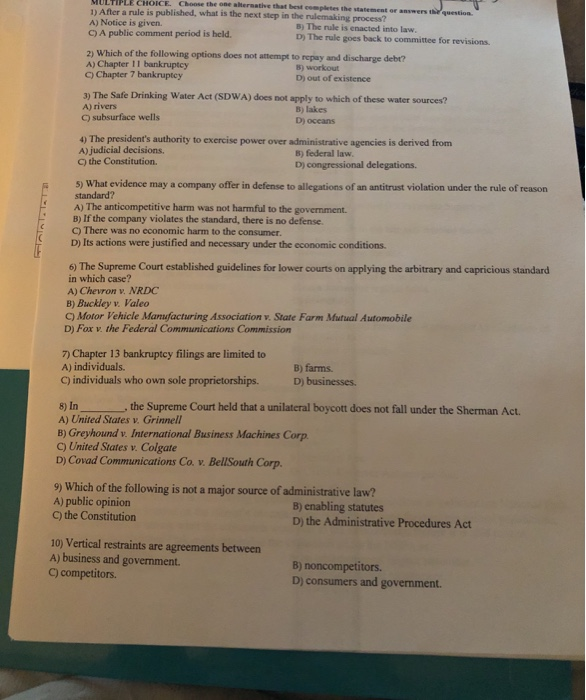
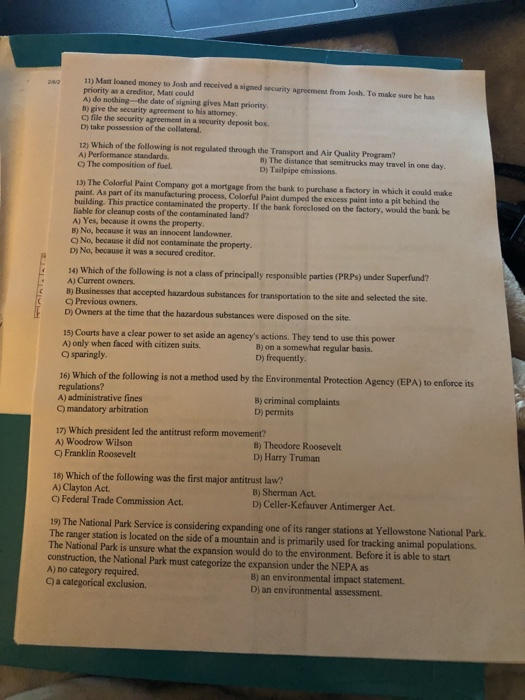
E. Choose the one alternative that best completes the statement or answers the question CHOICE 1) After a rule is published, what is the next step in the rulemaking process? A) Notice is given. B) The rule is enacted into law D) The rule goes back to committee for revisions. C) A public comment period is held 2) Which of the following options does not attempt to repay and discharge debt? A) Chapter II bankruptcy C) Chapter 7 bankruptcy s) workout D) out of existence 3) The Safe Drinking Water Act (SDWA) does not apply to which of these water sources? A) rivers C) subsurface wells B) lakes D) oceans 4) The president's authority to exercise power over administrative agencies is derived from A) judicial decisions. B) federal law D) congressional delegations. C) the Constitution. 5) What evidence may a company offer in defense to allegations of an antitrust violation under the rule of reason standard? A) The anticompetitive harm was not harmful to the government. B) If the company violates the standard, there is no defense. C) There was no economic harm to the consumer. D) Its actions were justified and necessary under the economic conditions. 6) The Supreme Court established guidelines for lower courts on applying the arbitrary and capricious standard in which case? A) Chevron v. NRDC B) Buckley v. Valeo C) Motor Vehicle Manufacturing Association v. State Farm Mutual Automobile D) Fox v. the Federal Communications Commission 7) Chapter 13 bankruptcy filings are limited to A) individuals. C) individuals who own sole proprietorships. D) businesses. B) farms. the Supreme Court held that a unilateral boycott does not fall under the Sherman Act. 8) A) United States v. Grinnell B) Greyhound v. International Business Machines Corp c) United States v. Colgate D) Covad Communications Co. v. BellSouth Corp 9) Which of the following is not a major source of administrative law? A) public opinion B) enabling statutes D) the Administrative Procedures Act C) the Constitution 10) Vertical restraints are agreements between A) business and government. C) competitors. B) noncompetitors. D) consumers and government. 11) Mact loaned money to Josh and received a signed security agreement from Josh. To make sure he has priority as a creditor, Matt could A) do nothing -the date of signing gives Matt priority B) give the security agreement to his attorney C) file the security agreement in a security deposit box. D) take possession of the collateral. 12) Which of the following is not regulated through the Transport and Air Quality Program? A) Performance standards. C) The composition of fuel. B) The distance that semitrucks may travel in one day. D) Tailpipe emissions 13) The Colorful Paint Company got a mortgage from the bank to purchase a factory paint building. This practice contaminated the property. If the bank foreclosed on the factory, would the bank be in which it could make process, Colorful liable for cleanup costs of the contaminated land? A) Yes, because it owns the property B) No, because it was an innocent landowner C) No, because it did not contaminate the property D) No, because it was a secured creditor. 14) Which of the following is not a class of principally responsible parties (PRPs) under Superfund? for transportation to the site and selected the site. A) Current owners B) Businesses that accepted hazardous substances CPrevious owners. D) Owners at the time that the hazardous substances were disposed on the site. 15) Courts have a clear power to set aside an agency's actions. They tend to use this power A) only when faced with citizen suits. C) sparingly B) on a somewhat regular basis. D) frequently t6) Which of the following is not a method used by the Environmental Protection Agency (EPA) to enforceits regulations? A) administrative fines B) criminal complaints D) permits ) mandatory arbitration 17) Which president led the antitrust reform movement? A) Woodrow Wilson C) Franklin Roosevelt B) Theodore Roosevelt D) Harry Truman 18) Which of the following was the first major antitrust law? A) Clayton Act C) Federal Trade Commission Act. B) Sherman Act. D) Celler-Kefauver Antimerger Act 19) The National Park Service is considering expanding one of its ranger stations at Yellowstone National Park. The ranger station is located on the side of a mountain and is primarily used for tracking animal populations. The National Park is unsure what the expansion would do to the environment. Before it is able to start construction, the National Park must categorize the expansion under the NEPA as A) no category required. C) a categorical exclusion. B) an environmental impact statement. D) an environmental assessment
Step by Step Solution
There are 3 Steps involved in it

Get step-by-step solutions from verified subject matter experts
 Study Help