







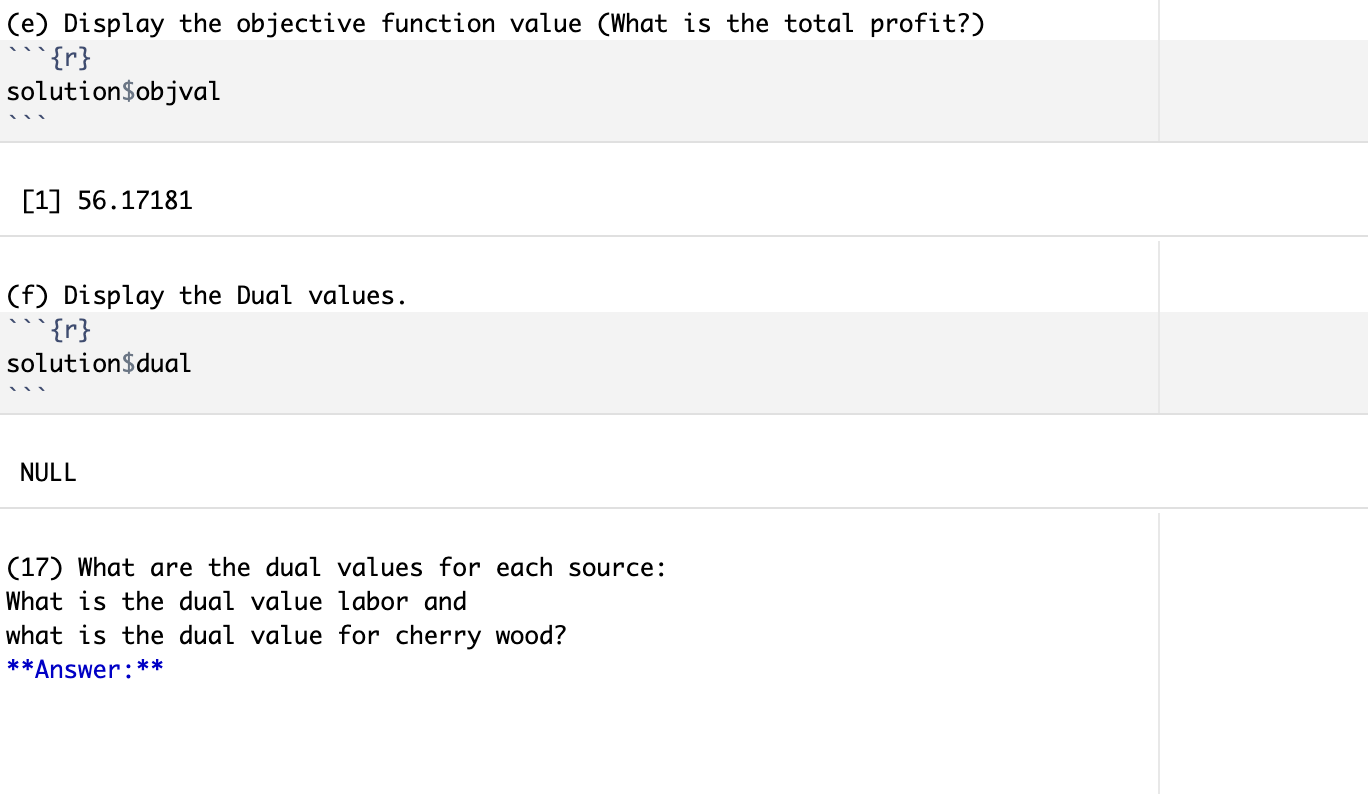
Question: (e) Display the objective function value (What is the total profit?) {r} solution$objval [1] 56.17181 (f) Display the Dual values. {r} solution $ dual NULL
![{r} solution\$objval [1] 56.17181 (f) Display the Dual values. {r} solution $](https://dsd5zvtm8ll6.cloudfront.net/si.experts.images/questions/2024/10/671f7cb605bad_789671f7cb57b0c7.jpg)
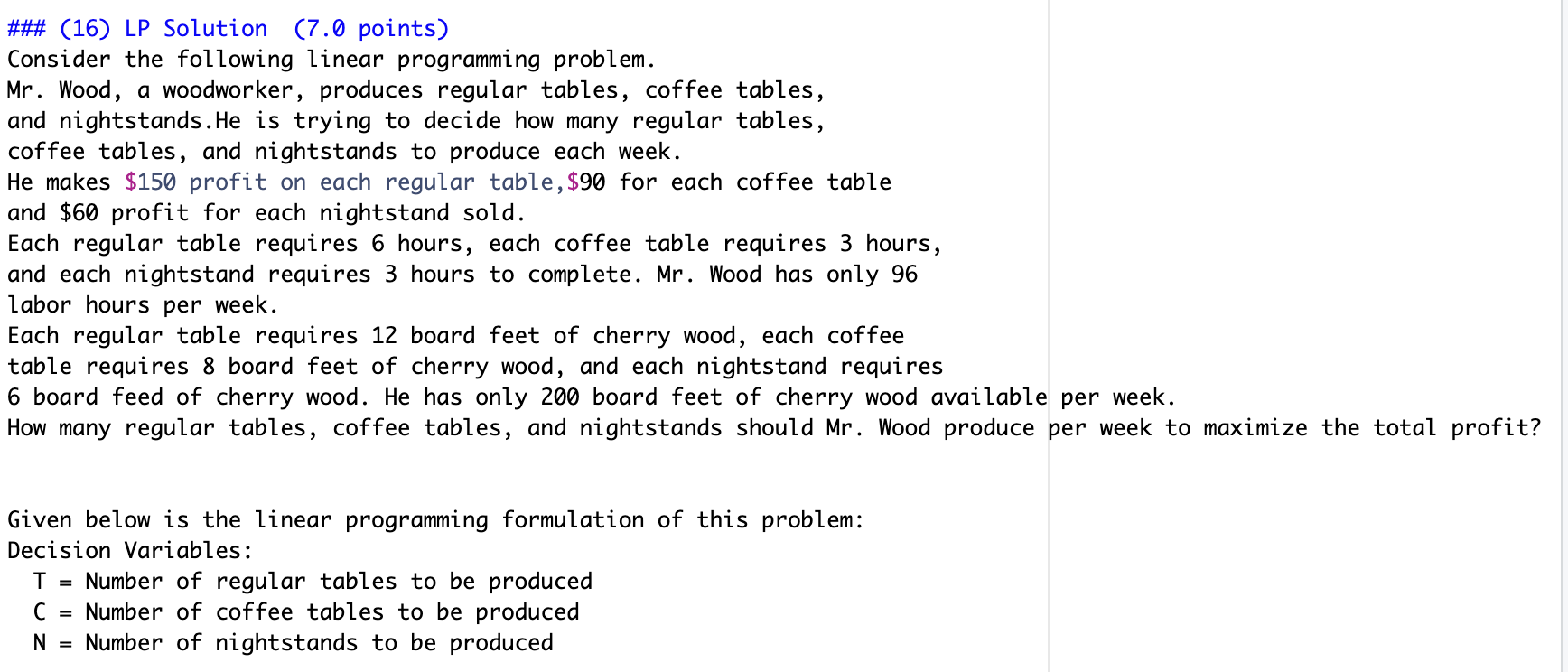
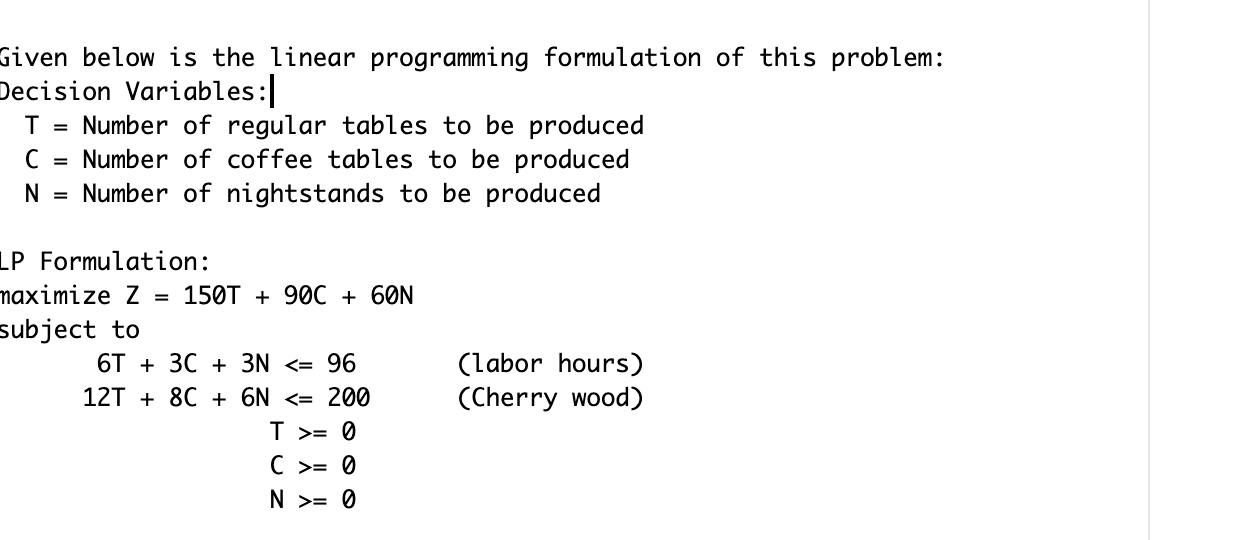
(e) Display the objective function value (What is the total profit?) {r} solution\$objval [1] 56.17181 (f) Display the Dual values. {r} solution $ dual NULL (17) What are the dual values for each source: What is the dual value labor and what is the dual value for cherry wood? **Answer: ** (a) How much would the profit increase if the company had one more labor hour? **Answer: ** (b) What would be the total profit if the company had one more board foot of cherry wood? **Answer: ** (c) If additional labor is available for $8 per hour, should Mr. Wood hire any labor by paying $8 per hour? **Answer: ** (d) If additional cherry wood is available at $8 for one board foot, should Mr. Wood purchase additional cherry wood at $8 per board foot? **Answer: ** \#\# (16) LP Solution (7.0 points) Consider the following linear programming problem. Mr. Wood, a woodworker, produces regular tables, coffee tables, and nightstands. He is trying to decide how many regular tables, coffee tables, and nightstands to produce each week. He makes $150 profit on each regular table, $90 for each coffee table and $60 profit for each nightstand sold. Each regular table requires 6 hours, each coffee table requires 3 hours, and each nightstand requires 3 hours to complete. Mr. Wood has only 96 labor hours per week. Each regular table requires 12 board feet of cherry wood, each coffee table requires 8 board feet of cherry wood, and each nightstand requires 6 board feed of cherry wood. He has only 200 board feet of cherry wood available per week. How many regular tables, coffee tables, and nightstands should Mr. Wood produce per week to maximize the total profit? Given below is the linear programming formulation of this problem: Decision Variables: T = Number of regular tables to be produced C= Number of coffee tables to be produced N= Number of nightstands to be produced iven below is the linear programming formulation of this problem: ecision Variables:| T= Number of regular tables to be produced C= Number of coffee tables to be produced N= Number of nightstands to be produced
Step by Step Solution
There are 3 Steps involved in it

Get step-by-step solutions from verified subject matter experts
 Study Help