


Question: . E F G H M N. O B # of X-pods # of Blueberrys 30 40 2 3 4 Unit Profits 5 6 Total
. E F G H M N. O B # of X-pods # of Blueberrys 30

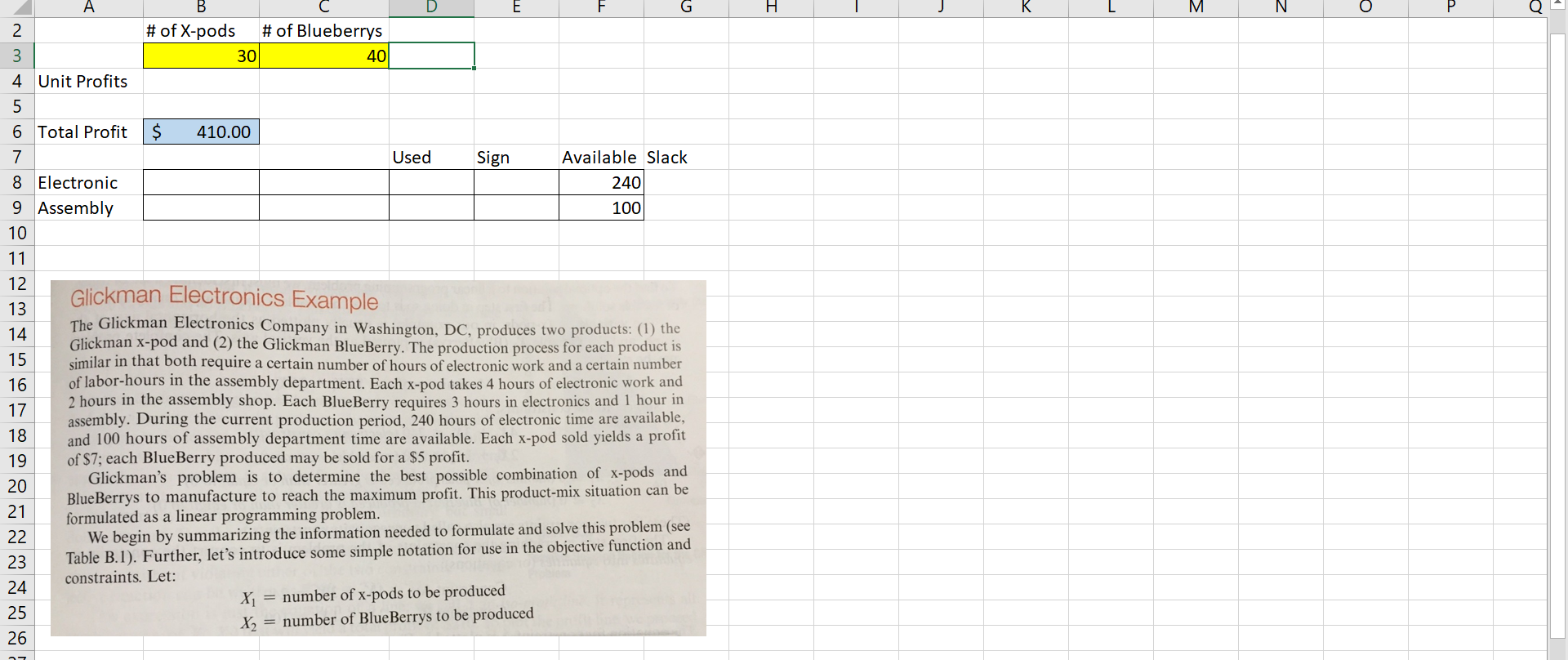
. E F G H M N. O B # of X-pods # of Blueberrys 30 40 2 3 4 Unit Profits 5 6 Total Profit 7 8 Electronic 9 Assembly 10 $ 410.00 Used Sign Available Slack 240 100 11 12 13 14 15 16 17 18 19 20 21 22 23 24 25 26 Glickman Electronics Example The Glickman Electronics Company in Washington, DC, produces two products: (1) the Glickman x-pod and (2) the Glickman BlueBerry. The production process for each product is similar in that both require a certain number of hours of electronic work and a certain number of labor-hours in the assembly department. Each x-pod takes 4 hours of electronic work and 2 hours in the assembly shop. Each BlueBerry requires 3 hours in electronics and 1 hour in assembly. During the current production period, 240 hours of electronic time are available, and 100 hours of assembly department time are available. Each x-pod sold yields a profit of $7; each Blue Berry produced may be sold for a $5 profit. Glickman's problem is to determine the best possible combination of x-pods and BlueBerrys to manufacture to reach the maximum profit. This product-mix situation can be formulated as a linear programming problem. We begin by summarizing the information needed to formulate and solve this problem (see Table B.1). Further, let's introduce some simple notation for use in the objective function and constraints. Let: Xi = number of x-pods to be produced X2 = number of BlueBerrys to be produced

Step by Step Solution

There are 3 Steps involved in it

1 Expert Approved Answer
Step: 1 Unlock blur-text-image

Question Has Been Solved by an Expert!

Get step-by-step solutions from verified subject matter experts

Step: 2 Unlock
Step: 3 Unlock

Students Have Also Explored These Related General Management Questions!