







Question: Recognizing whether reaction mechanisms should be cationic, anionic, or radical; whether intermediates should be cationic, anionic, or radical; and recognizing what could be reasonably
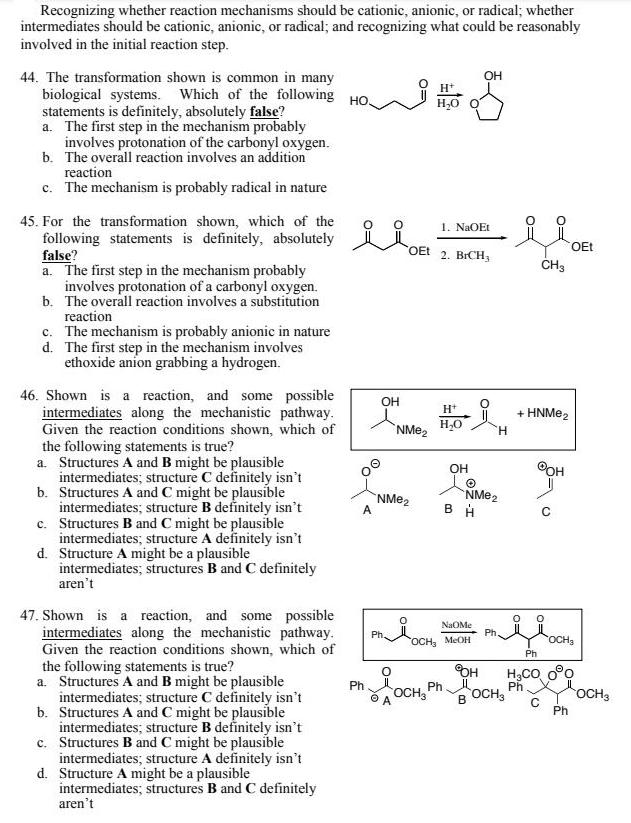
Recognizing whether reaction mechanisms should be cationic, anionic, or radical; whether intermediates should be cationic, anionic, or radical; and recognizing what could be reasonably involved in the initial reaction step. 44. The transformation shown is common in many biological systems. Which of the following statements is definitely, absolutely false? a. The first step in the mechanism probably involves protonation of the carbonyl oxygen. b. The overall reaction involves an addition reaction . c. The mechanism is probably radical in nature 45. For the transformation shown, which of the following statements is definitely, absolutely false? a. The first step in the mechanism probably involves protonation of a carbonyl oxygen. b. The overall reaction involves a substitution reaction c. The mechanism is probably anionic in nature d. The first step in the mechanism involves ethoxide anion grabbing a hydrogen. 1. NaOEt OEt OEt 2. BICH3 H3 46. Shown is a reaction, and some possible intermediates along the mechanistic pathway. Given the reaction conditions shown, which of the following statements is true? a. Structures A and B might be plausible intermediates; structure C definitely isn't b. Structures A and C might be plausble intermediates; structure B definitely isn't c. Structures B and C might be plausible intermediates; structure A definitely isn't d. Structure A might be a plausible intermediates; structures B and C definitely OH H* + HNME2 HO NM@2 H. OH OOH NME2 NME2 aren't 47. Shown is a reaction, and some possible intermediates along the mechanistic pathway. Given the reaction conditions shown, which of the following statements is true? a. Structures A and B might be plausible intermediates; structure C definitely isn't b. Structures A and C might be plausible intermediates; structure B definitely isn't c. Structures B and C might be plausible intermediates; structure A definitely isn't d. Structure A might be a plausible intermediates; structures B and C definitely aren't NaOMe Ph. Ph. OCH, MEOH OCH3 Ph OH OCH, Ph B H,CO 0 Ph OCH3 Ph OCH3 Ph
Step by Step Solution
3.39 Rating (161 Votes )
There are 3 Steps involved in it

Get step-by-step solutions from verified subject matter experts
 Study Help