



Question: E303. Problem Set #11 Name: Davis, Fall 2022 2. 1. Long Run Costs for the Firm. Consider the following long run cost curve. Cost Complementarities?
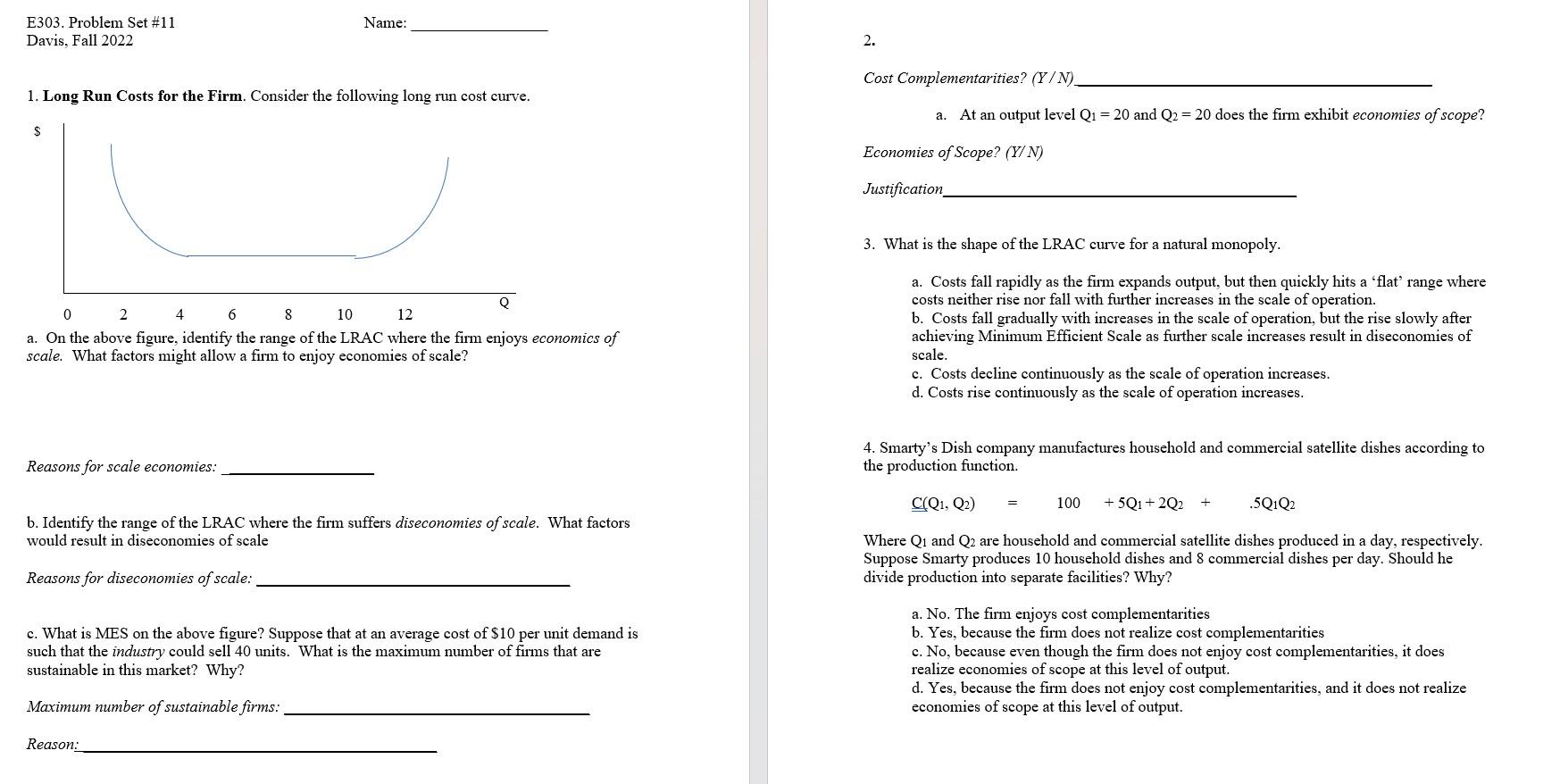
E303. Problem Set \#11 Name: Davis, Fall 2022 2. 1. Long Run Costs for the Firm. Consider the following long run cost curve. Cost Complementarities? (Y/N) a. At an output level Q1=20 and Q2=20 does the firm exhibit economies of scope? Economies of Scope? (Y/N) Justification 3. What is the shape of the LRAC curve for a natural monopoly. a. Costs fall rapidly as the firm expands output, but then quickly hits a 'flat' range where costs neither rise nor fall with further increases in the scale of operation. b. Costs fall gradually with increases in the scale of operation, but the rise slowly after a. Un the above tigure, 1dentity the range of the LKAC where the tirm enjoys economics of achieving Minimum Efficient Scale as further scale increases result in diseconomies of scale. What factors might allow a firm to enjoy economies of scale? scale. c. Costs decline continuously as the scale of operation increases. d. Costs rise continuously as the scale of operation increases. 4. Smarty's Dish company manufactures household and commercial satellite dishes according to Reasons for scale economies: the production function. b. Identify the range of the LRAC where the firm suffers diseconomies of scale. What factors C(Q1,Q2)=100+5Q1+2Q2+.5Q1Q2 would result in diseconomies of scale Where Q1 and Q2 are household and commercial satellite dishes produced in a day, respectively. Suppose Smarty produces 10 household dishes and 8 commercial dishes per day. Should he Reasons for diseconomies of scale: divide production into separate facilities? Why? c. What is MES on the above figure? Suppose that at an average cost of $10 per unit demand is a. No. The firm enjoys cost complementarities such that the industry could sell 40 units. What is the maximum number of firms that are b. Yes, because the firm does not realize cost complementarities sustainable in this market? Why? c. No, because even though the firm does not enjoy cost complementarities, it does realize economies of scope at this level of output. Maximum number of sustainable firms: d. Yes, because the firm does not enjoy cost complementarities, and it does not realize economies of scope at this level of output. Reas E303. Problem Set \#11 Name: Davis, Fall 2022 2. 1. Long Run Costs for the Firm. Consider the following long run cost curve. Cost Complementarities? (Y/N) a. At an output level Q1=20 and Q2=20 does the firm exhibit economies of scope? Economies of Scope? (Y/N) Justification 3. What is the shape of the LRAC curve for a natural monopoly. a. Costs fall rapidly as the firm expands output, but then quickly hits a 'flat' range where costs neither rise nor fall with further increases in the scale of operation. b. Costs fall gradually with increases in the scale of operation, but the rise slowly after a. Un the above tigure, 1dentity the range of the LKAC where the tirm enjoys economics of achieving Minimum Efficient Scale as further scale increases result in diseconomies of scale. What factors might allow a firm to enjoy economies of scale? scale. c. Costs decline continuously as the scale of operation increases. d. Costs rise continuously as the scale of operation increases. 4. Smarty's Dish company manufactures household and commercial satellite dishes according to Reasons for scale economies: the production function. b. Identify the range of the LRAC where the firm suffers diseconomies of scale. What factors C(Q1,Q2)=100+5Q1+2Q2+.5Q1Q2 would result in diseconomies of scale Where Q1 and Q2 are household and commercial satellite dishes produced in a day, respectively. Suppose Smarty produces 10 household dishes and 8 commercial dishes per day. Should he Reasons for diseconomies of scale: divide production into separate facilities? Why? c. What is MES on the above figure? Suppose that at an average cost of $10 per unit demand is a. No. The firm enjoys cost complementarities such that the industry could sell 40 units. What is the maximum number of firms that are b. Yes, because the firm does not realize cost complementarities sustainable in this market? Why? c. No, because even though the firm does not enjoy cost complementarities, it does realize economies of scope at this level of output. Maximum number of sustainable firms: d. Yes, because the firm does not enjoy cost complementarities, and it does not realize economies of scope at this level of output. Reas
Step by Step Solution
There are 3 Steps involved in it

Get step-by-step solutions from verified subject matter experts