



Question: E3-Y ANALYSIS: Exercises: The following exercises will guide you into building a simplified model of the Cathode Ray Tube's behavior. Please answer each question
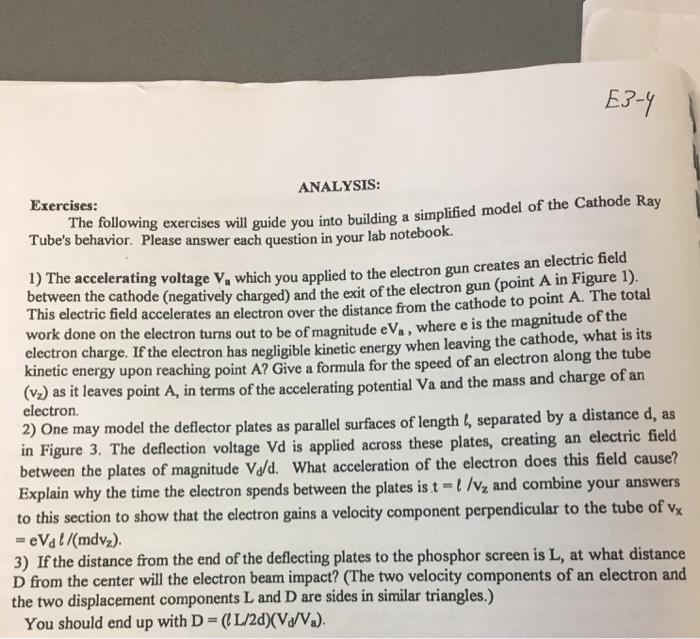
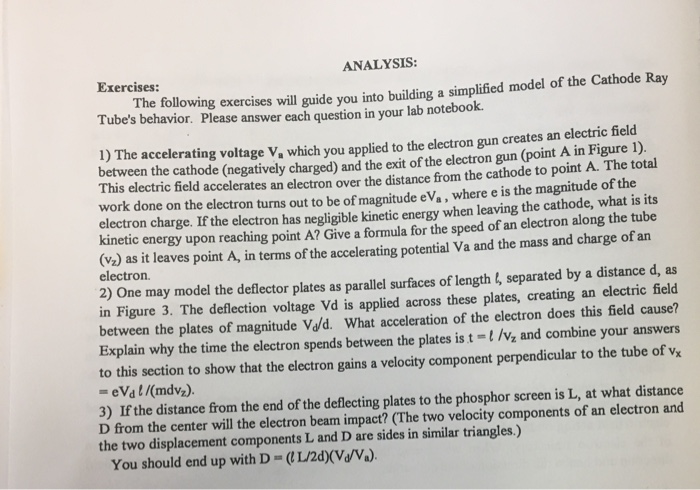
E3-Y ANALYSIS: Exercises: The following exercises will guide you into building a simplified model of the Cathode Ray Tube's behavior. Please answer each question in your lab notebook. 1) The accelerating voltage V, which you applied to the electron gun creates an electric field between the cathode (negatively charged) and the exit of the electron gun (point A in Figure 1). This electric field accelerates an electron over the distance from the cathode to point A. The total work done on the electron turns out to be of magnitude eVa, where e is the magnitude of the electron charge. If the electron has negligible kinetic energy when leaving the cathode, what is its kinetic energy upon reaching point A? Give a formula for the speed of an electron along the tube (vz) as it leaves point A, in terms of the accelerating potential Va and the mass and charge of an electron. 2) One may model the deflector plates as parallel surfaces of length , separated by a distance d, as in Figure 3. The deflection voltage Vd is applied across these plates, creating an electric field between the plates of magnitude Vald. What acceleration of the electron does this field cause? Explain why the time the electron spends between the plates is t t/v2 and combine your answers to this section to show that the electron gains a velocity component perpendicular to the tube of v eVat/(mdv) 3) If the distance from the end of the deflecting plates to the phosphor screen is L, at what distance D from the center will the electron beam impact? (The two velocity components of an electron and the two displacement components L and D are sides in similar triangles.) You should end up with D (L/2d)(Va/Va) ANALYSIS: Exercises: The following exercises will guide you into building a simplified model of the Cathode Ray Tube's behavior. Please answer each question in your lab notebook 1) The accelerating voltage V, which you applied to the electron gun creates an electric field between the cathode (negatively charged) and the exit of the electron gun (point A in Figure 1). This electric field accelerates an electron over the distance from the cathode to point A. The total work done on the electron turns out to be of magnitude eVa, where e is the magnitude of the electron charge. If the electron has negligible kinetic energy when leaving the cathode, what is its kinetic energy upon reaching point A? Give a formula for the speed of an electron along the tube (vz) as it leaves point A, in terms of the accelerating potential Va and the mass and charge of an electron 2) One may model the deflector plates as parallel surfaces of length, separated by a distance d, as in Figure 3. The deflection voltage Vd is applied across these plates, creating an electric field between the plates of magnitude Vald. What acceleration of the electron does this field cause? Explain why the time the electron spends between the plates is t -t/vz and combine your answers to this section to show that the electron gains a velocity component perpendicular to the tube of v eVal/(mdv2) 3) If the distance from the end of the deflecting plates to the phosphor screen is L, at what distance D from the center will the electron beam impact? (The two velocity components of an electron and the two displacement components L and D are sides in similar triangles.) You should end up with D (L/2d)(V/Va) ANALYSIS: Exercises: The following exercises will guide you into building a simplified model of the Cathode Ray Tube's behavior. Please answer each question in your lab notebook 1) The accelerating voltage V, which you applied to the electron gun creates an electric field between the cathode (negatively charged) and the exit of the electron gun (point A in Figure 1). This electric field accelerates an electron over the distance from the cathode to point A. The total work done on the electron turns out to be of magnitude eVa, where e is the magnitude of the electron charge. If the electron has negligible kinetic energy when leaving the cathode, what is its kinetic energy upon reaching point A? Give a formula for the speed of an electron along the tube (vz) as it leaves point A, in terms of the accelerating potential Va and the mass and charge of an electron 2) One may model the deflector plates as parallel surfaces of length, separated by a distance d, as in Figure 3. The deflection voltage Vd is applied across these plates, creating an electric field between the plates of magnitude Vald. What acceleration of the electron does this field cause? Explain why the time the electron spends between the plates is t -t/vz and combine your answers to this section to show that the electron gains a velocity component perpendicular to the tube of v eVal/(mdv2) 3) If the distance from the end of the deflecting plates to the phosphor screen is L, at what distance D from the center will the electron beam impact? (The two velocity components of an electron and the two displacement components L and D are sides in similar triangles.) You should end up with D (L/2d)(V/Va)
Step by Step Solution
3.54 Rating (164 Votes )
There are 3 Steps involved in it
Lets go through each part of the exercise step by step 1 Speed of the Electron at Point A Given Acce... View full answer

Get step-by-step solutions from verified subject matter experts