



Question: Each journal entry is posted automatically to the general ledger. Think of the general ledger as sorting all of your journal entries by account title.
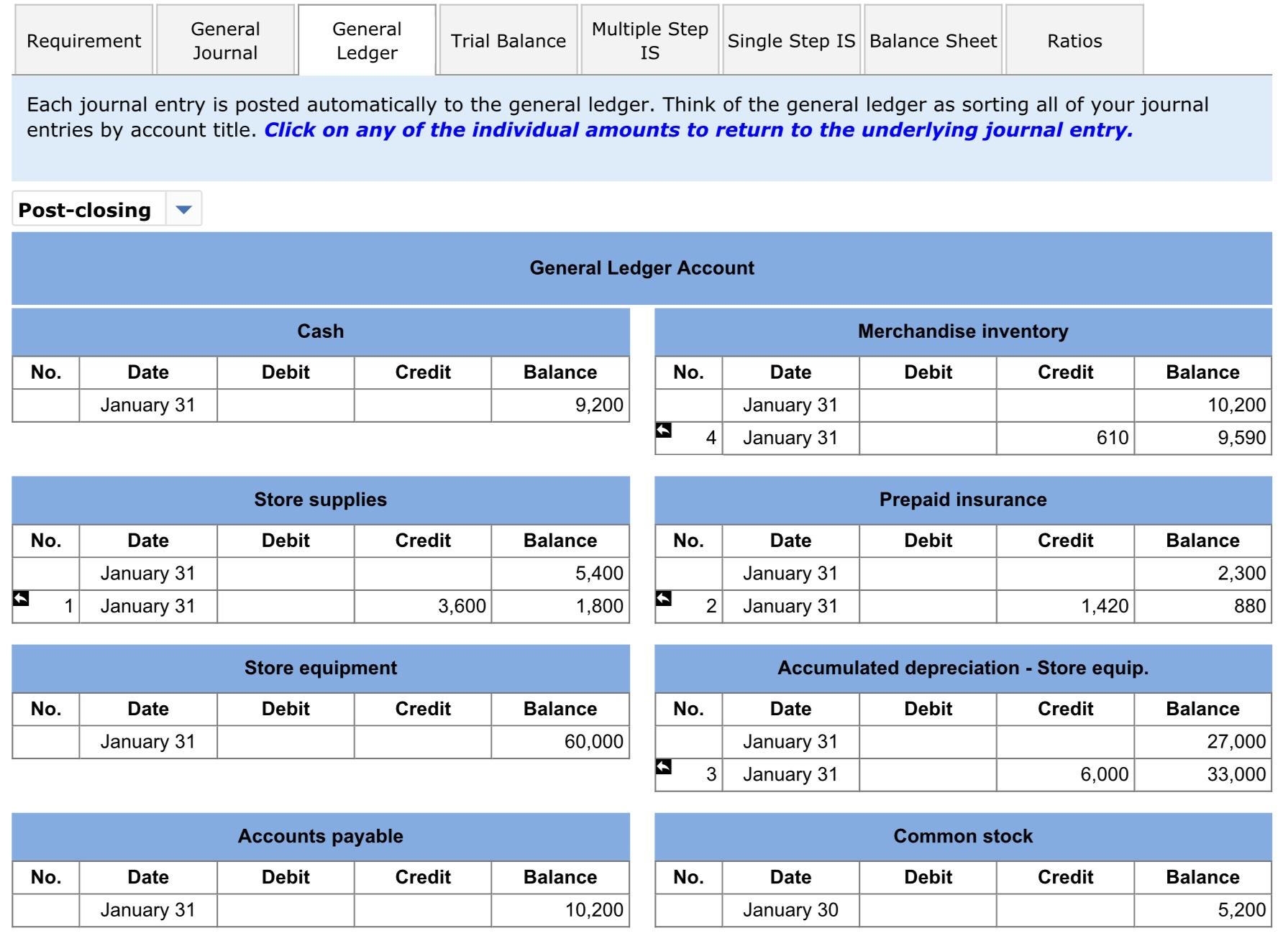
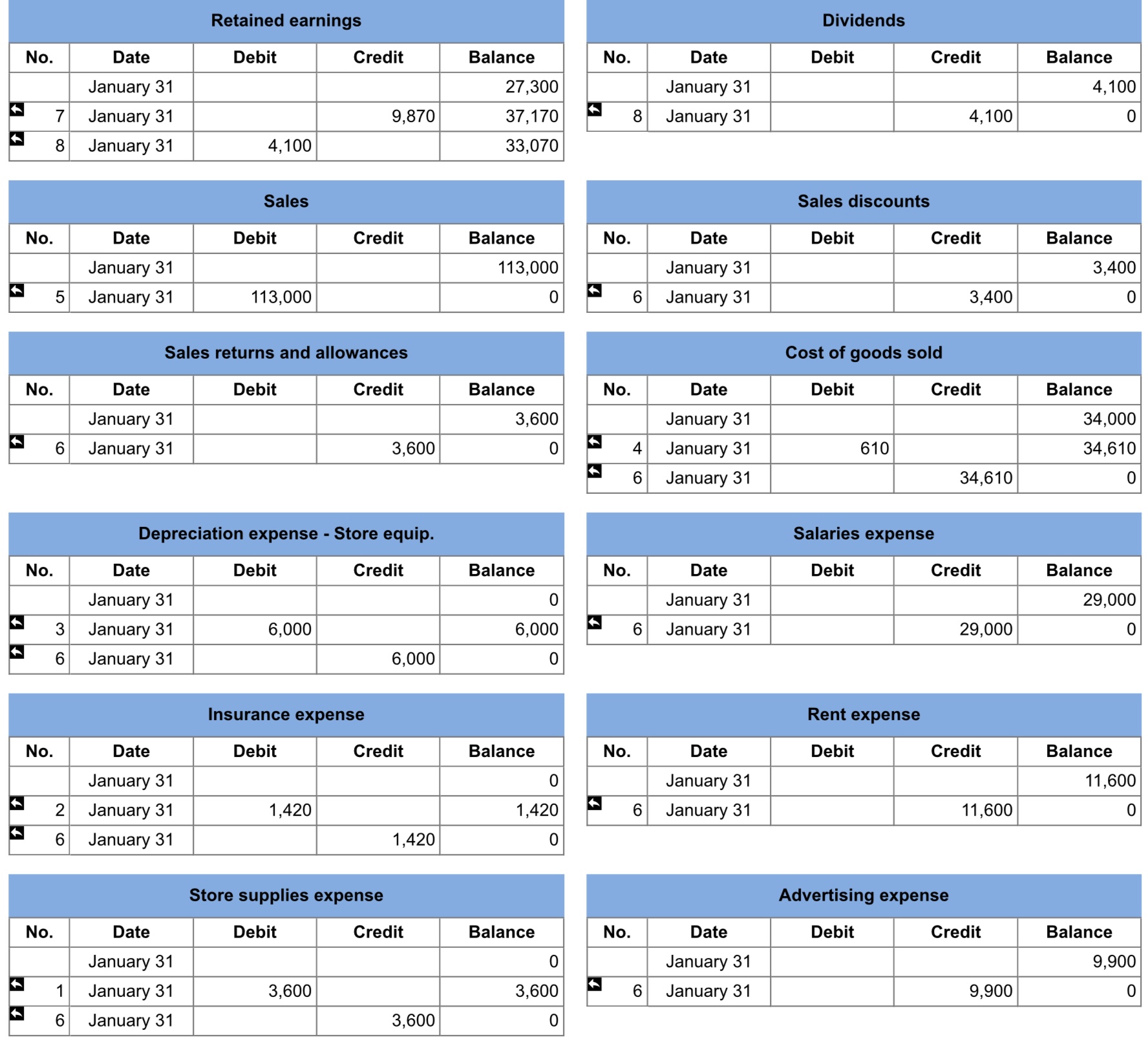
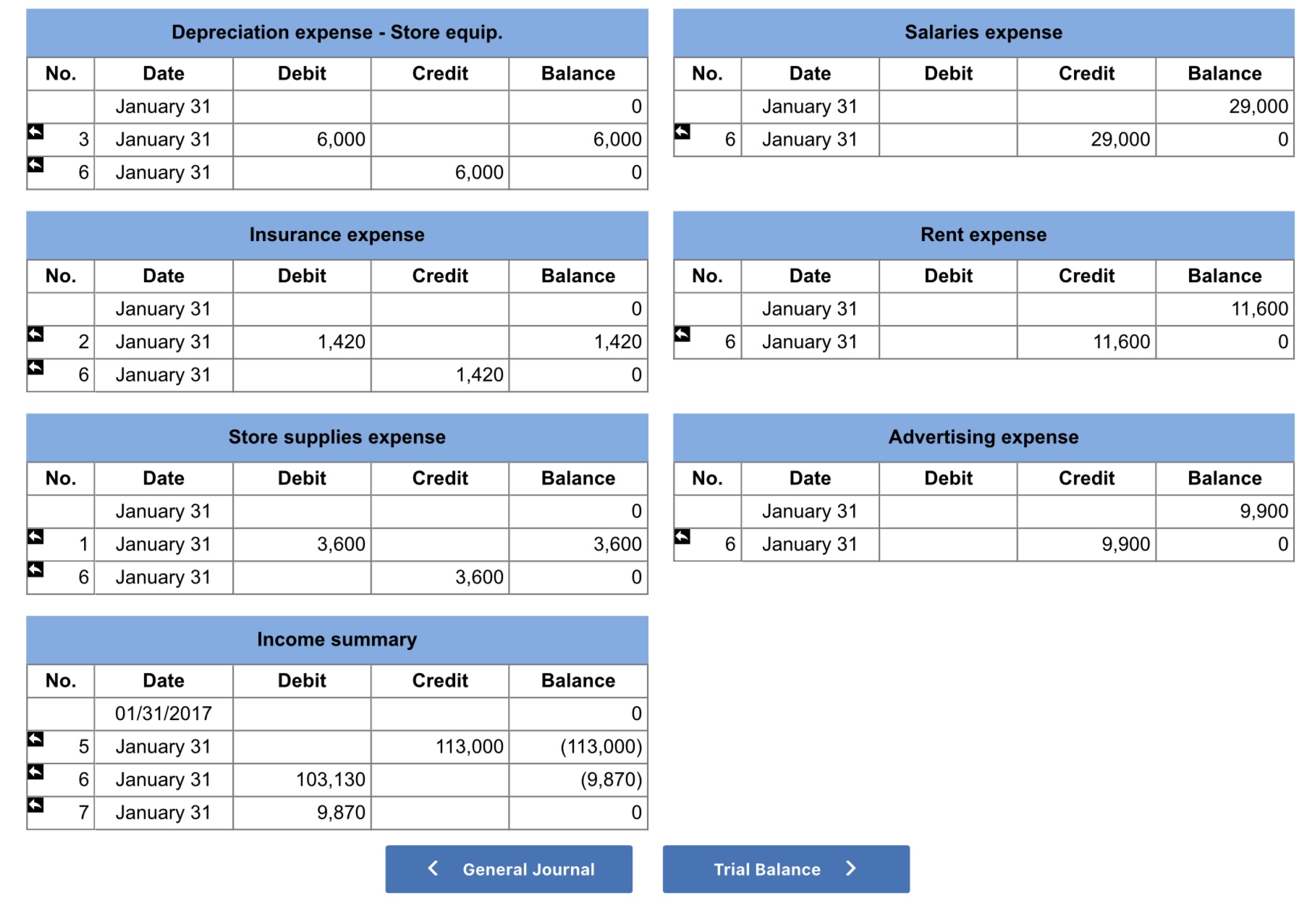
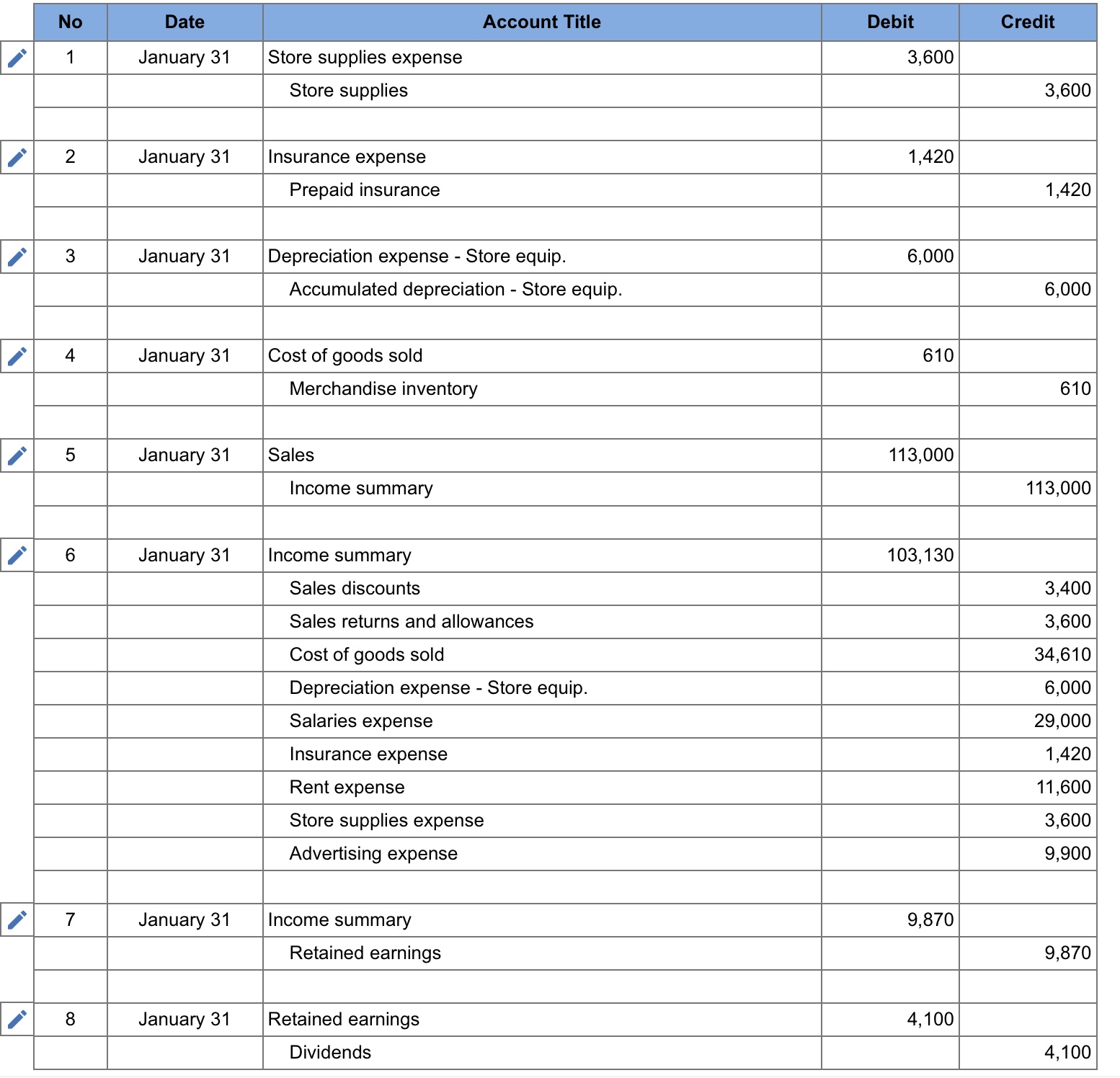
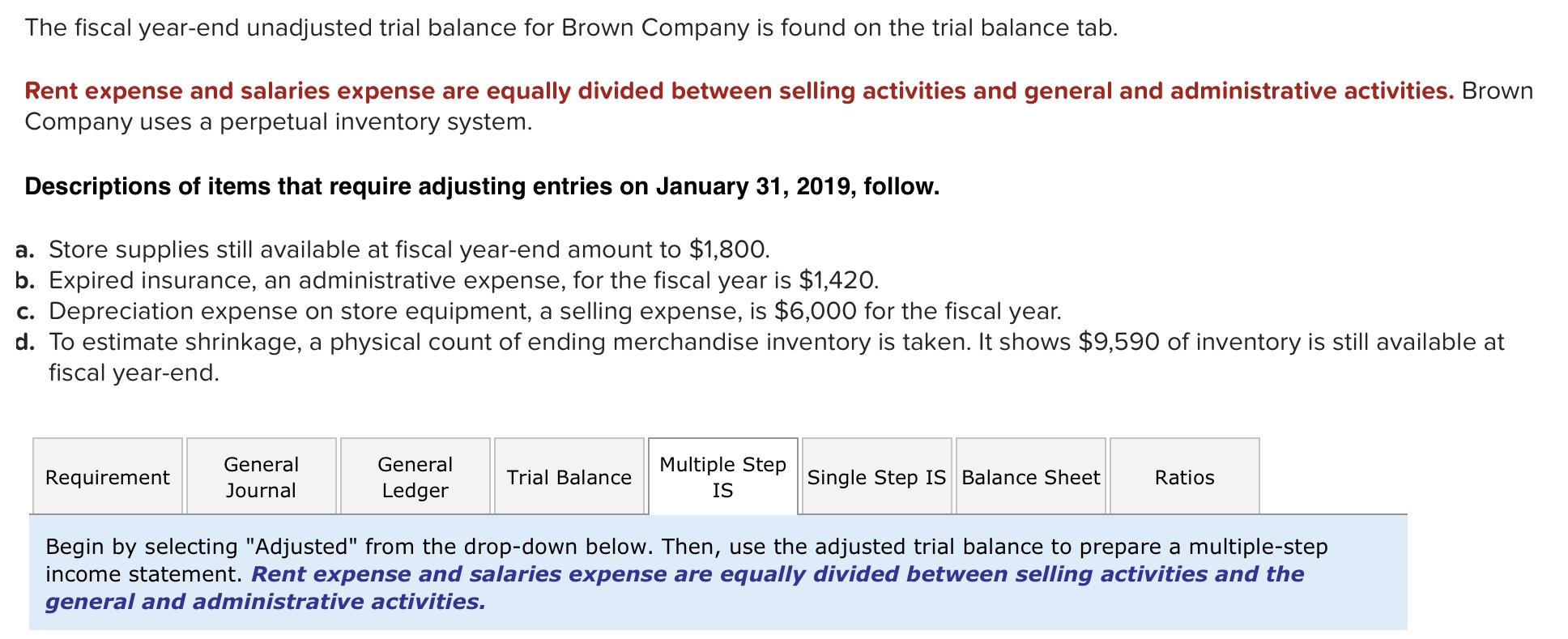
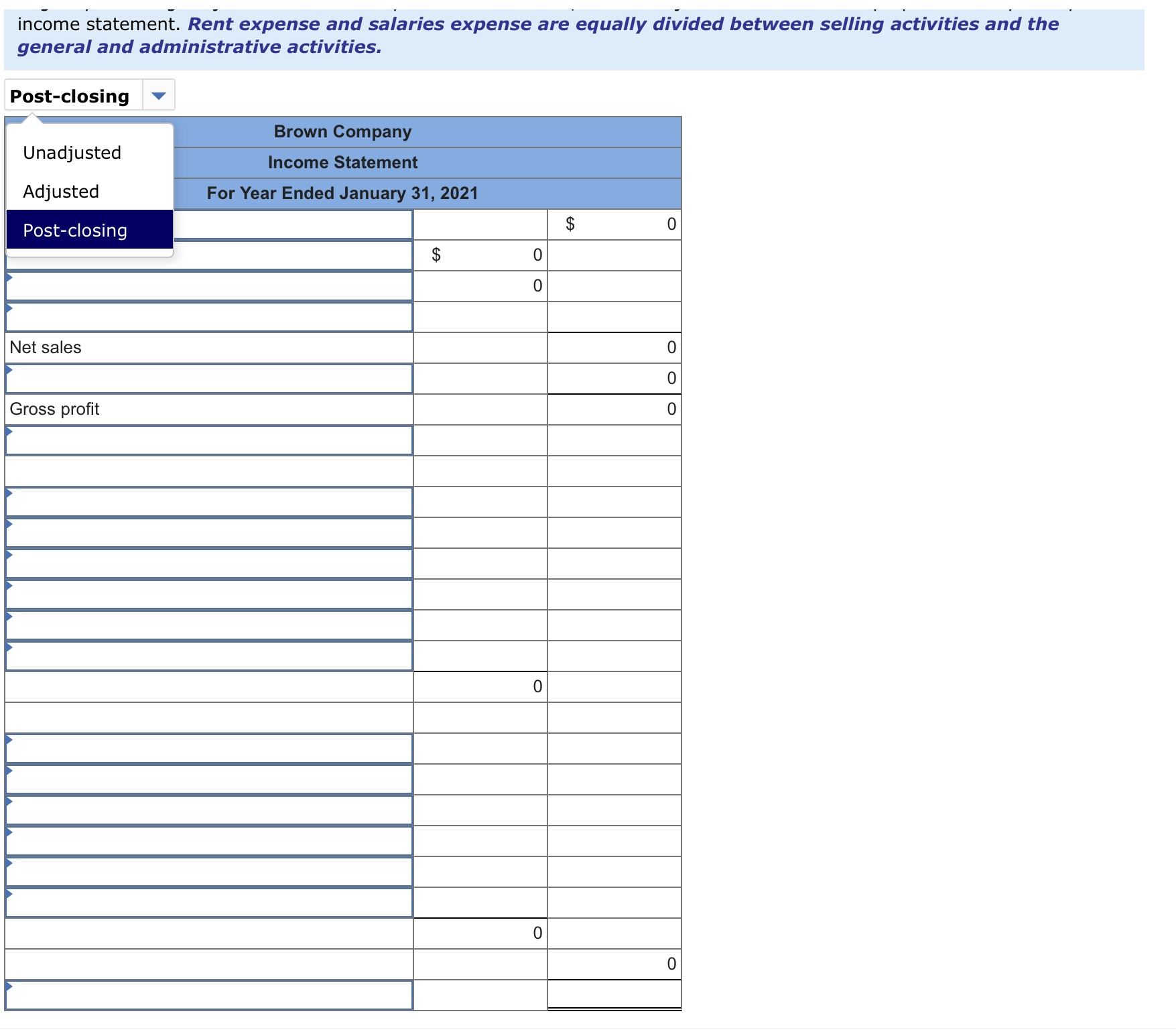
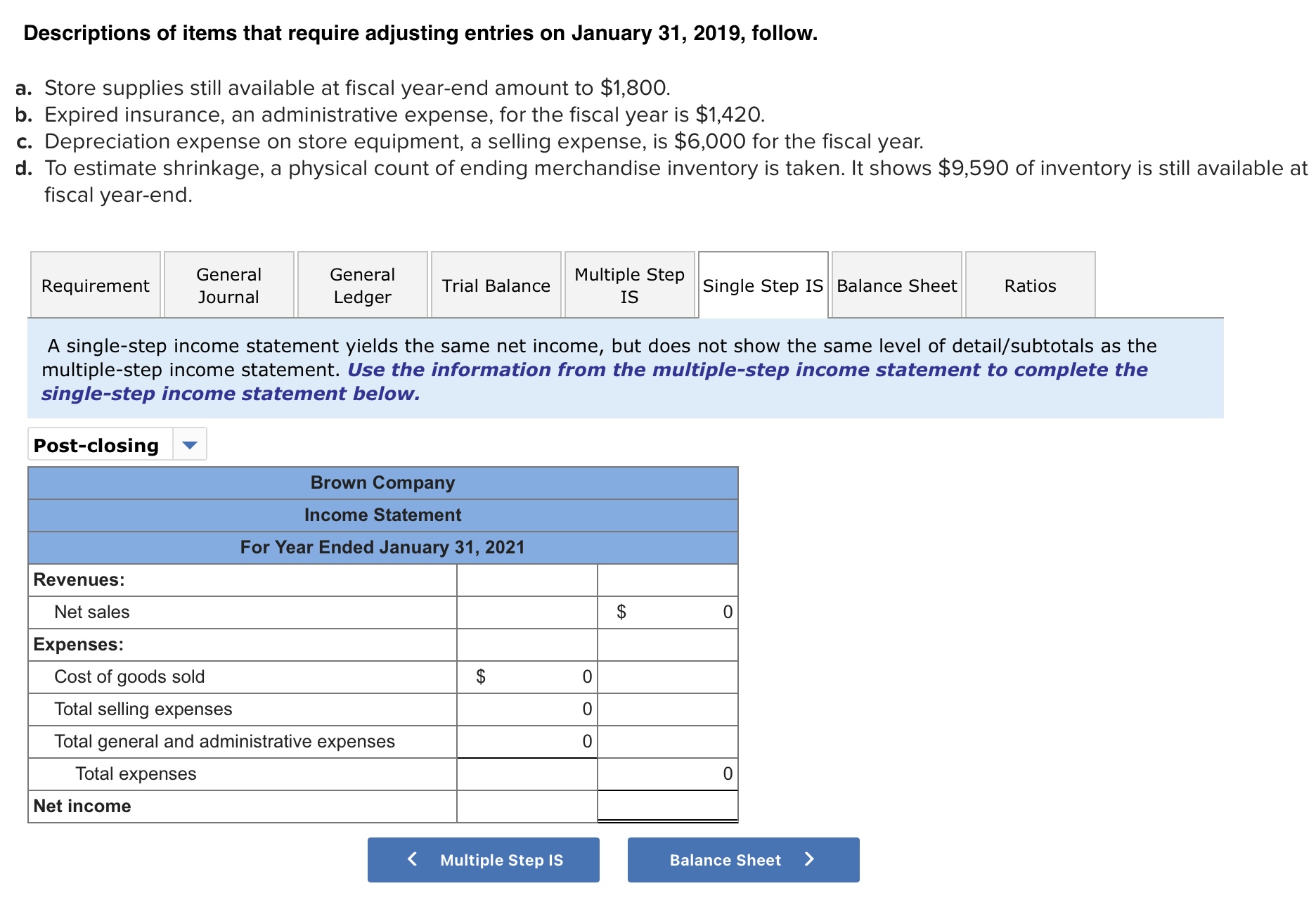
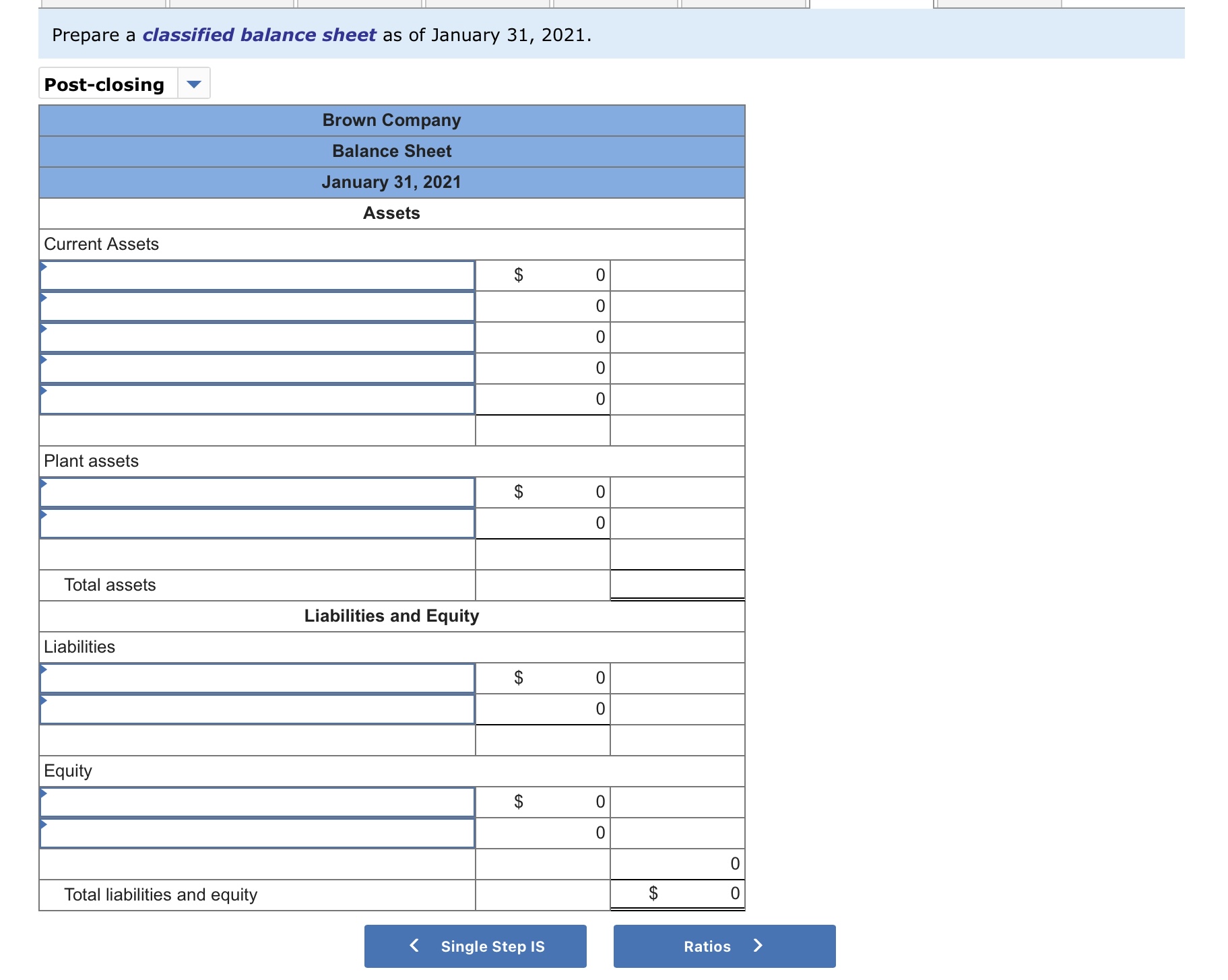
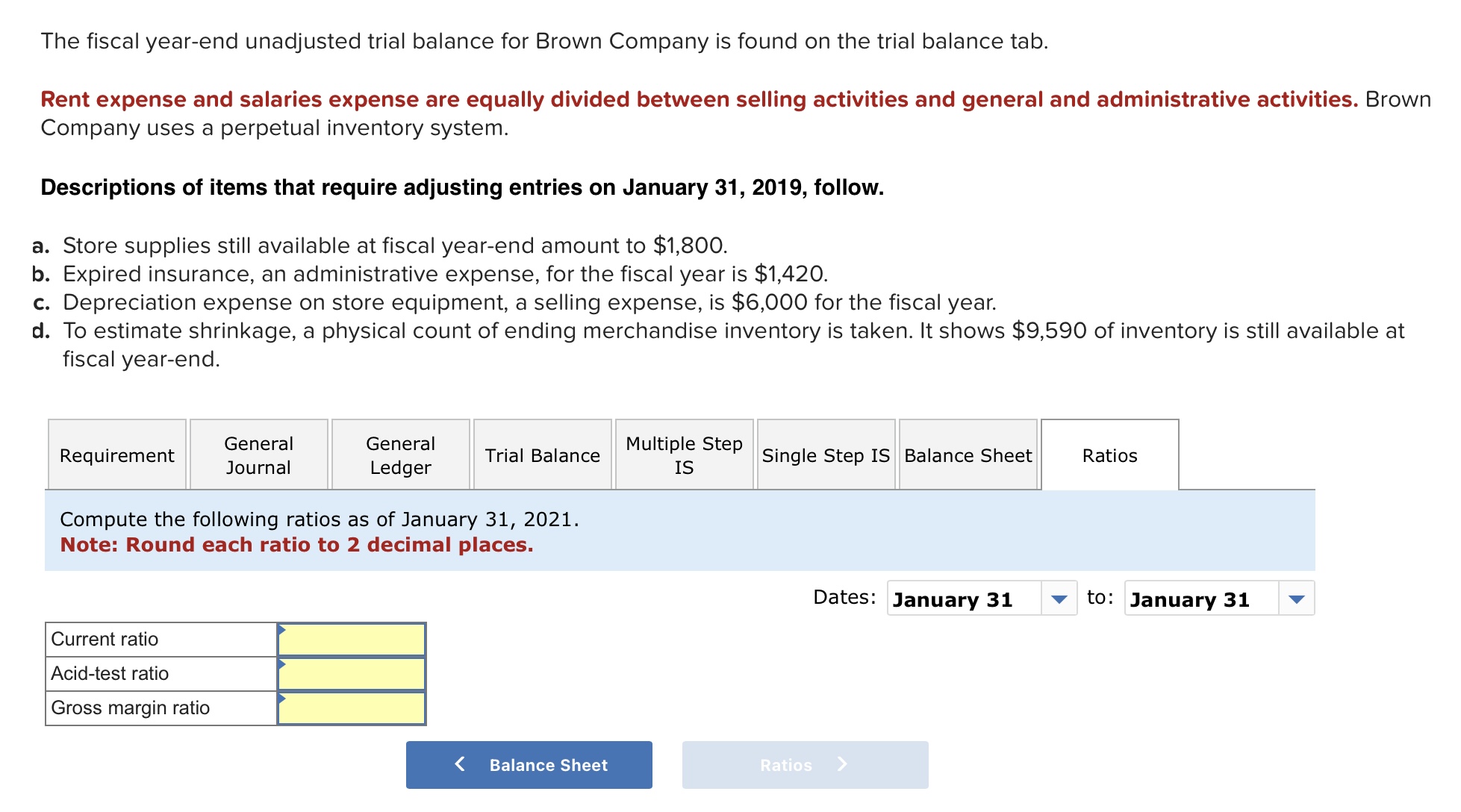
Each journal entry is posted automatically to the general ledger. Think of the general ledger as sorting all of your journal entries by account title. Click on any of the individual amounts to return to the underlying journal entry. Retained earnings \begin{tabular}{|c|c|c|c|c|} \hline \multicolumn{5}{|c|}{ Depreciation expense - Store equip. } \\ \hline No. & Date & Debit & Credit & Balance \\ \hline & January 31 & & & 0 \\ \hline A 3 & January 31 & 6,000 & & 6,000 \\ \hline A 6 & January 31 & & 6,000 & 0 \\ \hline \end{tabular} \begin{tabular}{|r|c|c|r|r|} \multicolumn{7}{|c|}{ Salaries expense } \\ \hline No. & Date & Debit & \multicolumn{1}{c|}{ Credit } & \multicolumn{1}{c|}{ Balance } \\ \hline & January 31 & & & 29,000 \\ \hline & January 31 & & 29,000 & 0 \\ \hline \end{tabular} \begin{tabular}{|c|c|c|c|c|} \hline \multicolumn{5}{|c|}{ Insurance expense } \\ \hline No. & Date & Debit & Credit & Balance \\ \hline & January 31 & & & 0 \\ \hline & January 31 & 1,420 & & 1,420 \\ \hline \$ 6 & January 31 & & 1,420 & 0 \\ \hline \end{tabular} \begin{tabular}{|r|c|c|r|r|} \multicolumn{7}{|c|}{ Rent expense } \\ \hline No. & Date & Debit & \multicolumn{1}{c|}{ Credit } & \multicolumn{1}{c|}{ Balance } \\ \hline & January 31 & & & 11,600 \\ \hline & January 31 & & 11,600 & 0 \\ \hline \end{tabular} \begin{tabular}{|c|c|c|c|c|} \hline \multicolumn{5}{|c|}{ Store supplies expense } \\ \hline No. & Date & Debit & Credit & Balance \\ \hline & January 31 & & & 0 \\ \hline A & January 31 & 3,600 & & 3,600 \\ \hline A 6 & January 31 & & 3,600 & 0 \\ \hline \end{tabular} \begin{tabular}{|r|c|c|r|r|} \multicolumn{6}{|c|}{ Advertising expense } \\ \hline No. & Date & Debit & \multicolumn{1}{c|}{ Credit } & \multicolumn{1}{c|}{ Balance } \\ \hline & January 31 & & & 9,900 \\ \hline & January 31 & & 9,900 & 0 \\ \hline \end{tabular} \begin{tabular}{|c|c|c|c|c|} \hline \multicolumn{5}{|c|}{ Income summary } \\ \hline No. & Date & Debit & Credit & Balance \\ \hline & 01/31/2017 & & & 0 \\ \hline A 5 & January 31 & & 113,000 & (113,000) \\ \hline A & January 31 & 103,130 & & (9,870) \\ \hline A 7 & January 31 & 9,870 & & 0 \\ \hline \end{tabular} General Journal Trial Balance The fiscal year-end unadjusted trial balance for Brown Company is found on the trial balance tab. Rent expense and salaries expense are equally divided between selling activities and general and administrative activities. Brown Company uses a perpetual inventory system. Descriptions of items that require adjusting entries on January 31, 2019, follow. a. Store supplies still available at fiscal year-end amount to $1,800. b. Expired insurance, an administrative expense, for the fiscal year is $1,420. c. Depreciation expense on store equipment, a selling expense, is $6,000 for the fiscal year. d. To estimate shrinkage, a physical count of ending merchandise inventory is taken. It shows $9,590 of inventory is still available at fiscal year-end. Begin by selecting "Adjusted" from the drop-down below. Then, use the adjusted trial balance to prepare a multiple-step income statement. Rent expense and salaries expense are equally divided between selling activities and the general and administrative activities. income statement. Rent expense and salaries expense are equally divided between selling activities and the general and administrative activities. Descriptions of items that require adjusting entries on January 31, 2019, follow. a. Store supplies still available at fiscal year-end amount to $1,800. b. Expired insurance, an administrative expense, for the fiscal year is $1,420. c. Depreciation expense on store equipment, a selling expense, is $6,000 for the fiscal year. d. To estimate shrinkage, a physical count of ending merchandise inventory is taken. It shows $9,590 of inventory is still available at fiscal year-end. A single-step income statement yields the same net income, but does not show the same level of detail/subtotals as the multiple-step income statement. Use the information from the multiple-step income statement to complete the single-step income statement below. Prepare a classified balance sheet as of January 31, 2021. The fiscal year-end unadjusted trial balance for Brown Company is found on the trial balance tab. Rent expense and salaries expense are equally divided between selling activities and general and administrative activities. Brown Company uses a perpetual inventory system. Descriptions of items that require adjusting entries on January 31, 2019, follow. a. Store supplies still available at fiscal year-end amount to $1,800. b. Expired insurance, an administrative expense, for the fiscal year is $1,420. c. Depreciation expense on store equipment, a selling expense, is $6,000 for the fiscal year. d. To estimate shrinkage, a physical count of ending merchandise inventory is taken. It shows $9,590 of inventory is still available at fiscal year-end. Compute the following ratios as of January 31, 2021. Note: Round each ratio to 2 decimal places. Each journal entry is posted automatically to the general ledger. Think of the general ledger as sorting all of your journal entries by account title. Click on any of the individual amounts to return to the underlying journal entry. Retained earnings \begin{tabular}{|c|c|c|c|c|} \hline \multicolumn{5}{|c|}{ Depreciation expense - Store equip. } \\ \hline No. & Date & Debit & Credit & Balance \\ \hline & January 31 & & & 0 \\ \hline A 3 & January 31 & 6,000 & & 6,000 \\ \hline A 6 & January 31 & & 6,000 & 0 \\ \hline \end{tabular} \begin{tabular}{|r|c|c|r|r|} \multicolumn{7}{|c|}{ Salaries expense } \\ \hline No. & Date & Debit & \multicolumn{1}{c|}{ Credit } & \multicolumn{1}{c|}{ Balance } \\ \hline & January 31 & & & 29,000 \\ \hline & January 31 & & 29,000 & 0 \\ \hline \end{tabular} \begin{tabular}{|c|c|c|c|c|} \hline \multicolumn{5}{|c|}{ Insurance expense } \\ \hline No. & Date & Debit & Credit & Balance \\ \hline & January 31 & & & 0 \\ \hline & January 31 & 1,420 & & 1,420 \\ \hline \$ 6 & January 31 & & 1,420 & 0 \\ \hline \end{tabular} \begin{tabular}{|r|c|c|r|r|} \multicolumn{7}{|c|}{ Rent expense } \\ \hline No. & Date & Debit & \multicolumn{1}{c|}{ Credit } & \multicolumn{1}{c|}{ Balance } \\ \hline & January 31 & & & 11,600 \\ \hline & January 31 & & 11,600 & 0 \\ \hline \end{tabular} \begin{tabular}{|c|c|c|c|c|} \hline \multicolumn{5}{|c|}{ Store supplies expense } \\ \hline No. & Date & Debit & Credit & Balance \\ \hline & January 31 & & & 0 \\ \hline A & January 31 & 3,600 & & 3,600 \\ \hline A 6 & January 31 & & 3,600 & 0 \\ \hline \end{tabular} \begin{tabular}{|r|c|c|r|r|} \multicolumn{6}{|c|}{ Advertising expense } \\ \hline No. & Date & Debit & \multicolumn{1}{c|}{ Credit } & \multicolumn{1}{c|}{ Balance } \\ \hline & January 31 & & & 9,900 \\ \hline & January 31 & & 9,900 & 0 \\ \hline \end{tabular} \begin{tabular}{|c|c|c|c|c|} \hline \multicolumn{5}{|c|}{ Income summary } \\ \hline No. & Date & Debit & Credit & Balance \\ \hline & 01/31/2017 & & & 0 \\ \hline A 5 & January 31 & & 113,000 & (113,000) \\ \hline A & January 31 & 103,130 & & (9,870) \\ \hline A 7 & January 31 & 9,870 & & 0 \\ \hline \end{tabular} General Journal Trial Balance The fiscal year-end unadjusted trial balance for Brown Company is found on the trial balance tab. Rent expense and salaries expense are equally divided between selling activities and general and administrative activities. Brown Company uses a perpetual inventory system. Descriptions of items that require adjusting entries on January 31, 2019, follow. a. Store supplies still available at fiscal year-end amount to $1,800. b. Expired insurance, an administrative expense, for the fiscal year is $1,420. c. Depreciation expense on store equipment, a selling expense, is $6,000 for the fiscal year. d. To estimate shrinkage, a physical count of ending merchandise inventory is taken. It shows $9,590 of inventory is still available at fiscal year-end. Begin by selecting "Adjusted" from the drop-down below. Then, use the adjusted trial balance to prepare a multiple-step income statement. Rent expense and salaries expense are equally divided between selling activities and the general and administrative activities. income statement. Rent expense and salaries expense are equally divided between selling activities and the general and administrative activities. Descriptions of items that require adjusting entries on January 31, 2019, follow. a. Store supplies still available at fiscal year-end amount to $1,800. b. Expired insurance, an administrative expense, for the fiscal year is $1,420. c. Depreciation expense on store equipment, a selling expense, is $6,000 for the fiscal year. d. To estimate shrinkage, a physical count of ending merchandise inventory is taken. It shows $9,590 of inventory is still available at fiscal year-end. A single-step income statement yields the same net income, but does not show the same level of detail/subtotals as the multiple-step income statement. Use the information from the multiple-step income statement to complete the single-step income statement below. Prepare a classified balance sheet as of January 31, 2021. The fiscal year-end unadjusted trial balance for Brown Company is found on the trial balance tab. Rent expense and salaries expense are equally divided between selling activities and general and administrative activities. Brown Company uses a perpetual inventory system. Descriptions of items that require adjusting entries on January 31, 2019, follow. a. Store supplies still available at fiscal year-end amount to $1,800. b. Expired insurance, an administrative expense, for the fiscal year is $1,420. c. Depreciation expense on store equipment, a selling expense, is $6,000 for the fiscal year. d. To estimate shrinkage, a physical count of ending merchandise inventory is taken. It shows $9,590 of inventory is still available at fiscal year-end. Compute the following ratios as of January 31, 2021. Note: Round each ratio to 2 decimal places
Step by Step Solution
There are 3 Steps involved in it

Get step-by-step solutions from verified subject matter experts