







Question: Each of three players simultaneously chooses an integer between 1 and 10, including 1 and 10. The players whose numbers are the closest to 3
Each of three players simultaneously chooses an integer between 1 and 10, including 1 and 10. The players whose numbers are the closest to 3 4 th of the average of the three announced integers win and share one dollar equally. Losing players receive nothing. For example, if the three numbers chosen the players are (1, 2, 3) then the average is (1+2+3)/3 =2 and 3/4 of the average (called the "target") is t = 2 3 4 = 1.5. In this case, Players 1 and 2's numbers, 1 and 2, are the closest to the target t = 1.5, so Players 1 and 2 are co-winners; Player 3 loses because his number, 3, is not the closest to the current target t = 1.5. a) (4pts) Show that (1, 1, 1), namely each player chooses 1, is a Nash equilibrium. Hint: This question requires a bit more algebra. First find out how much payoff Player 1 is getting if he chooses 1. Then holding Players 2 and 3's choices at s2 = 1, s3 = 1, suppose Player 1 chooses some number k > 1. The new average is a = k+1+1 3 and the target to hit is t = 3 4 a = k+1+1 4 = k+2 4 . Now calculate each player's distance from this target. For Player 1, the distance is d1 = k ? t. For Players 2 and 3, their distances from target is t ? 1. Who has the closest distance to target t? Who win(s)? Is it a better strategy to choose k > 1 for Player 1? b) (4pts) Is (3, 3, 3) a Nash? Explain your answer. c) (4pts) Is there any other Nash equilibrium of the form (m, m, m) (all three players choose the same number m)? Justify your answer. Hint: Can player 1 find a better strategy than m given that the other two players both choose m?
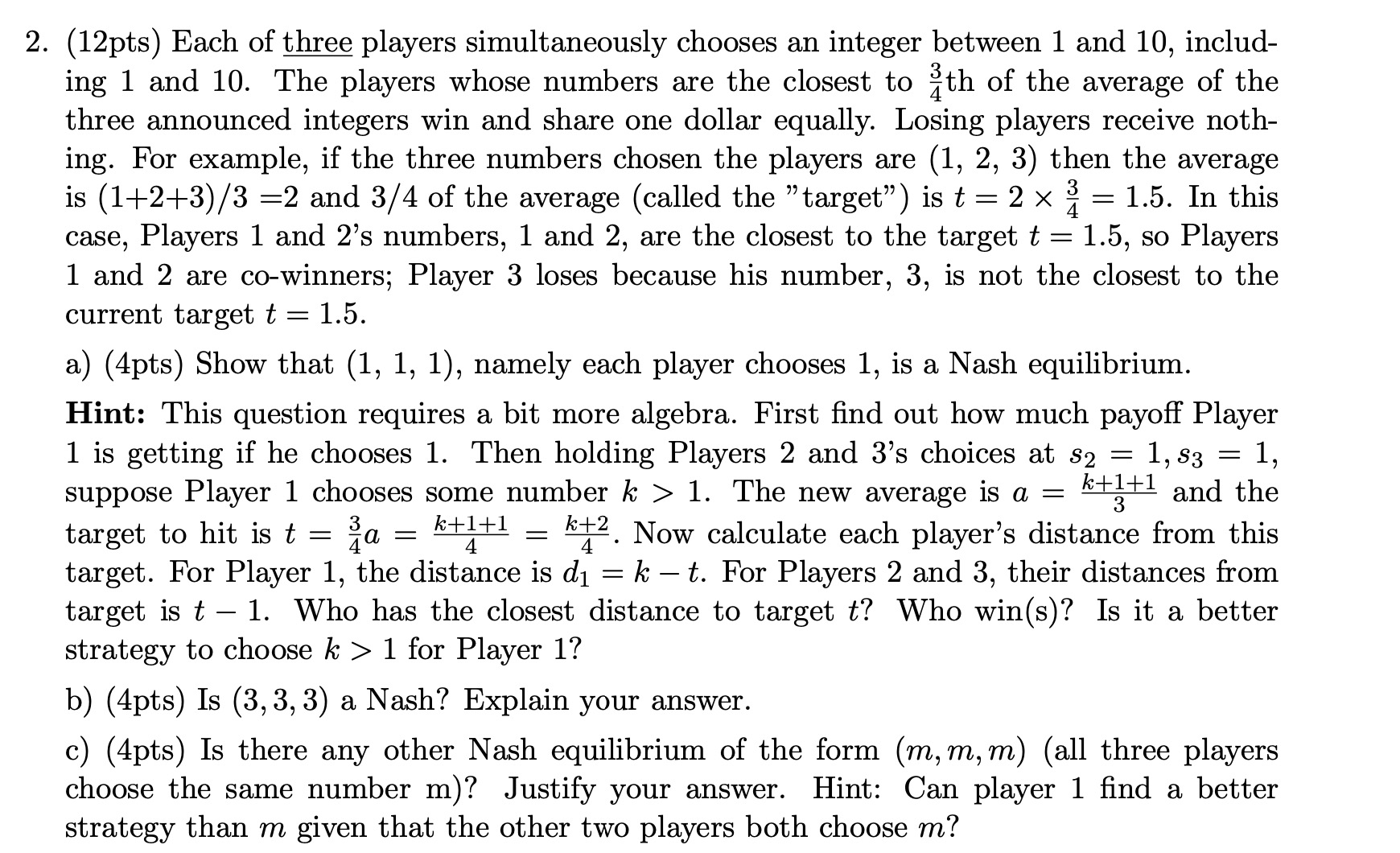
2. (12pts) Each of three players simultaneously chooses an integer between 1 and 10, includ- ing 1 and 10. The players whose numbers are the closest to gth of the average of the three announced integers win and share one dollar equally. Losing players receive noth- ing. For example, if the three numbers chosen the players are (1, 2, 3) then the average is (1+2+3) / 3 =2 and 3/4 of the average (called the \"target\") is t = 2 X 2 = 1.5. In this case, Players 1 and 2's numbers, 1 and 2, are the closest to the target t = 1.5, so Players 1 and 2 are cowinners; Player 3 loses because his number, 3, is not the closest to the current target t = 1.5. a) (4pts) Show that (1, 1, 1), namely each player chooses 1, is a Nash equilibrium. Hint: This question requires a bit more algebra. First nd out how much payoff Player 1 is getting if he chooses 1. Then holding Players 2 and 3's choices at 32 = 1,33 = 1, suppose Player 1 chooses some number k > 1. The new average is a = % and the target to hit is t = %a = '\"J% = #12. Now calculate each player's distance from this target. For Player 1, the distance is d1 = k t. For Players 2 and 3, their distances from target is t 1. Who has the closest distance to target t? Who win(s)? Is it a better strategy to choose 19 > 1 for Player 1? b) (4pts) Is (3,3, 3) a Nash? Explain your answer. 0) (4pts) Is there any other Nash equilibrium of the form (m, m, m) (all three players choose the same number m)? Justify your answer. Hint: Can player 1 nd a better strategy than m given that the other two players both choose m
Step by Step Solution
There are 3 Steps involved in it

Get step-by-step solutions from verified subject matter experts
 Study Help