







Question: ead the article and answer the following questions: Article Link: IS THIS THE END OF COLLEGE AS WE KNOW IT? For millions of Americans, getting
ead the article and answer the following questions:
Article Link:
"IS THIS THE END OF COLLEGE AS WE KNOW IT? For millions of Americans, getting a four-year
degree no longer makes sense. Here's what could replace it" DOUGLAS BELKIN WSJ NOV. 12, 2020. (https://www.wsj.com/articles/is-this-the-end-of-college-as-we-know-it-11605196909)
If you cannot open the link, I attached the pictures below:
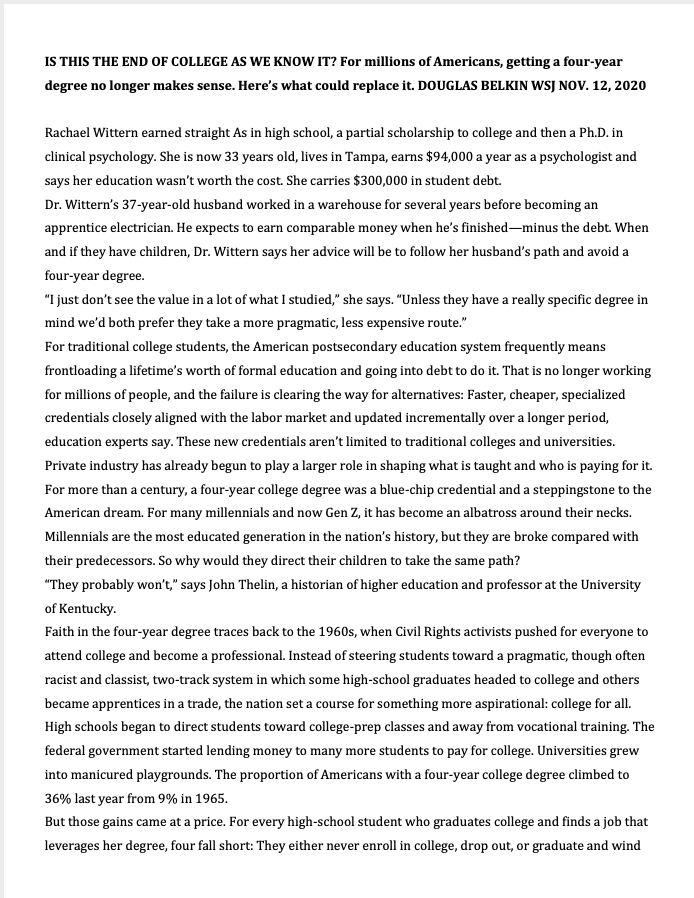
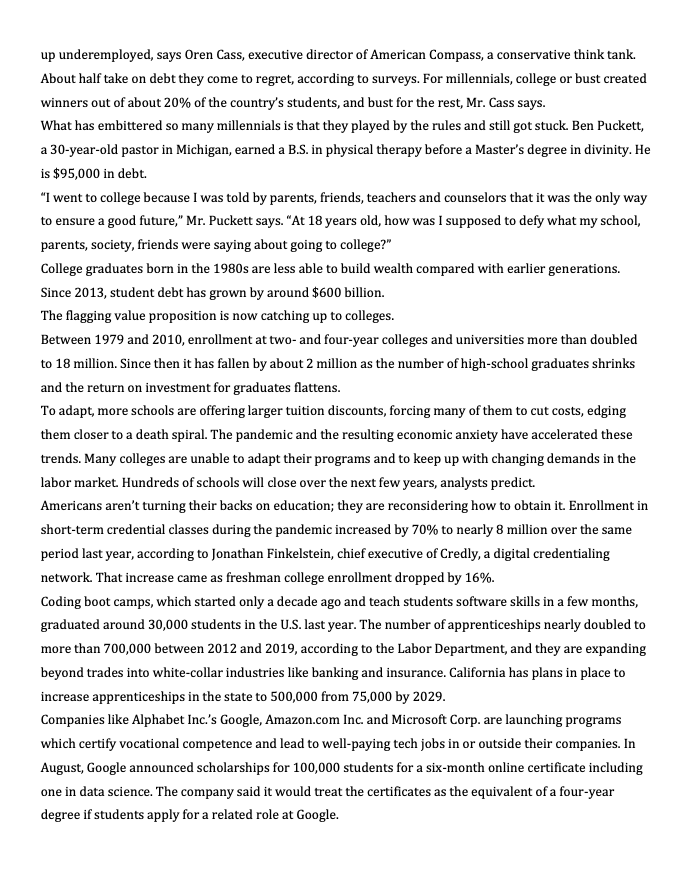
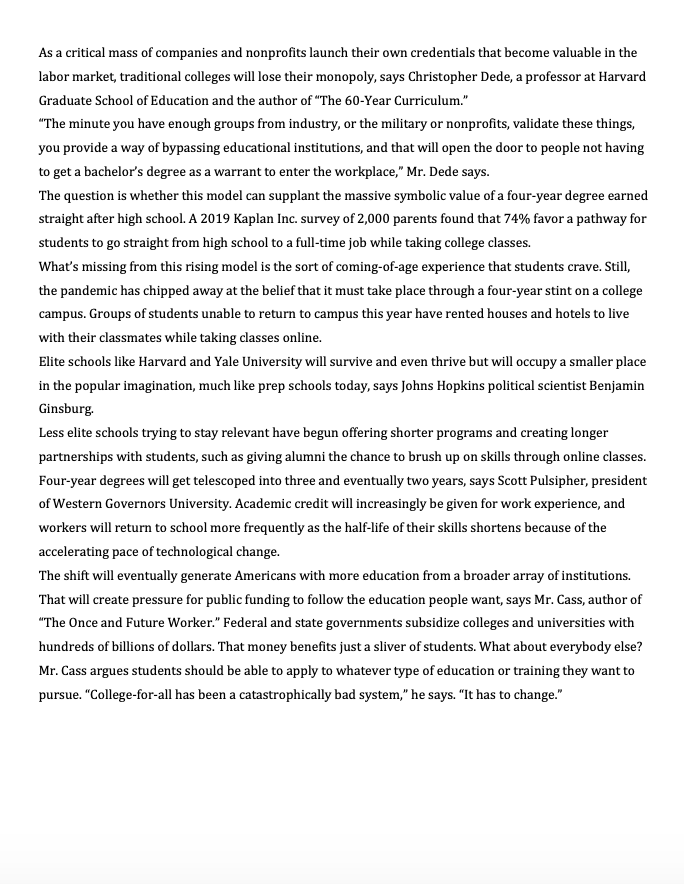
IS THIS THE END OF COLLEGE AS WE KNOW IT? For millions ofAmerlcanx, getting a four-year degree no longer makes sense. Here's what could replace it. DOUGLAS BELKIN W5] NOV. 12, 2020 Rachael Wittern earned straight As in high school, a partial scholarship to college and then a PhD. in clinical psychology. She is now 33 years old, lives in Tampa, earns $94,000 a year as a psychologist and says her education wasn't worth the cost She carries $300.0 [II] in student debt Dr. Wittern's 37yearold husband worked in a warehouse for several years before becoming an apprentice electrician. He expects to eam comparable moneywhen he's nishedminus the debt. When and if they have children, Dr. Wittern says her advice will be to follow her husband's path and avoid a fouryear degree. "1 just don't see the value in a lot of what ] studied,\" she says. "Unless they have a really specic degree in mind we'd both prefer they take a more pragmatic. less expensive route.\" For traditional college students. the American postsecondary education system Frequently means 'ontloading a lifetime's worth of formal education and going into debt to do it. That is no longerworking for millions ofpeople. and the failure is clearing the way for alternatives: Faster, cheaper. specialized credentials closely aligned with the labor market and updated lncrementally over a longer period. education experts say. These new credentials aren't limited to traditional colleges and universities. Private Industry has already begun to play a larger role in shaping what is taught and who is paying for it For more than a century, a fouryear college degree was a bluechip credenlial and a steppingstone to the American dream. For many rnillennials and now Gen 1, it has become an albatross around their necks. Millennials are the most educated generation in the nation's history, but they are broke compared with their predecessors. So why would they direct their children to take the same path? IIThey probably won't." says ]ohn Thelin, a historian ofhigher education and professor at the University of Kentucky. Faith In the fouryear degree traces back to the 196 Us, when Civil Rights activists pushed for everyone to attend college and become a professional. Instead of steering students toward a pragmatic, though oen racist and classist. twotrack system in which some high-school graduates headed to college and others became apprentices in a trade, the nation set a course for something more aspirational: college for all. High schools began to direct students toward collegeprep classes and away from vocational training. The federal government started lending money to many more students to pay for college. Universities grew into manicured playgrounds. The proportion ofmericans with a fouryear college degree climbed to 36% last year from 9% in 1965. But those gains came at a price. For every high-school student who graduates college and finds a ]ob that leverages her degree, four fall short: They either never enroll in college. drop out. or graduate and wind up underemployed, says Oren Cass, executive director of American Compass, a conservative think tank About halftake on debt they come to regret, according to surveys. For millennials, college or bust created winners out of about 2 0% of the counnys students, and bust for the rest, Mr. Cass says. What has embittered so many millennials is that they played by the rules and still got stuck. Ben Puckett, a 30-year-old pastor in Michigan, earned a BS. In physical therapy before a Master's degree in divinity. He is $95,000 In debt. '1 went to college because [was told by parents, friends, teachers and counselors that it was the only way to ensure a good future," Mr. Puckett says. \"At 13 years old, howwas ] supposed to defy what my school, parents, society, friends were saying about going to college?\" College graduates born in the 1930s are less able to build wealth compared with earlier generations. Since 2013, student debt has grown by around $600 billion. The flagging value pmpositlon is now catching up to colleges. Between 1929 and 2010, enrollment at two and four-year colleges and universities more than doubled to 18 million. Since then it has fallen by about 2 million as the number of high-school graduates shrinks and the return on investment for graduates attens. To adapt, more schools are offering larger tuition discounts, forcing many of them to cut costs, edging them closer to a death spiral. The pandemic and the resulting economic anxiety have accelerated these trends. Many colleges are unable to adapt their programs and to keep up with changing demands in the labor market Hundreds ofschools will close over the next few years, analysls predict. Americans aren't turning their backs on education; they are reconsidering how to obtain It. Enrollment in short-tenn credential classes during the pandemic increased by 70% to nearly 8 million over the same period last year, according to ]onathan Finkelstein, chief executive of Credly, a digital credentialing network. That Increase came as freshman college enrollment dropped by 16%. Coding boot camps, which started only a decade ago and teach students software skills in a few months, graduated around 30,000 students In the U.S. last year. The number of apprenticeships nearly doubled to more than 700,000 between 2012 and 2019, according to the Labor Department. and they are expanding beyond trades into white-collar industries like banking and Insurance. California has plans in place to increase apprenticeships in the state to 500.0 00 from 5,000 by 2029. Companies like Alphabet Inc's Google, Amazoncom [nc. and Micmsoft Corp. are launching programs which certify vocational competence and lead to wellpaying tech jobs in or outside their companies. in August, Google announced scholarships for 100,000 students for a six-month onlIne certicate including one in data science. The company said it would treat the certicates as the equivalent of a fouryear degree I.fstudents apply for a related role at Google. As a critical mass of companies and nonprots launch their own credentials that become valuable in the labor market. traditional colleges will lose their monopoly, says Christopher Dede, a professor at Harvard Graduate School ofEducation and the author of \"The llYear Curriculum.\" \"The minute you have enough groups from industry. or the military or nonprots, validate these things, you provide a way of bypassing educational institutions, and that will open the door to people not having to get a bachelor's degree as a warrant to enter the workplace,\" Mr. Dede says. The question Is whether this model can supplant the massive symbolic value ofa fouryear degree earned su-aight aer high schooL A 2019 Kaplan inc. survey of 2.000 parents found that 74% Favor a pathway for studenls to go straight from high school to a fulltime job while taking college classes What's missing from this rising model is the sort of comingofage experience that students crave. Still, the pandemic has chipped away at the belief that it must take place through a fouryear stint on a college campus. Groups ofstudents unable to return to campus this year have rented houses and hotels to live with their classmates while taking classes online. Elite schools like Harvard and Yale University will survive and even thrive but will occupy a smaller place in the popular imagination. much like prep schools today, says [ohns Hopkins political scientist Benjamin Ginsburg Less elite schools trying to stay relevant have begin: offering shorter programs and creating longer partnerships with students. such as giving alumni the chance to brush up on skills through online classes. Fouryear degrees will get telescoped into three and eventually two years, says Scott Pulsipher, president of Western Governors University. Academic credit will increasinglybe given for work experience. and workers will return to school more frequently as the halflife oftheir skills shortens because of the accelerating pace of technological change. The shift will eventually generate Americans with more education from a broader array ofinstitutlons That will create pressure for public funding to follow the education people want, says Mr. Cass, author of \"The Once and Future Worker." Federal and state governments subsidize colleges and universities with hundreds ofbillions of dollars. That money benets just a sliver ofstudents. what about everybody else? Mr. Cass argues students should be able to apply to whatever type of education or lraining they want to pursue. "College-forall has been a catasu-ophically bad system," he says. "It has to change.\
Step by Step Solution
There are 3 Steps involved in it

Get step-by-step solutions from verified subject matter experts
 Study Help