







Question: Easy Java Question In each of the blanks below, write F if the statement beside the blank is true, F otherwise.
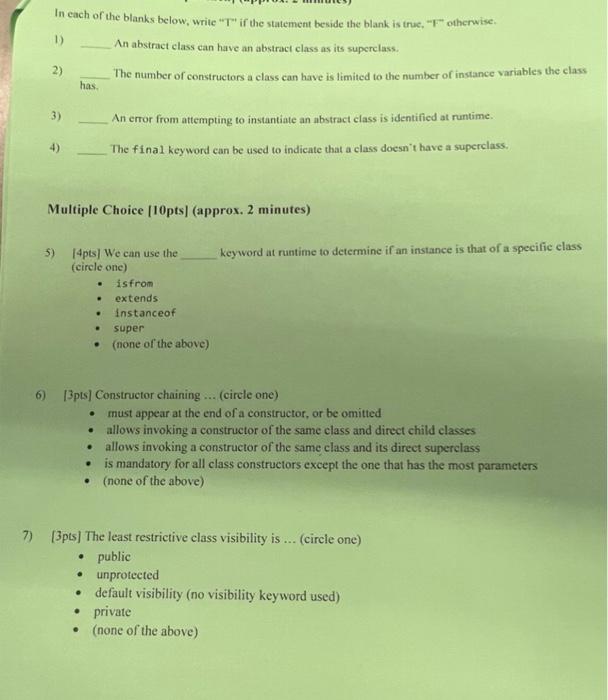
In each of the blanks below, write " F " if the statement beside the blank is true, " F " otherwise. 1) An abstract class can have an abstract class as its superclass. 2) has. The number of constructors a class can have is limited to the number of instance variables the class. 3) An error from attempting to instantiate an ubstract class is identified at runtime. 4) The final keyword can be used to indicate that a class doesn't have a superclass. Multiple Choice [10pts] (approx. 2 minutes) 5) [4pts] We can use the keyword at runtime to determine if an instance is that of a specific class (circle one) - isfrom - extends - Instanceof - super - (none of the above) 6) [3pts] Constructor chaining ... (circle one) - must appear at the end of a constructor, or be omitted - allows invoking a constructor of the same class and direct child classes - allows invoking a constructor of the same class and its direct superclass - is mandatory for all class constructors except the one that has the most parameters - (none of the above) 7) [3pts] The least restrictive class visibility is ... (circle one) - public - unprotected - default visibility (no visibility keyword used) - private - (none of the above)
Step by Step Solution
There are 3 Steps involved in it

Get step-by-step solutions from verified subject matter experts
 Study Help